5 Key Concepts Behind Agentic AI Every Engineer Must Understand
Our take
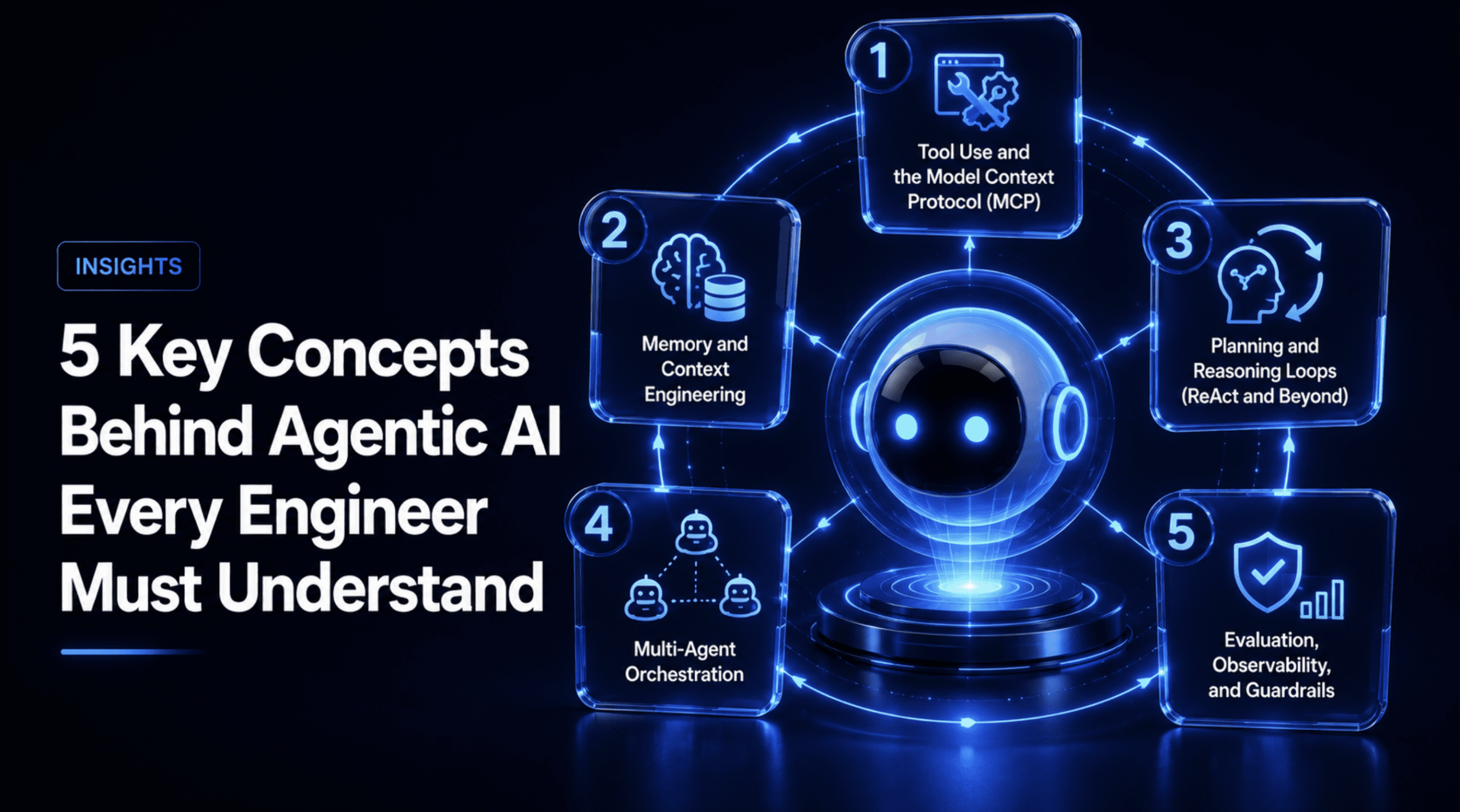
The recent surge in discussion around agentic AI has become almost inescapable, yet much of the conversation remains at a high level, glossing over the core technical underpinnings. The article "5 Key Concepts Behind Agentic AI Every Engineer Must Understand" is a crucial contribution, offering a much-needed deep dive into the foundational elements that truly power these systems. It’s not enough to simply declare something “agentic”; a true understanding requires grasping concepts like memory, planning, tools, observation, and reflection – and the article does an excellent job of unpacking each. For engineers, data scientists, and anyone building the future of AI-powered workflows, this isn’t just interesting theory; it’s the essential roadmap for practical implementation. Indeed, this aligns with our broader focus on empowering users with accessible AI tools, something we explored in Demystifying Large Language Models and further discussed with practical implications in Building Intelligent Workflows. The emphasis on practical understanding, rather than breathless hype, is precisely what's needed to move beyond experimentation and into real-world application.
What makes this article particularly valuable is its focus on *how* agentic AI works, not just *that* it works. The breakdown of each concept – memory for persistent state, planning for goal decomposition, tools for external interaction, observation for environmental awareness, and reflection for iterative improvement – reveals a surprisingly structured architecture beneath the seemingly emergent behavior. Traditional spreadsheet workflows, often reliant on rigid formulas and manual updates, stand in stark contrast to this dynamic, adaptive approach. The limitations of those legacy systems become even more apparent when considering the potential of agents to autonomously manage, analyze, and optimize data, freeing up human users to focus on higher-level strategic thinking. This shift represents a fundamental change in how we interact with data – moving from reactive manipulation to proactive orchestration. It’s a progression towards a future where spreadsheets aren’t just places to store data, but platforms for intelligent, self-managing workflows.
The broader significance of agentic AI extends far beyond simply automating existing tasks. It's about creating systems that can learn, adapt, and solve problems in ways previously unimaginable. Consider the implications for complex financial modeling, supply chain optimization, or even scientific research. An agentic system, equipped with the right tools and memory, could autonomously explore various scenarios, identify potential risks, and recommend optimized strategies – a level of sophistication far exceeding the capabilities of even the most experienced human analyst. This isn’t about replacing human expertise, but augmenting it, allowing us to tackle challenges that are currently beyond our reach. We’ve seen similar trends in automation before, but the agentic paradigm introduces a degree of autonomy and adaptability that represents a significant leap forward. For example, the challenges of integrating these agents into existing systems are discussed in detail in AI Integration Best Practices.
Looking ahead, the most critical question surrounding agentic AI isn’t about its technical feasibility – that’s rapidly becoming clear – but rather about its governance and ethical implications. As these systems become increasingly autonomous, ensuring that they align with human values and operate responsibly will be paramount. The ability for agents to "reflect" on their actions, as highlighted in the article, provides a crucial pathway for addressing these concerns, but it also introduces new complexities around accountability and transparency. How do we ensure that agents are not only effective but also ethical? And how do we design systems that allow humans to retain meaningful control over their actions? These questions will shape the future of AI and demand careful consideration as we continue to explore the transformative potential of agentic technology.
Read on the original site
Open the publisher's page for the full experience