5 Must-Know Python Concepts for AI Engineers
Our take
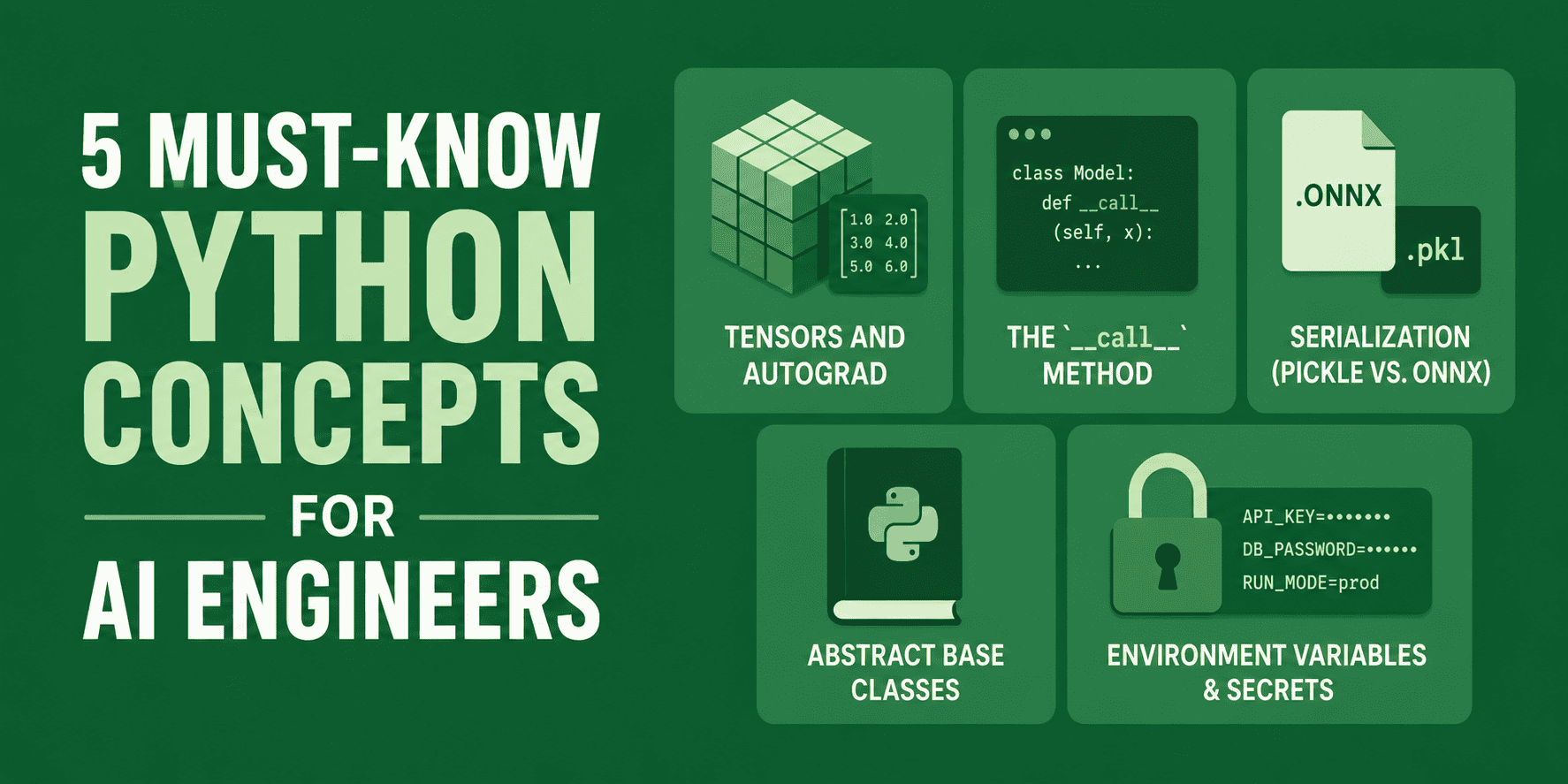
The recent guide on “5 Must‑Know Python Concepts for AI Engineers” arrives at a pivotal moment for anyone looking to move beyond ad‑hoc scripts toward production‑grade AI systems. While the article rightly highlights decorators, context managers, type hinting, concurrency primitives, and packaging, the real value lies in how these concepts unlock scalability and security for data‑driven teams. Readers who have wrestled with fragile notebooks will recognize the same friction points discussed in our piece on Why Do LLMs Corrupt Your Documents When You Delegate?, where the loss of structure mirrors the chaos that unstructured Python code can introduce. By grounding AI workflows in solid language features, engineers can transform experimental pipelines into reliable services that stakeholders can trust. Moreover, the guide’s emphasis on type hinting resonates with the growing demand for transparent, auditable models—a concern echoed in the debate over online AI education in Is an Online Master’s Degree in AI a Good Idea?, where curricula increasingly stress reproducibility alongside theory.
What makes these five concepts more than a checklist is their collective impact on the entire data lifecycle. Decorators, for instance, enable cross‑cutting concerns such as logging, authentication, and latency monitoring without scattering boilerplate throughout the codebase. This modularity directly supports the shift from monolithic notebooks to micro‑services that can be versioned, rolled back, and scaled horizontally. Context managers bring deterministic resource handling to the fore, ensuring that file handles, database connections, and GPU sessions are cleanly released—even when exceptions occur. In a field where a stray memory leak can stall a model training job for hours, that predictability translates into tangible productivity gains.
Concurrency primitives—asyncio, threading, and multiprocessing—address another blind spot for many AI engineers: the efficient orchestration of I/O‑bound data ingestion and CPU‑bound model inference. By mastering these tools, teams can design pipelines that ingest terabytes of raw data, preprocess it in parallel, and feed it to models without bottlenecks. This capability is essential for enterprises that must serve real‑time predictions at scale, where latency directly influences user experience and revenue. Meanwhile, robust packaging practices, from pyproject.toml configurations to virtual environment isolation, lay the groundwork for secure deployment. Proper packaging mitigates supply‑chain risks, enforces dependency hygiene, and makes it easier to audit code for compliance—a non‑negotiable requirement as regulations around AI transparency tighten.
Beyond the technical merits, the article signals a broader cultural shift: AI engineering is maturing into a disciplined craft that values maintainability as much as model accuracy. By encouraging engineers to adopt these Python fundamentals, the community is moving away from the “quick‑and‑dirty” prototype mindset that has long dominated research labs. This evolution supports organizations that aim to embed AI into core products without sacrificing reliability or security. It also empowers individual contributors to position themselves as architects of resilient systems, rather than merely model builders.
Looking ahead, the true test will be how quickly these practices become standard in AI tooling ecosystems. As spreadsheet‑style AI platforms evolve to incorporate native code execution, we may see the line between data preparation and model deployment blur even further. Will the next generation of AI‑native spreadsheets abstract away these Python concepts, or will they demand an even deeper integration of developer‑grade code? The answer will shape the future of accessible, yet enterprise‑ready, AI solutions.
Read on the original site
Open the publisher's page for the full experience