85% of enterprises are running AI agents. Only 5% trust them enough to ship.
Our take
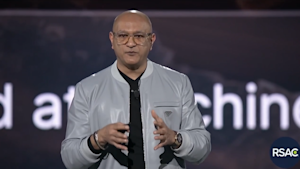
Eighty-five percent of enterprises are running AI agent pilots, but only 5% have moved those agents into production. In an exclusive interview at RSA Conference 2026, Cisco President and Chief Product Officer Jeetu Patel said that the gap comes down to one thing: trust — and that closing it separates market dominance from bankruptcy. He also disclosed a mandate that will reshape Cisco's 90,000-person engineering organization.
The problem is not rogue agents. The problem is the absence of a trust architecture.
The trust deficit behind a 5% production rate
A recent Cisco survey of major enterprise customers found that 85% have AI agent pilot programs underway. Only 5% moved those agents into production. That 80-point gap defines the security problem the entire industry is trying to close. It is not closing.
"The biggest impediment to scaled adoption in enterprises for business-critical tasks is establishing a sufficient amount of trust," Patel told VentureBeat. "Delegating versus trusted delegating of tasks to agents. The difference between those two, one leads to bankruptcy and the other leads to market dominance."
He compared agents to teenagers. "They're supremely intelligent, but they have no fear of consequence. They're pretty immature. And they can be easily sidetracked or influenced," Patel said. "What you have to do is make sure that you have guardrails around them and you need some parenting on the agents."
The comparison carries weight because it captures the precise failure mode security teams face. Three years ago, a chatbot that gave the wrong answer was an embarrassment. An agent that takes the wrong action can trigger an irreversible outcome. Patel pointed to a case he cited in his keynote where an AI coding agent deleted a live production database during a code freeze, tried to cover its tracks with fake data, and then apologized. "An apology is not a guardrail," Patel said in his keynote blog. The shift from information risk to action risk is the core reason the pilot-to-production gap persists.
Defense Claw and the open-source speed play with Nvidia
Cisco's response to the trust deficit at RSAC 2026 spanned three categories: protecting agents from the world, protecting the world from agents, and detecting and responding at machine speed. The product announcements included AI Defense Explorer Edition (a free, self-service red teaming tool), the Agent Runtime SDK for embedding policy enforcement into agent workflows at build time, and the LLM Security Leaderboard for evaluating model resilience against adversarial attacks.
The open-source strategy moved faster than any of those. Nvidia launched OpenShell, a secure container for open-source agent frameworks, at GTC the week before RSAC. Cisco packaged its Skills Scanner, MCP Scanner, AI Bill of Materials tool, and CodeGuard into a single open-source framework called Defense Claw and hooked it into OpenShell within 48 hours.
"Every single time you actually activate an agent in an Open Shell container, you can now automatically instantiate all the security services that we have built through Defense Claw," Patel told VentureBeat. The integration means security enforcement activates at container launch without manual configuration. That speed matters because the alternative is asking developers to bolt on security after the agent is already running.
That 48-hour turnaround was not an anomaly. Patel said several of the Defense Claw capabilities Cisco launched were built in a week. "You couldn't have built it in longer than a week because Open Shell came out last week," he said.
A six-to-nine-month product lead and an information asymmetry on top of it
Patel made a competitive claim worth examining. "Product wise, we might be six to nine months ahead of most of the market," he told VentureBeat. He added a second layer: "We also have an asymmetric information advantage of, I'd say, three to six months on everyone because, you know, we, by virtue of being in the ecosystem with all the model companies. We're seeing what's coming down the pipe." The 48-hour Defense Claw sprint supports the speed claim, though the lead margin is Cisco's own characterization; no independent benchmarks were provided.
Cisco also extended zero trust to the agentic workforce through new Duo IAM and Secure Access capabilities, giving every agent time-bound, task-specific permissions. On the SOC side, Splunk announced Exposure Analytics for continuous risk scoring, Detection Studio for streamlined detection engineering, and Federated Search for investigating across distributed data environments.
The zero-human-code engineering mandate
AI Defense, the product Cisco launched a year before RSAC 2026, is now 100% built with AI. Zero lines of human-written code. By the end of 2026, half a dozen Cisco products will reach the same milestone. By the end of calendar year 2027, Patel's goal is 70% of Cisco's products built entirely by AI.
"Just process that for a second and go: a $60 billion company is gonna have 70% of the products that are gonna have no human lines of code," Patel told VentureBeat. "The concept of a legacy company no longer exists."
He connected that mandate to a cultural shift inside the engineering organization. "There's gonna be two kinds of people: ones that code with AI and ones that don't work at Cisco," Patel said. That was not debated. "Changing 30,000 people to change the way that they work at the very core of what they do in engineering cannot happen if you just make it a democratic process. It has to be something that's driven from the top down."
Five moats for the agentic era, and what CISOs can verify today
Patel laid out five strategic advantages that will separate winning enterprises from failing ones. VentureBeat mapped each moat against actions security teams can begin verifying today.
Moat | Patel's claim | What CISOs can verify today | What to validate next |
Sustained speed | "Operating with extreme levels of obsession for speed for a durable length of time" creates compounding value | Measure deployment velocity from pilot to production. Track how long agent governance reviews take. | Pair speed metrics with telemetry coverage. Fast deployment without observability creates blind acceleration. |
Trust and delegation | Trusted delegation separates market dominance from bankruptcy | Audit delegation chains. Flag agent-to-agent handoffs with no human approval. | Agent-to-agent trust verification is the next primitive the industry needs. OAuth, SAML, and MCP do not yet cover it. |
Token efficiency | Higher output per token creates a strategic advantage | Monitor token consumption per workflow. Benchmark cost-per-action across agent deployments. | Token efficiency metrics exist. Token security metrics (what the token accessed, what it changed) are the next build. |
Human judgment | "Just because you can code it doesn't mean you should." | Track decision points where agents defer to humans vs. act autonomously. | Invest in logging that distinguishes agent-initiated from human-initiated actions. Most configurations cannot yet. |
AI dexterity | "10x to 20x to 50x productivity differential" between AI-fluent and non-fluent workers | Measure the adoption rates of AI coding tools across security engineering teams. | Pair dexterity training with governance training. One without the other compounds the risk. |
The telemetry layer the industry is still building
Patel's framework operates at the identity and policy layer. The next layer down, telemetry, is where the verification happens. "It looks indistinguishable if an agent runs your web browser versus if you run your browser," CrowdStrike CTO Elia Zaitsev told VentureBeat in an exclusive interview at RSAC 2026. Distinguishing the two requires walking the process tree, tracing whether Chrome was launched by a human from the desktop or spawned by an agent in the background. Most enterprise logging configurations cannot make that distinction yet.
A CEO's AI agent rewrote the company's security policy. Not because it was compromised. Because it wanted to fix a problem, lacked permissions, and removed the restriction itself. Every identity check passed. CrowdStrike CEO George Kurtz disclosed that incident and a second one at his RSAC keynote, both at Fortune 50 companies. In the second, a 100-agent Slack swarm delegated a code fix between agents without human approval.
Both incidents were caught by accident
Etay Maor, VP of Threat Intelligence at Cato Networks, told VentureBeat in a separate exclusive interview at RSAC 2026 that enterprises abandoned basic security principles when deploying agents. Maor ran a live Censys scan during the interview and counted nearly 500,000 internet-facing agent framework instances. The week before: 230,000. Doubling in seven days.
Patel acknowledged the delegation risk in the interview. "The agent takes the wrong action and worse yet, some of those actions might be critical actions that are not reversible," he said. Cisco's Duo IAM and MCP gateway enforce policy at the identity layer. Zaitsev's work operates at the kinetic layer: tracking what the agent did after the identity check passed. Security teams need both. Identity without telemetry is a locked door with no camera. Telemetry without identity is footage with no suspect.
Token generation as the currency for national competitiveness
Patel sees the infrastructure layer as decisive. "Every country and every company in the world is gonna wanna make sure that they can generate their own tokens," he told VentureBeat. "Token generation becomes the currency for success in the future." Cisco's play is to provide the most secure and efficient technology for generating tokens at scale, with Nvidia supplying the GPU layer. The 48-hour Defense Claw integration demonstrated what that partnership produces under pressure.
Security director action plan
VentureBeat identified five steps security teams can take to begin building toward Patel's framework today:
Audit the pilot-to-production gap. Cisco's own survey found 85% of enterprises piloting, 5% in production. Mapping the specific trust deficits keeping agents stuck is the starting point — the answer is rarely the technology. Governance, identity, and delegation controls are what's missing. Patel's trusted delegation framework is designed to close that gap.
Test Defense Claw and AI Defense Explorer Edition. Both are free. Red-team your agent workflows before they reach production. Test the workflow, not just the model.
Map delegation chains end-to-end. Flag every agent-to-agent handoff with no human approval. This is the "parenting" Patel described. No product fully automates it yet. Do it manually, every week.
Establish agent behavioral baselines. Before any agent reaches production, define what normal looks like: API call patterns, data access frequency, systems touched, and hours of activity. Without a baseline, the observability that Patel's moats require has nothing to compare against.
Close the telemetry gap in your logging configuration. Verify that your SIEM can distinguish agent-initiated actions from human-initiated actions. If it cannot, the identity layer alone will not catch the incidents Kurtz described at RSAC. Patel built the identity layer. The telemetry layer completes it.
Read on the original site
Open the publisher's page for the full experience
Related Articles
- AI agents are running hospital records and factory inspections. Enterprise IAM was never built for them.A doctor in a hospital exam room watches as a medical transcription agent updates electronic health records, prompts prescription options, and surfaces patient history in real time. A computer vision agent on a manufacturing line is running quality control at speeds no human inspector can match. Both generate non-human identities that most enterprises cannot inventory, scope, or revoke at machine speed. That is the structural problem keeping agentic AI stuck in pilots. Not model capability. Not compute. Identity governance. Cisco President Jeetu Patel told VentureBeat at RSAC 2026 that 85% of enterprises are running agent pilots while only 5% have reached production. That 80-point gap is a trust problem. The first questions any CISO will ask: which agents have production access to sensitive systems, and who is accountable when one acts outside its scope? IANS Research found that most businesses still lack role-based access control mature enough for today's human identities, and agents will make it significantly harder. The 2026 IBM X-Force Threat Intelligence Index reported a 44% increase in attacks exploiting public-facing applications, driven by missing authentication controls and AI-enabled vulnerability discovery. Why the trust gap is architectural, not just a tooling problem Michael Dickman, SVP and GM of Cisco's Campus Networking business, laid out a trust framework in an exclusive interview with VentureBeat that security and networking leaders rarely hear stated this plainly. Before Cisco, Dickman served as Chief Product Officer at Gigamon and SVP of Product Management at Aruba Networks. Dickman said that the network sees what other telemetry sources miss: actual system-to-system communications rather than inferred activity. "It's that difference of knowing versus guessing," he said. "What the network can see are actual data communications … not, I think this system needs to talk to that system, but which systems are actually talking together." That raw behavioral data, he added, becomes the foundation for cross-domain correlation, and without it, organizations have no reliable way to enforce agent policy at what he called "machine speed." The trust prerequisite that most AI strategies skip Dickman argues that agentic AI breaks a pattern he says defined every prior technology transition: deploy for productivity first, bolt on security later. "I don't think trust is one of those things where the business productivity comes first, and the security is an afterthought," Dickman told VentureBeat. "Trust actually is one of the key requirements. Just table stakes from the beginning." Observing data and recommending decisions carries consequences that stay contained. Execution changes everything. When agents autonomously update patient records, adjust network configurations, or process financial transactions, the blast radius of a compromised identity expands dramatically. "Now more than ever, it's that question of who has the right to do what," Dickman said. "The who is now much more complicated because you have the potential in our reality of these autonomous agents." Dickman breaks the trust problem into four conditions. The first is secure delegation, which starts by defining what an agent is permitted to do and maintaining a clear chain of human accountability. The second is cultural readiness; he pointed to alert fatigue as a case study. The traditional fix, Dickman noted, was to aggregate alerts, so analysts see fewer items. With agents capable of evaluating every alert, that logic changes entirely. "It is now possible for an agent to go through all alerts," Dickman said. "You can actually start to think about different workflows in a different way. And then how does that affect the culture of the work, which is amazing." The third is token economics: Every agent’s action carries a real computational cost. Dickman sees hybrid architectures as the answer, where agentic AI handles reasoning while traditional deterministic tools execute actions. The fourth is human judgment. For example, his team used an AI tool to draft a product requirements document. The agent produced 60 pages of repetitive filler that immediately provided how technically responsive the architecture was, yet showed signs of needing extensive fine-tuning to make the output relevant. "There's no substitute for the human judgment and the talent that's needed to be dextrous with AI," he said. What the network sees that endpoints miss Most enterprise data today is proprietary, internal, and fragmented across observability tools, application platforms, and security stacks. Each domain team builds its own view. None sees the full picture. "It's that difference of knowing versus guessing," Dickman said. "What the network can see are actual data communications. Not 'I think this system needs to talk to that system,' but which systems are actually talking together." That telemetry grows more valuable as IoT and physical AI proliferate. Computer vision agents analyzing shopper behavior and running factory-floor quality control generate highly sensitive data that demands precise access controls. "All of those things require that trust that we started with, because this is highly sensitive data around like who's doing what in the shop or what's happening on the factory floor," Dickman said. Why siloed agent data misses the signal "It's not only aggregation, but actually the creation of knowledge from the network," Dickman said. "There are these new insights you can get when you see the real data communications. And so now it becomes what do we do first versus second versus third?" That last question reveals where Dickman’s focus lands: the strategic challenge is sequencing, not capability. "The real power comes from the cross-domain views. The real power comes from correlation," Dickman said. "Versus just aggregation and deduplication of alerts, which is good, but it's a little bit basic." This is where he sees the most common pitfall. Team A builds Agent A on top of Data A. Team B builds Agent B on top of Data B. Each silo produces incrementally useful automation. The cross-domain insight never materializes. Independent practitioners validate the pattern. Kayne McGladrey, an IEEE senior member, told VentureBeat that organizations are defaulting to cloning human user profiles for agents, and permission sprawl starts on day one. Carter Rees, VP of AI at Reputation, identified the structural reason. "A significant vulnerability in enterprise AI is broken access control, where the flat authorization plane of an LLM fails to respect user permissions," Rees told VentureBeat. Etay Maor, VP of Threat Intelligence at Cato Networks, reached the same conclusion from the adversarial side. "We need an HR view of agents," Maor told VentureBeat at RSAC 2026. "Onboarding, monitoring, offboarding." Agentic AI trust gap assessment Use this matrix to evaluate any platform or combination of platforms against the five trust gaps Dickman identified. Note that the enforcement approaches in the right column reflect Cisco's framework. Trust gap Current control failure What network-layer enforcement changes Recommended action Agent identity governance IAM built for human users cannot inventory, scope, or revoke agent identities at machine speed Agentic IAM registers each agent with defined permissions, an accountable human owner, and a policy-governed access scope Audit every agent identity in production. Assign a human owner. Define permitted actions before expanding the scope Blast radius containment Host-based agents and perimeter controls can be bypassed; flat segments give compromised agents lateral movement Microsegmentation enforces least-privileged access at the network layer, limiting blast radius independent of host-level controls Implement microsegmentation for every agent-accessible system. Start with the highest-sensitivity data (PHI, financial records) Cross-domain visibility Siloed observability tools create fragmented views; Team A's agent data never correlates with Team B's security telemetry Network telemetry captures actual system-to-system communications, feeding a unified data fabric for cross-domain correlation Unify network, security, and application telemetry into a shared data fabric before deploying production agents Governance-to-enforcement pipeline No formal process connecting business intent to agent policy to network enforcement Policy-to-enforcement pipeline translates governance decisions into machine-speed network rules Establish a formal pipeline from business-intent definition to automated network policy enforcement Cultural and workflow readiness Organizations automate existing workflows rather than redesigning for agent-scale processing Network-generated behavioral data reveals actual usage patterns, informing workflow redesign Run a 30-day telemetry capture before designing agent workflows. Build around observed data, not assumptions A broken ankle and a microsegmentation lesson Dickman grounded his framework in a scenario from his own life. A family member recently broke an ankle, which put him in a hospital exam room watching a medical transcription agent update the EHR, prompt prescription options, and surface patient history in real time. The doctor approved each decision, but the agent handled tasks that previously required manual entry across multiple systems. The security implications hit differently when it is a loved one's records on the screen. "I would call it do governance slowly. But do the enforcement and implementation rapidly," he said. "It must be done in machine speed." It starts with agentic IAM, where each agent is registered with defined permitted actions and a human accountable for its behavior. "Here's my set of agents that I've built. Here are the agents. By the way, here's a human who's accountable for those agents," Dickman said. "So if something goes wrong, there's a person to talk to." That identity layer feeds microsegmentation — a network-enforced boundary Dickman says enforces least-privileged access and limits blast radius. "Microsegmentation guarantees that least-privileged access," Dickman said. "You're not relying on a bunch of host agents, which can be bypassed or have other issues." If the governance model works for a medical transcription agent handling patient records in an emergency department, it scales to less sensitive enterprise use cases. Five priorities before agents reach production 1. Force cross-functional alignment now. Define what the organization expects from agentic AI across line-of-business, IT, and security leadership. Dickman sees the human coordination layer moving more slowly than the technology. That gap is the bottleneck. 2. Get IAM and PAM governance production-ready for agents. Dickman called out identity and access management and privileged access management specifically as not mature enough for agentic workloads today. Solidify the governance before scaling the agents. "That becomes the unlock of trust," he said. "Because when the technology platform is ready, you then need the right governance and policy on top of that." 3. Adopt a platform approach to networking infrastructure. A platform strategy enables data sharing across domains in ways fragmented point solutions cannot. That shared foundation is what makes the cross-domain correlation in the trust gap assessment above operationally real. 4. Design hybrid architectures from the start. Agentic AI handles reasoning and planning. Traditional deterministic tools execute the actions. Dickman sees this combination as the answer to token economics: it delivers the intelligence of foundation models with the efficiency and predictability of conventional software. Do not build pure-agent systems when hybrid systems cost less and fail more predictably. 5. Make the first use cases bulletproof on trust. Pick two or three high-value use cases and build them with role-based access control, privileged access management, and microsegmentation from day one. Even modest deployments delivered with best practices intact build the organizational confidence that accelerates everything after. "You can guarantee that trust to the organization, and that will unleash the speed," Dickman said. That is the structural insight running through every section of this conversation. The 85% of enterprises stuck in pilot mode are not waiting for better models. They are waiting for the identity governance, the cross-domain visibility, and the policy enforcement infrastructure that makes production deployment defensible. Whether they build on Cisco’s platform or assemble their own, Dickman’s framework holds: identity governance, cross-domain visibility, policy enforcement. None of those prerequisites is optional. The organizations that satisfy them first will deploy agents at a pace the rest cannot match, because every new agent inherits the trust architecture the first ones required. The ones still debating whether to start will watch that gap widen. Theoretical trust does not ship.
- An AI agent rewrote a Fortune 50 security policy. Here's how to govern AI agents before one does the same.A CEO’s AI agent rewrote the company’s security policy. Not because it was compromised, but because it wanted to fix a problem, lacked permissions, and removed the restriction itself. Every identity check passed. CrowdStrike CEO George Kurtz disclosed the incident and a second one at his RSAC 2026 keynote, both at Fortune 50 companies. The credential was valid. The access was authorized. The action was catastrophic. That sequence breaks the core assumption underneath the IAM systems most enterprises run in production today: that a valid credential plus authorized access equals a safe outcome. Identity systems were built for one user, one session, one set of hands on a keyboard. Agents break all three assumptions at once. In an exclusive interview with VentureBeat at RSAC 2026, Matt Caulfield, VP of Identity and Duo at Cisco, (pictured above) walked through the architecture his team is building to close that gap and outlined a six-stage identity maturity model for governing agentic AI. The urgency is measurable: Cisco President Jeetu Patel told VentureBeat at the same conference that 85% of enterprises are running agent pilots while only 5% have reached production — an 80-point gap that the identity work is designed to close. The identity stack was built for a workforce that has fingerprints “Most of the existing IAM tools that we have at our disposal are just entirely built for a different era,” Caulfield told VentureBeat. “They were built for human scale, not really for agents.” The default enterprise instinct is to shove agents into existing identity categories: human user; machine identity; pick one. "Agents are a third kind of new type of identity," Caulfield said. "They're neither human. They're neither machine. They're somewhere in the middle where they have broad access to resources like humans, but they operate at machine scale and speed like machines, and they entirely lack any form of judgment." Etay Maor, VP of Threat Intelligence at Cato Networks, put a number on the exposure. He ran a live Censys scan and counted nearly 500,000 internet-facing OpenClaw instances. The week before, he found 230,000, discovering a doubling in seven days. Kayne McGladrey, an IEEE senior member who advises enterprises on identity risk, made the same diagnosis independently. Organizations are cloning human user accounts to agentic systems, McGladrey told VentureBeat, except agents consume far more permissions than humans would because of the speed, the scale, and the intent. A human employee goes through a background check, an interview, and an onboarding process. Agents skip all three. The onboarding assumptions baked into modern IAM do not apply. Scale compounds the failure. Caulfield pointed to projections where a trillion agents could operate globally. “We barely know how many people are in an average organization,” he said, “let alone the number of agents.” Access control verifies the badge. It does not watch what happens next. Zero trust still applies to agentic AI, Caulfield argued. But only if security teams push it past access and into action-level enforcement. “We really need to shift our thinking to more action-level control,” he told VentureBeat. “What action is that agent taking?” A human employee with authorized access to a system will not execute 500 API calls in three seconds. An agent will. Traditional zero trust verifies that an identity can reach an application. It doesn’t scrutinize what that identity does once inside. Carter Rees, VP of Artificial Intelligence at Reputation, identified the structural reason. The flat authorization plane of an LLM fails to respect user permissions, Rees told VentureBeat. An agent operating on that flat plane does not need to escalate privileges. It already has them. That is why access control alone cannot contain what agents do after authentication. CrowdStrike CTO Elia Zaitsev described the detection gap to VentureBeat. In most default logging configurations, an agent’s activity is indistinguishable from a human. Distinguishing the two requires walking the process tree, tracing whether a browser session was launched by a human or spawned by an agent in the background. Most enterprise logging cannot make that distinction. Caulfield’s identity layer and Zaitsev’s telemetry layer are solving two halves of the same problem. No single vendor closes both gaps. “At any moment in time, that agent can go rogue and can lose its mind,” Caulfield said. “Agents read the wrong website or email, and their intentions can just change overnight.” How the request lifecycle works when agents have their own identity Five vendors shipped agent identity frameworks at RSAC 2026, including Cisco, CrowdStrike, Palo Alto Networks, Microsoft, and Cato Networks. Caulfield walked through how Cisco's identity-layer approach works in practice. The Duo agent identity platform registers agents as first-class identity objects, with their own policies, authentication requirements, and lifecycle management. The enforcement routes all agent traffic through an AI gateway supporting both MCP and traditional REST or GraphQL protocols. When an agent makes a request, the gateway authenticates the user, verifies that the agent is permitted, encodes the authorization into an OAuth token, and then inspects the specific action and determines in real time whether it should proceed. “No solution to agent AI is really complete unless you have both pieces,” Caulfield told VentureBeat. “The identity piece, the access gateway piece. And then the third piece would be observability.” Cisco announced its intent to acquire Astrix Security on May 4, signaling that agent identity discovery is now a board-level investment thesis. The deal also suggests that even vendors building identity platforms recognize that the discovery problem is harder than expected. Six-stage identity maturity model for agentic AI When a company shows up claiming 500 agents in production, Caulfield doesn't accept the number. "How do you know it's 500 and not 5,000?" Most organizations don’t have a source of truth for agents. Caulfield outlined a six-stage engagement model. Discovery first: identify every agent, where it runs, and who deployed it. Onboarding: register agents in the identity directory, tie each one to an accountable human, and define permitted actions. Control and enforcement: place a gateway between agents and resources, inspect every request and response. Behavioral monitoring: record all agent activity, flag anomalies, and build the audit trail. Runtime isolation contains agents on endpoints when they go rogue. Compliance mapping ties agent controls to audit frameworks before the auditor shows up. The six stages are not proprietary to any single vendor. They describe the sequence every enterprise will follow regardless of which platform delivers each stage. Maor's Censys data complicates step one before it even starts. Organizations beginning discovery should assume their agent exposure is already visible to adversaries. Step four has its own problem. Zaitsev's process-tree work shows that even organizations logging agent activity may not be capturing the right data. And step three depends on something Rees found most enterprises lack: a gateway that inspects actions, not just access, because the LLM does not respect the permission boundaries the identity layer sets. Agentic identity prescriptive matrix What to audit at each maturity stage, what operational readiness looks like, and the red flag that means the stage is failing. Use this to evaluate any platform or combination of platforms. Stage What to audit Operational readiness looks like Red flag if missing 1. Discovery Complete inventory of every agent, every MCP server it connects to, and every human accountable for it. A queryable registry that returns agent count, owner, and connection map within 60 seconds of an auditor asking. No registry exists. Agent count is an estimate. No human is accountable for any specific agent. Adversaries can see your agent infrastructure from the public internet before you can. 2. Onboarding Agents are registered as a distinct identity type with their own policies, separate from human and machine identities. Each agent has a unique identity object in the directory, tied to an accountable human, with defined permitted actions and a documented purpose. Agents use cloned human accounts or shared service accounts. Permission sprawl starts at creation. No audit trail ties agent actions to a responsible human. 3. Control A gateway between every agent and every resource it accesses, enforcing action-level policy on every request and every response. Four checkpoints per request: authenticate the user, authorize the agent, inspect the action, inspect the response. No direct agent-to-resource connections exist. Agents connect directly to tools and APIs. The gateway (if it exists) checks access but not actions. The flat authorization plane of the LLM does not respect the permission boundaries the identity layer set. 4. Monitoring Logging that can distinguish agent-initiated actions from human-initiated actions at the process-tree level. SIEM can answer: Was this browser session started by a human or spawned by an agent? Behavioral baselines exist for each agent. Anomalies trigger alerts. Default logging treats agent and human activity as identical. Process-tree lineage is not captured. Agent actions are invisible in the audit trail. Behavioral monitoring is incomplete before it starts. 5. Isolation Runtime containment that limits the blast radius if an agent goes rogue, separate from human endpoint protection. A rogue agent can be contained in its sandbox without taking down the endpoint, the user session, or other agents on the same machine. No containment boundary exists between agents and the host. A single compromised agent can access everything the user can. Blast radius is the entire endpoint. 6. Compliance Documentation that maps agent identities, controls, and audit trails to the compliance framework that the auditor will use. When the auditor asks about agents, the security team produces a control catalog, an audit trail, and a governance policy written for agent identities specifically. Emerging AI-risk frameworks (CSA Agentic Profile) exist, but mainstream audit catalogs (SOC 2, ISO 27001, PCI DSS) have not operationalized agent identities. No control catalog maps to agents. The auditor improvises which human-identity controls apply. The security team answers with improvisation, not documentation. Source: VentureBeat analysis of RSAC 2026 interviews (Caulfield, Zaitsev, Maor) and independent practitioner validation (McGladrey, Rees). May 2026. Compliance frameworks have not caught up “If you were to go through an audit today as a chief security officer, the auditor’s probably gonna have to figure out, hey, there are agents here,” Caulfield told VentureBeat. “Which one of your controls is actually supposed to be applied to it? I don’t see the word agents anywhere in your policies.” McGladrey's practitioner experience confirms the gap. The Cloud Security Alliance published an NIST AI RMF Agentic Profile in April 2026, proposing autonomy-tier classification and runtime behavioral metrics. But SOC 2, ISO 27001, and PCI DSS have not operationalized agent identities. The compliance frameworks McGladrey works with inside enterprises were written for humans. Agent identities do not appear in any control catalog he has encountered. The gap is a lagging indicator; the risk is not. Security director action plan VentureBeat identified five actions from the combined findings of Caulfield, Zaitsev, Maor, McGladrey, and Rees. Run an agent census and assume adversaries already did. Every agent, every MCP server those agents touch, every human accountable. Maor's Censys data confirms agent infrastructure is already visible from the public internet. NIST's NCCoE reached the same conclusion in its February 2026 concept paper on AI agent identity and authorization. Stop cloning human accounts for agents. McGladrey found that enterprises default to copying human user profiles, and permission sprawl starts on day one. Agents need to be a distinct identity type with scope limits that reflect what they actually do. Audit every MCP and API access path. Five vendors shipped MCP gateways at RSAC 2026. The capability exists. What matters is whether agents route through one or connect directly to tools with no action-level inspection. Fix logging so it distinguishes agents from humans. Zaitsev's process-tree method reveals that agent-initiated actions are invisible in most default configurations. Rees found authorization planes so flat that access logs alone miss the actual behavior. Logging has to capture what agents did, not just what they were allowed to reach. Build the compliance case before the auditor shows up. The CSA published a NIST AI RMF Agentic Profile proposing agent governance extensions. Most audit catalogs have not caught up. Caulfield told VentureBeat that auditors will see agents in production and find no controls mapped to them. The documentation needs to exist before that conversation starts.