Advanced Tree Counting: Mathematical Layouts With `sibling-index()` And `sibling-count()`
Our take
In the world of web design, achieving visually engaging effects often leads developers down convoluted paths filled with complex code, especially when it comes to creating staggered animations. The introduction of `sibling-index()` and `sibling-count()` in CSS offers a refreshing solution for developers looking to implement these effects with minimal hassle. For those who have struggled with traditional methods—often relying on JavaScript workarounds or intricate `:nth-child()` selectors—this new capability simplifies the approach significantly. As highlighted in articles like Excel is so messed up that it has made my daily tasks unbearable, the frustration users experience with outdated tools is palpable, and this advancement in CSS could be a game-changer.
The `sibling-index()` and `sibling-count()` functions allow developers to easily manage animations and layouts for any number of elements, whether it’s five items or five thousand. By leveraging these new functions, designers can create a staggered cascade effect in a single line of CSS, thus enhancing user experience without the overhead of additional code. This not only streamlines the development process but also encourages a more innovative approach to design. As we see in other discussions surrounding tools and platforms, like those found in Looking for real world comparisons between WALL OSS pi0.6 and OpenVLA[D, we must recognize the importance of evolution in technology and how it empowers creators.
One of the broader implications of these advancements is the shift towards more efficient coding practices. As developers increasingly seek out tools that reduce complexity, features like `sibling-index()` and `sibling-count()` not only improve workflow but also catalyze a change in how web design is taught and implemented. The CSS Working Group’s commitment to evolving these specifications demonstrates a keen awareness of developers' needs and a willingness to adapt to modern practices. This shift is crucial as it reflects an industry that is moving away from cumbersome legacy systems, as seen in frustrations expressed in articles on outdated software like Scammers are abusing an internal Microsoft account to send spam links.
As we move forward, the introduction of these CSS functions signals a growing trend towards creating more intuitive and user-friendly web experiences. This is not just a boon for developers but also for end-users who benefit from faster-loading, more visually appealing sites. The question now becomes: how will this innovation influence the broader landscape of web development? Will we see more tools emerge that prioritize simplicity and efficiency, leading to a renaissance in web design? As the industry embraces these changes, we can anticipate a future where the barriers to creativity are significantly lowered, paving the way for even more innovative, accessible solutions. The next steps taken by the CSS Working Group and the wider community will undoubtedly shape the trajectory of web design in profound ways.
You know that thing where you have a grid of cards, and you want them to fade in one after another? That staggered cascade effect. Looks great. Should be simple. And yet every time I’ve built it, the implementation has made me feel like I’m doing something fundamentally stupid.
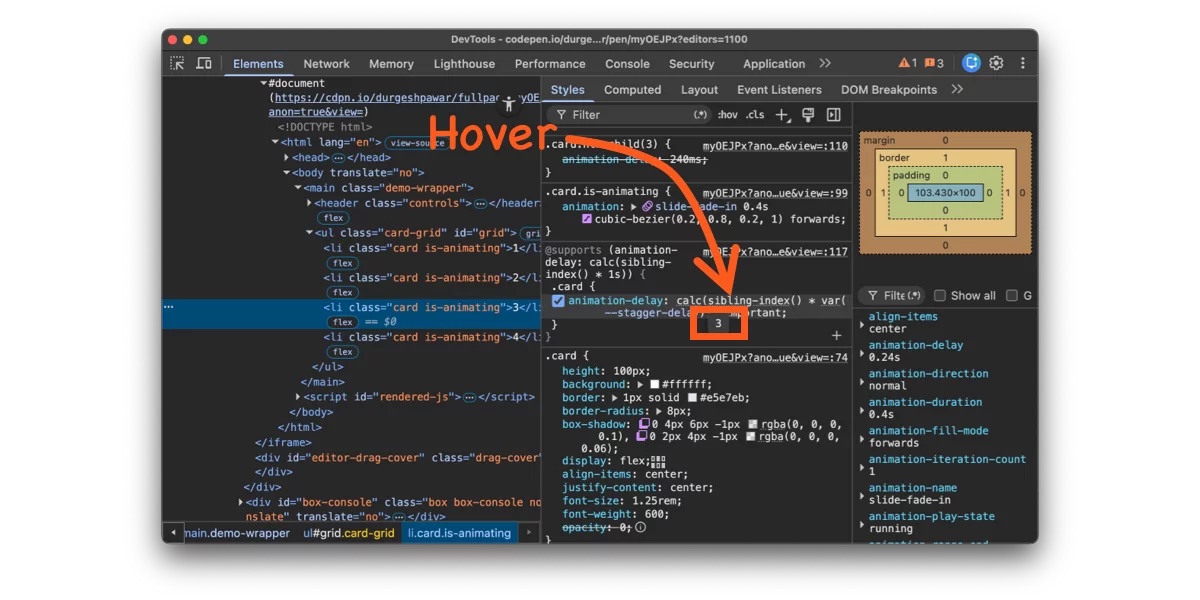
The current spec only counts all element siblings. But the CSSWG has documented a planned extension in issue #9572: an of <selector> argument, matching what :nth-child() already supports.
Something like sibling-index(of .active) would let you count only siblings matching a specific selector. An element that’s the eighth child overall but the third .active child would return 3. For dynamic UIs where you’re filtering or toggling visibility, that would keep the index sequential without requiring DOM manipulation.
There’s also been CSSWG discussion around children-count() and descendant-count() functions — the first would tell you how many children an element has (useful for parent-driven layouts), the second would count all descendants recursively. Both are still at the proposal stage, but they’d round out the tree-counting story: sibling-index() and sibling-count() give you the horizontal view (where am I among my peers?), while children-count() and descendant-count() would give you the vertical view (what’s below me?).
That feeling I mentioned at the top — writing ten :nth-child() rules for a staggered animation and wondering if you’re missing something obvious? You weren’t. The obvious thing just didn’t exist yet.
Read on the original site
Open the publisher's page for the full experience