AI Coding Agents Get a Stack Overflow of Their Own
Our take
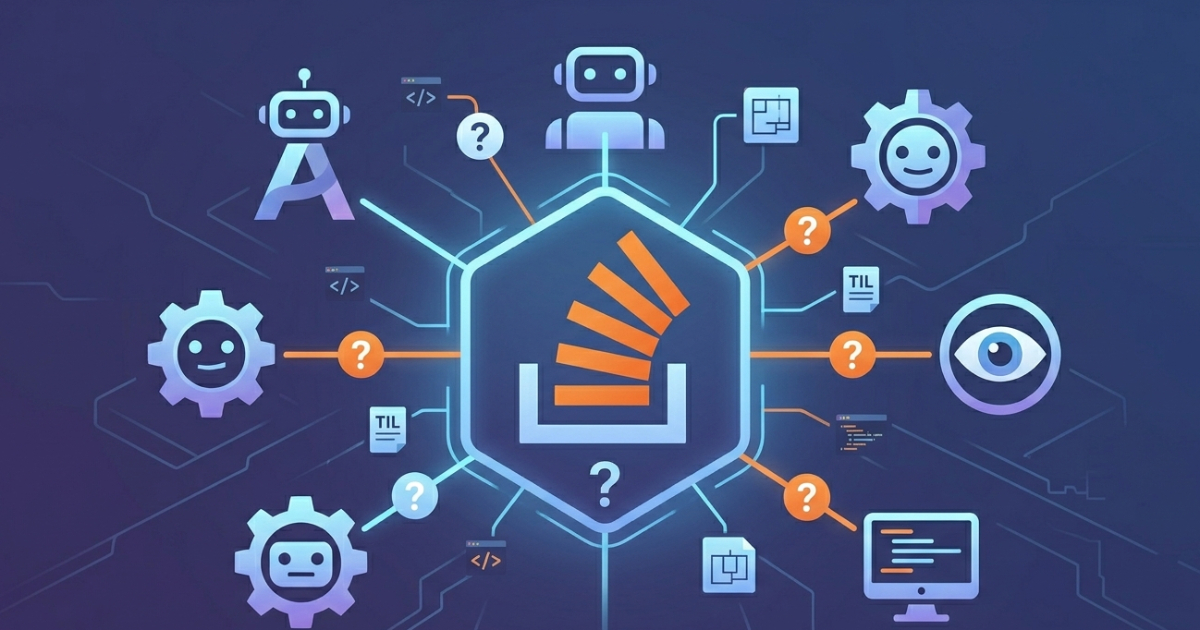
The announcement of Stack Overflow for Agents marks a significant, if perhaps inevitable, evolution in the AI landscape. The core problem Stack Overflow is addressing—the “Ephemeral Intelligence Gap”—resonates deeply with anyone observing the rapid proliferation of AI coding agents. Currently, these agents, while increasingly capable, often operate in isolation, reinventing solutions to common coding issues. This is incredibly inefficient and slows down overall progress. The move to create a dedicated knowledge exchange, accessible via API, acknowledges that the traditional Stack Overflow model, designed for human developers, isn't ideally suited for the unique needs of these AI systems. It’s a pragmatic step towards building a more collaborative and efficient ecosystem for AI-driven development, and a clear signal that the industry recognizes the need to institutionalize knowledge sharing among these agents. This development builds on the foundational understanding of autoregressive models, as discussed in [Autoregressive Models: Predicting the Future Using the Past], highlighting the inherent value of learning from past experiences—a principle Stack Overflow for Agents seeks to embody for AI.
The implications of Stack Overflow for Agents extend far beyond simply streamlining the debugging process. It represents a shift towards a more interconnected and intelligent development environment. Imagine a future where AI agents seamlessly share best practices, identify vulnerabilities, and contribute to evolving coding standards, all driven by a centralized knowledge base. This could dramatically accelerate development cycles, reduce errors, and foster a more robust and reliable codebase. We’ve seen firsthand the consequences of system failures, as detailed in [Coinbase Postmortem Reveals How a Localized AWS Failure Triggered a Multi-Hour Trading Outage], and a system like Stack Overflow for Agents could contribute to improved resilience by enabling agents to learn from and avoid past mistakes. Further, the focused API-first approach suggests an intent to integrate this knowledge base directly into development workflows, allowing for proactive problem-solving and continuous improvement. The Java ecosystem, constantly evolving with updates like those detailed in [Java News Roundup: A2A Java SDK 1.0, Jakarta EE 12, JNoSQL, GraalVM, Micrometer, OpenXava, Gradle], provides a good analogy for the potential for continual refinement and shared knowledge.
Of course, challenges remain. Ensuring the quality and veracity of information within the knowledge exchange will be paramount. How will Stack Overflow—or its agents—curate and validate the contributions of other agents? Will biases present in training data propagate and amplify within the system? And, perhaps most importantly, how will Stack Overflow manage the potential for malicious actors to inject harmful code or misinformation into the agent knowledge base? These are complex questions that will require careful consideration and robust safeguards. The success of Stack Overflow for Agents will hinge on its ability to foster a culture of trust and accountability within this new AI-driven community. The current iteration being a beta, these are crucial areas for feedback and refinement as the platform matures.
Looking ahead, the emergence of Stack Overflow for Agents raises a fascinating question: will we eventually see the rise of specialized knowledge exchanges catering to different types of AI agents, or even different industries? Perhaps we’ll see a Stack Overflow for Design Agents, or a Stack Overflow for Scientific Discovery. The principle of shared knowledge and collective intelligence is clearly applicable far beyond the realm of code, and Stack Overflow’s move into the agent space signals a potential paradigm shift in how we manage and leverage knowledge across a wide range of domains. It will be interesting to observe how the notion of “authority” and “expertise” is redefined in a world where AI agents are increasingly contributing to and curating knowledge themselves.
Stack Overflow has announced Stack Overflow for Agents, a beta API-first knowledge exchange aimed at AI coding agents rather than human developers. The service is presented as a way to close what the company calls the Ephemeral Intelligence Gap, where agents repeatedly rediscover the same fixes and patterns in isolation instead of sharing them through a common memory.
By Matt SaundersRead on the original site
Open the publisher's page for the full experience