Article: InfoQ Cloud and DevOps Trends Report - 2026
Our take
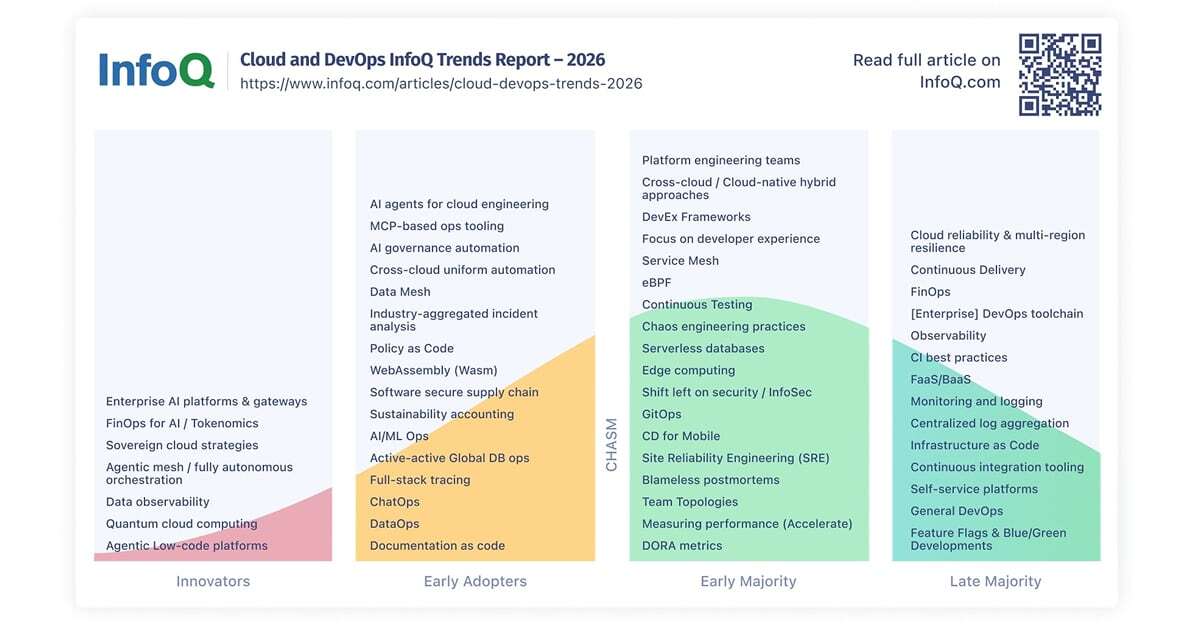
The InfoQ Cloud and DevOps Trends Report for 2026 paints a compelling picture of a maturing landscape, moving beyond the initial hype cycles and settling into a phase of pragmatic adoption and refinement. The report’s focus on areas like AI-powered observability, serverless architectures evolving beyond simple functions, and the increasing importance of platform engineering signals a shift towards operational efficiency and developer experience. We've seen similar discussions around the evolution of cloud-native practices in our own coverage of service meshes – Service Mesh Landscape – and the ongoing debate around the future of Kubernetes, highlighting the need for tools and approaches that simplify complexity and accelerate value delivery. The emphasis on observability is particularly noteworthy; as systems become increasingly distributed and complex, the ability to proactively monitor, diagnose, and resolve issues will be paramount to maintaining performance and reliability. It’s no longer sufficient to simply *detect* problems; organizations need to *understand* them and automatically remediate them.
What's truly significant about this report’s projections isn't necessarily the individual trends themselves, but the interconnectedness they represent. The rise of platform engineering, for instance, is directly fueled by the desire to streamline developer workflows and reduce the operational burden associated with cloud-native deployments. This aligns with the growing recognition that developers shouldn't be spending their time wrestling with infrastructure; they should be focused on building and delivering business value. Similarly, the increased adoption of serverless technologies isn’t just about cost savings; it’s about enabling developers to focus on code without worrying about server management. This convergence suggests a future where infrastructure is increasingly abstracted away, allowing teams to operate with greater agility and efficiency. We’ve explored similar themes around developer velocity and the role of tooling in achieving it – DevSecOps being a key example of how security can be integrated seamlessly into the development lifecycle. The report’s acknowledgement of this trend is a validation of the industry’s direction.
The report’s discussion of AI's role in DevOps is particularly insightful. While the initial wave of AI in DevOps focused primarily on automating simple tasks, the future, as InfoQ highlights, lies in leveraging AI to augment human capabilities—providing deeper insights, predicting potential issues, and automating complex remediation workflows. This moves beyond simple automation to intelligent automation, allowing DevOps teams to be more proactive and responsive. However, this also introduces new challenges related to data quality, model bias, and the need for robust governance frameworks. The authors rightly point out that simply throwing AI at a problem isn't a solution; it requires a thoughtful and strategic approach. Furthermore, the increasing reliance on AI necessitates a shift in skillsets within DevOps teams, requiring individuals to develop expertise in areas such as machine learning and data science. It's crucial that organizations invest in training and development to ensure their teams are equipped to leverage these new capabilities effectively. The long-term success of AI-powered DevOps will depend on building trust in these systems and ensuring they are aligned with business objectives.
Looking ahead, a critical question emerges: how will the increasing complexity of these trends impact smaller organizations and those with limited resources? While larger enterprises may be able to invest in specialized platform teams and AI-powered tools, smaller companies may struggle to keep pace. The democratization of these technologies – through open-source initiatives, low-code/no-code platforms, and managed services – will be essential to ensuring that all organizations can benefit from the advancements in cloud and DevOps. The report’s findings highlight a need for accessible and user-friendly solutions that empower teams of all sizes to embrace the future of data management and deployment. It will be fascinating to observe how the industry responds to this challenge and whether we see a widening gap between those who can leverage these technologies effectively and those who are left behind.
InfoQ editorial staff and friends of InfoQ are discussing the current trends in the domain of Cloud and DevOps as part of the process of creating our annual 2026 trends report.
By Steef-Jan Wiggers, Matt Saunders, Shweta Vohra, Daniel Bryant, Mark SilvesterRead on the original site
Open the publisher's page for the full experience