Build an Emergency Helpline Voice Agent with LangChain
Our take
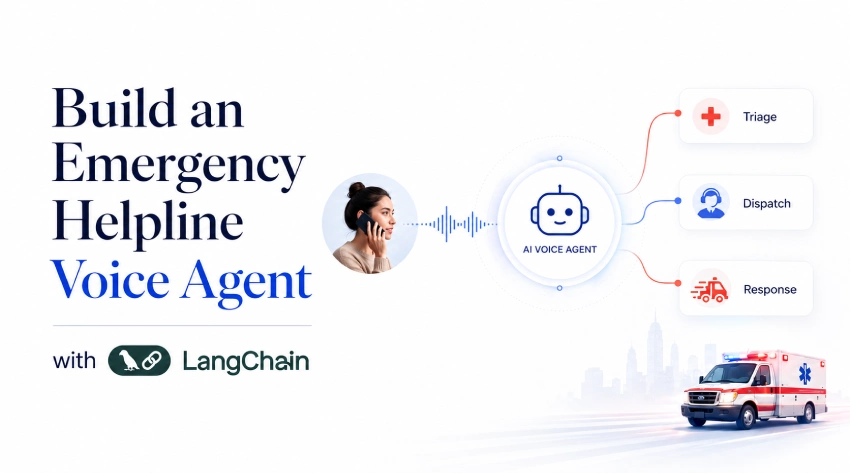
When seconds feel like minutes, the last thing we need is a convoluted keypad maze to reach help. The article “Build an Emergency Helpline Voice Agent with LangChain” tackles this pain point by showing how an AI‑driven voice assistant can listen, understand, and route callers instantly. It also nudges us toward a future where emergency support is no longer a bottleneck but a seamless, AI‑powered experience. Alongside this, explore how foundational LLM concepts shape such solutions in “5 Fun Papers That Explain LLMs Clearly”(/post/5-fun-papers-that-explain-llms-clearly-cmq60bbb501r312xwbi3jmhl5) and “7 Steps to Mastering Time Series Analysis with Python”(/post/7-steps-to-mastering-time-series-analysis-with-python-cmq60aoya01op12xwqq7n2roy) to deepen your understanding of the underlying technology and data patterns that drive real‑time decision making.
The core innovation lies in marrying LangChain’s modular architecture with robust speech‑to‑text and natural language understanding. Rather than relying on static menu prompts, the agent parses spoken commands, identifies intent, and routes the call to the appropriate specialist. This move from menu‑driven to intent‑driven interaction reduces cognitive load during high‑stress moments. For practitioners, the tutorial demonstrates how to stitch together pre‑trained transformers, fine‑tuned embeddings, and contextual retrieval to create a conversational flow that feels natural. The result is a system that can, for example, detect a caller’s urgency, triage symptoms, and even provide preliminary instructions—all while the human agent focuses on the clinical details.
Beyond the technical elegance, the article underscores a broader shift in how we think about resilience and accessibility. Emergency services have traditionally been constrained by legacy telephony infrastructure that prioritizes volume over nuance. By embedding AI at the frontline, we empower agencies to handle more calls with the same resources, scaling support without compromising quality. Moreover, the open‑source nature of LangChain means that smaller organizations can adopt and adapt the framework, democratizing access to advanced voice AI. This inclusivity aligns with our human‑centered ethos: technology should lift people, not create new barriers.
The implications ripple across several domains. In public health, faster triage can translate to saved lives, especially in regions where ambulance availability is limited. In disaster response, AI agents can guide citizens to the nearest shelter or medical facility, reducing confusion and panic. Even in everyday customer service, the same conversational paradigm can replace static IVRs, leading to higher satisfaction and lower abandonment rates. As AI models grow more capable, the line between automated assistance and human empathy will blur, offering a hybrid experience that feels both efficient and caring.
Looking ahead, we must ask how to balance automation with accountability. As voice agents take on more critical decisions, governance frameworks will need to evolve to ensure transparency, data privacy, and bias mitigation. Additionally, the integration of multimodal inputs—such as real‑time video or sensor data—could further enrich the agent’s context, enabling proactive interventions before a situation escalates. For our readers, the key takeaway is that this isn’t just a technical milestone; it’s a foundational step toward a future where AI acts as an invisible ally in moments that matter most.
We have all been in an emergency where every second matters. Someone’s life is at risk but there you’re panicking. Now, imagine in this situation of distress when a helpline asks you to press numbers on your keypad to connect with the right agent? Pure chaos, right? Here, we just need someone to listen and […]
The post Build an Emergency Helpline Voice Agent with LangChain appeared first on Analytics Vidhya.
Read on the original site
Open the publisher's page for the full experience