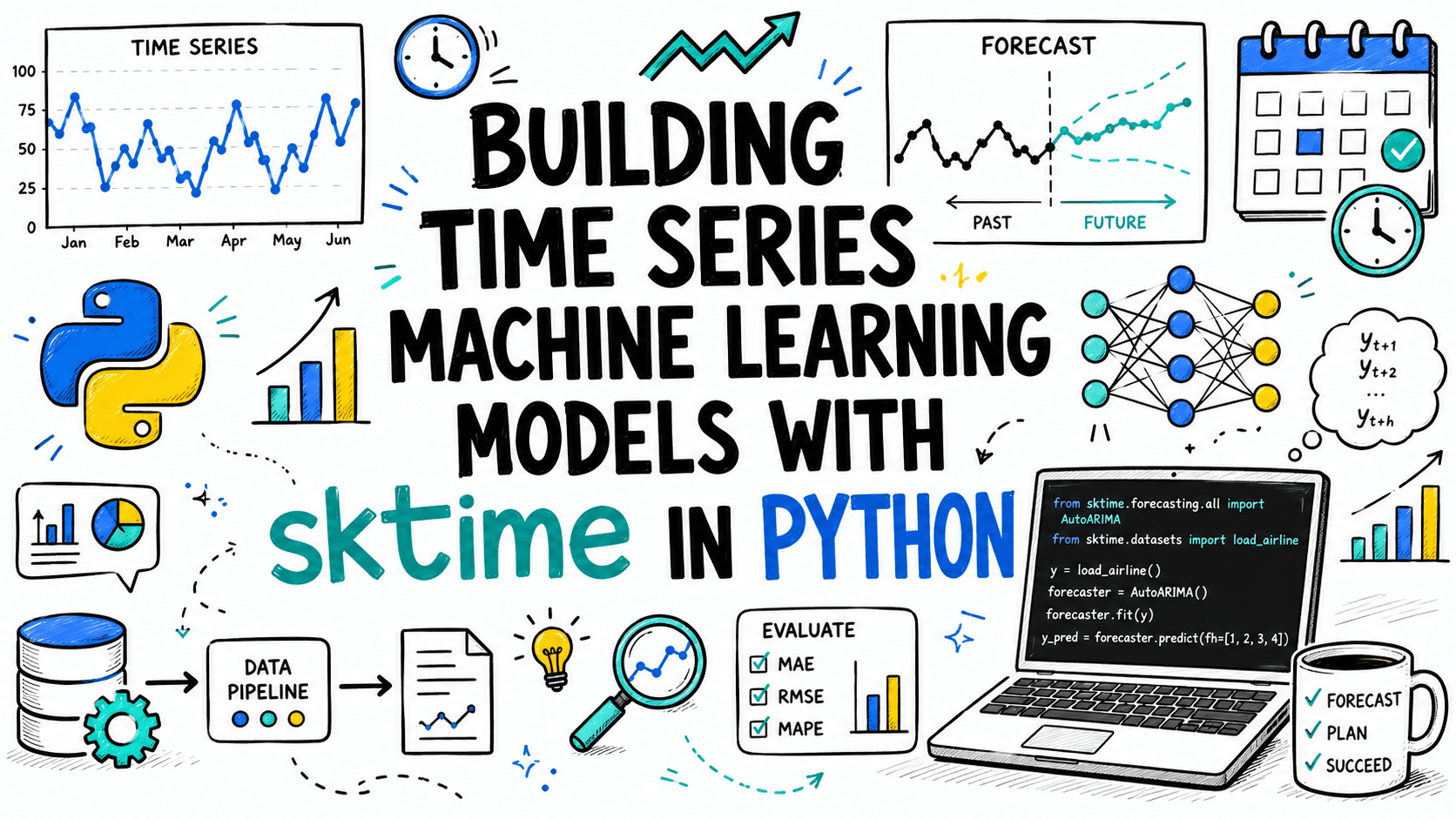
The emergence of robust, accessible libraries for time-series machine learning is a significant development, and the recent article detailing the use of `sktime` in Python is a welcome contribution. For those grappling with the complexities of forecasting, understanding and leveraging the right tools is paramount. The increasing interest in decentralized AI training, as explored in Could AI training be decentralized like Bitcoin mining?, highlights a broader desire for more efficient and democratized workflows, and time-series analysis often sits at the heart of such efforts, particularly when dealing with resource allocation or predictive maintenance. Similarly, the work on Concept-Vector: A design framework for human-interpretable word embeddings underscores the importance of model transparency and interpretability, qualities that, while perhaps not immediately apparent in time-series modeling, become increasingly crucial as these models are integrated into decision-making processes. `sktime`’s focus on core data structures for forecasting workflows directly addresses the need for a standardized, reliable foundation upon which to build more complex solutions.
The appeal of `sktime` lies in its commitment to simplifying what can often be a daunting field. Traditional time-series analysis often involves navigating a maze of statistical methods and custom implementations. `sktime` offers a more streamlined approach, providing a unified interface for a variety of algorithms and data structures. This is particularly valuable for data scientists who may not be specialized time-series experts. The ability to quickly prototype and deploy forecasting models, without being bogged down in low-level implementation details, allows teams to focus on deriving actionable insights from their data. Furthermore, the emphasis on standardized data structures promotes interoperability and facilitates collaboration, a critical factor in increasingly complex data science environments. It’s a pragmatic response to the growing demand for predictive capabilities across various industries, from finance and retail to healthcare and energy.
The broader significance of this development extends beyond the immediate benefits of easier model building. As organizations accumulate more time-stamped data – sensor readings, website traffic, sales figures – the ability to accurately forecast future trends becomes increasingly vital for strategic planning and operational efficiency. The rise of AI-native spreadsheet technology, which allows for direct integration of these models into business workflows, amplifies the impact. The ability to seamlessly incorporate forecasts into dashboards, reports, and even automated decision-making systems unlocks a new level of responsiveness and agility. While some are contemplating the future of AI training itself, as shown in the discussion around Recent CS graduate looking for GPU compute collaborators for LLM/VLM research, the more immediate need is to effectively utilize existing data and predictive tools to drive tangible business value. `sktime` is a crucial step in that direction.
Looking ahead, it will be interesting to observe how `sktime` evolves to incorporate the latest advances in deep learning for time-series forecasting. While traditional statistical methods remain valuable, deep learning models have demonstrated impressive performance on certain tasks. The challenge lies in integrating these approaches into a framework that remains accessible and user-friendly. Moreover, the increasing focus on explainable AI (XAI) will necessitate the development of tools and techniques for understanding and interpreting the predictions generated by `sktime` models. The ability to not only forecast accurately but also to explain *why* a particular forecast was made will be essential for building trust and ensuring responsible AI adoption. How will `sktime` and similar libraries adapt to meet these evolving demands and continue to empower data scientists to unlock the full potential of time-series data?