Claude’s Hidden Art Skill: Making Illustrations With Code
Our take
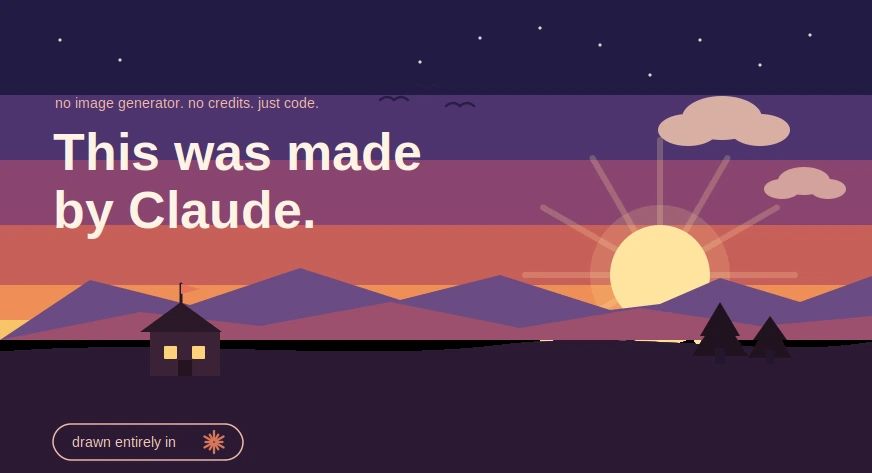
The narrative around large language models (LLMs) often fixates on their ability to generate text, translate languages, and answer questions. However, the recent discovery of Claude’s surprising skill – generating vector graphics using Scalable Vector Graphics (SVG) code – offers a compelling glimpse into the latent capabilities within these models. It challenges the assumption that image generation requires dedicated image models, showcasing a truly novel approach to visual creation. This capability is particularly interesting when considering the broader landscape of AI development, especially in light of discussions around the future of AI education, as highlighted in [Would you let an ML PhD student graduate without a top-tier paper? [D]] – demonstrating that unexpected skills can emerge even without a specific, targeted training focus. The fact that Claude can produce visually coherent illustrations using purely code-based instructions speaks volumes about its underlying understanding of spatial relationships and geometric principles, a skillset often considered separate from language processing. It’s a subtle but significant shift in our understanding of what these models are truly capable of.
This development is more than just a neat trick; it signifies a potential paradigm shift in how AI interacts with visual data. Traditional image generation relies on complex neural networks trained on massive datasets of images. Claude’s approach, however, bypasses this entirely, utilizing its language processing abilities to construct visual representations directly from code. The implications are substantial. SVG, being a vector format, allows for infinitely scalable graphics without loss of quality—a significant advantage over pixel-based images. Furthermore, the code-based nature of the output provides a level of control and precision that is difficult to achieve with traditional image generation methods. We’ve seen similar discussions around streamlining processes already, such as the potential for AI to accelerate claims processing, as explored in [Accelerating Claims with AI from FNOL to Settlement | A Sutherland Webinar]. This speaks to a broader trend of AI augmenting existing workflows and creating novel solutions in unexpected areas. The ability to generate graphics programmatically could revolutionize fields like web design, data visualization, and even scientific illustration.
The sheer fact that Claude can produce these illustrations without any image model involvement is remarkable, and it prompts a deeper exploration of the internal representations within LLMs. It suggests that language models possess a more nuanced understanding of the physical world than previously assumed. This isn't about Claude "seeing" in the way a human does; it’s about its ability to translate abstract concepts and instructions into a structured, visual format. This ability has clear implications for the future of AI-assisted design and creative workflows. The ease of manipulating and customizing SVG code also opens up possibilities for dynamic and interactive graphics, exceeding the capabilities of static image generation. The contrasting news about the passing of Claude Guillemot, co-founder of Ubisoft, [Ubisoft co-founder Claude Guillemot dies in plane crash] serves as a poignant reminder of the human element driving innovation, even as AI tools continue to evolve and redefine creative possibilities.
Looking ahead, it’s fascinating to consider how this capability will evolve and what other hidden talents might be lurking within LLMs. Will we see other models adopting similar code-based approaches to visual generation? Could this lead to the development of AI tools that can automatically generate illustrations from textual descriptions, blurring the lines between language and visual creation? The ability to generate high-quality, scalable graphics without relying on image models represents a significant advancement, and it’s a development worth watching closely as it promises to reshape the future of design and data visualization. The question becomes, what other unexpected creative domains will these language models unlock?
Everyone says Claude can’t make pictures. That’s partly true. Here is the kind of art it makes on its own, with no plugins and no connectors: Drawn by Claude in SVG, no image model anywhere near it. Not pixels but code: shapes and coordinates that stay sharp at any size and redraw themselves when you […]
The post Claude’s Hidden Art Skill: Making Illustrations With Code appeared first on Analytics Vidhya.
Read on the original site
Open the publisher's page for the full experience