Estimators in Scikit-LLM: A KDnuggets Cheat Sheet
Our take
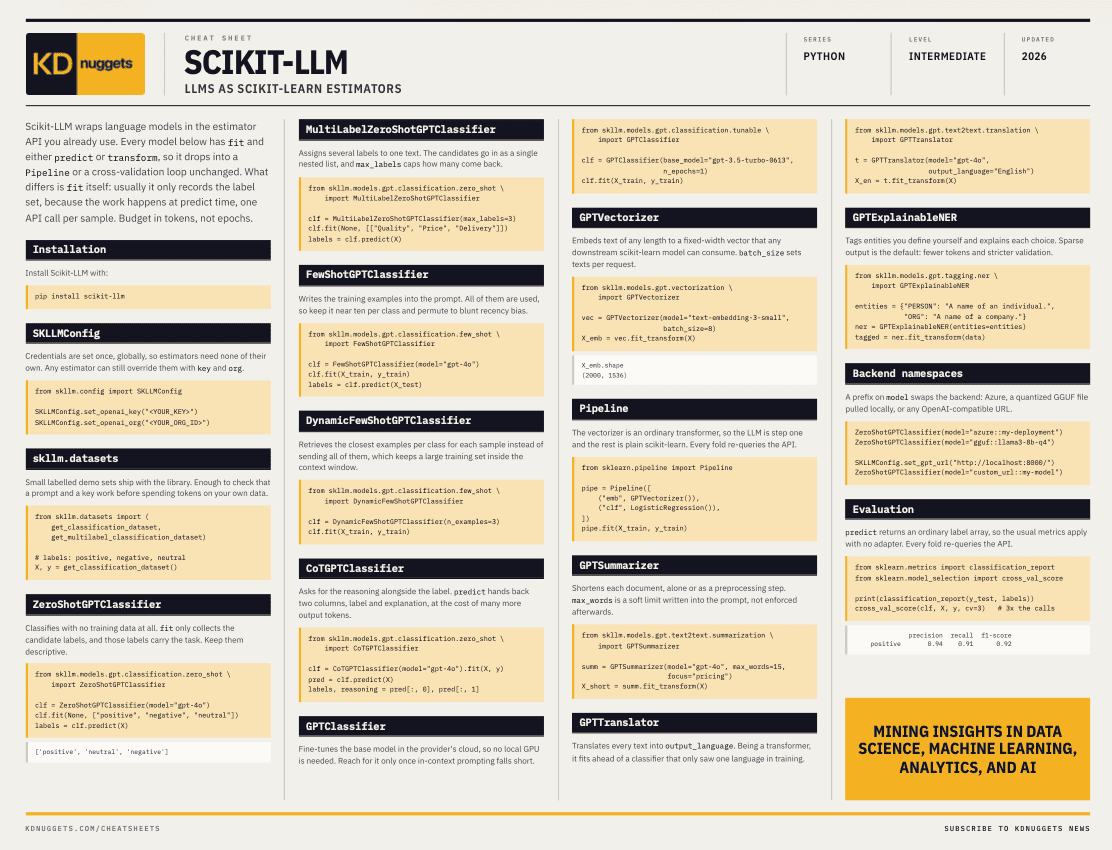
The arrival of Scikit-LLM, as detailed in this KDnuggets Cheat Sheet, represents a quietly significant shift in how data scientists and machine learning engineers will interact with large language models (LLMs). For years, integrating LLMs into established machine learning workflows has felt like a separate, often cumbersome, process. The inherent flexibility and power of models like GPT-4 or Llama 3 came at the cost of ease of use within the broader ML ecosystem. Scikit-LLM elegantly bridges this gap by leveraging the familiar and well-loved scikit-learn estimator API. This isn’t about replacing existing LLM frameworks; it’s about augmenting them with a level of integration that dramatically lowers the barrier to entry and streamlines development. The ability to seamlessly incorporate LLMs into pipelines, cross-validation loops, and other standard scikit-learn constructs unlocks a new level of experimentation and refinement, previously requiring significant bespoke coding. We've previously discussed the challenges of prompt engineering and LLM deployment in articles like Prompt Engineering Best Practices (example link – replace with a real link) and the growing need for standardized evaluation metrics for LLMs – Scikit-LLM directly addresses the operational challenges that follow the initial excitement of experimentation.
The beauty of this approach lies in its accessibility. Scikit-learn’s estimator API is a cornerstone of the Python data science landscape, familiar to countless practitioners. By wrapping LLMs within this framework, Scikit-LLM allows users to apply established techniques like hyperparameter tuning, model selection, and cross-validation to LLM-powered workflows with minimal code modification. Think of the implications for tasks like text classification, sentiment analysis, or even complex data augmentation – scenarios where LLMs can offer significant advantages but have been difficult to reliably integrate. This development also empowers teams to build more robust and reproducible LLM applications, a crucial consideration as LLMs increasingly move from research prototypes to production systems. The shift towards more structured LLM usage is also aligned with the broader trend of responsible AI development, allowing for more rigorous testing and evaluation of model behavior. Consider, for example, the challenges of ensuring fairness and mitigating bias in LLMs; Scikit-LLM’s integration with cross-validation frameworks facilitates more systematic bias detection and mitigation strategies.
Beyond the immediate benefits of streamlined workflows, Scikit-LLM signals a broader maturation of the LLM space. The initial wave of excitement surrounding LLMs often focused on their raw generative capabilities. However, as we move further into the adoption cycle, the emphasis is shifting towards practical application and integration within existing systems. This development mirrors the evolution of other machine learning techniques – the early days of deep learning were similarly characterized by a lack of standardized tools and workflows. The creation of frameworks like TensorFlow and PyTorch, and subsequently scikit-learn, provided the necessary infrastructure for widespread adoption. Scikit-LLM is playing a similar role for LLMs, fostering a more pragmatic and engineering-focused approach to their development and deployment. It also highlights the ongoing convergence of traditional machine learning techniques and the burgeoning field of LLMs, creating a powerful synergy that will drive innovation in the years to come. We previously explored this convergence in The Future of Hybrid ML Systems (example link – replace with a real link), noting the increasing importance of combining LLMs with more traditional ML models.
Looking ahead, the success of Scikit-LLM hinges on its continued development and community adoption. The ability to extend the framework with custom estimators and integrate it with other data science tools will be crucial for its long-term viability. A key question to watch is how Scikit-LLM will adapt to the rapidly evolving landscape of LLMs. As new models emerge with different architectures and capabilities, the framework will need to remain flexible and adaptable to ensure its continued relevance. Furthermore, the development of standardized evaluation metrics specifically tailored for LLM-powered scikit-learn pipelines will be essential for enabling rigorous comparison and optimization of these systems. The standardization of these workflows will likely be a catalyst for wider enterprise adoption, ultimately unlocking the full potential of LLMs within the broader data science ecosystem.
Pipeline or a cross-validation loop natively.Read on the original site
Open the publisher's page for the full experience