Fine-Tuning Explained for Noobs (How Pretrained Models Learn New Skills)
Our take
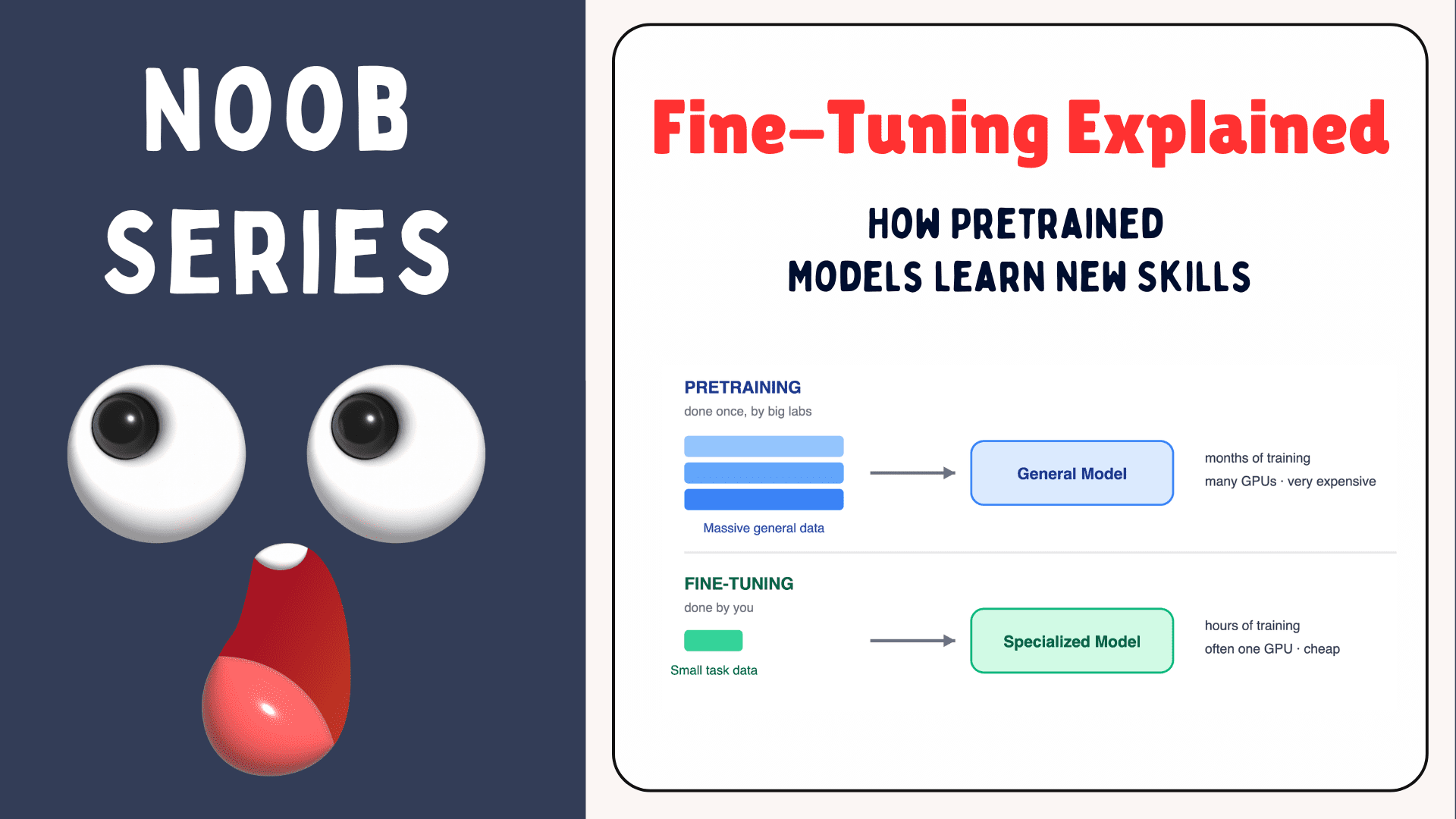
The recent accessibility of fine-tuning techniques for pretrained models marks a significant shift in the AI landscape, democratizing capabilities previously confined to research labs. The article "Fine-Tuning Explained for Noobs (How Pretrained Models Learn New Skills)" rightly emphasizes that a deep understanding of machine learning isn't a prerequisite to leveraging this powerful tool. This is particularly pertinent when considering the current state of AI adoption, as highlighted by the surprisingly low engagement rates observed in initiatives like [1.6M agents registered for OpenClaw and did NOTHING]. While the sheer number of registrations initially suggested widespread interest, the lack of substantive activity underscores the challenge of translating theoretical knowledge into practical application – a challenge fine-tuning directly addresses by lowering the barrier to entry. The ability to adapt existing, robust models to specific tasks, rather than building from scratch, represents a pragmatic and efficient path towards realizing the potential of AI across diverse domains.
The beauty of fine-tuning lies in its efficiency. Instead of retraining an entire model, which is computationally expensive and time-consuming, fine-tuning leverages the knowledge already embedded within a pretrained model – often trained on massive datasets – and subtly adjusts it to perform a new, related task. This echoes the broader trend towards optimized AI infrastructure, exemplified by discussions around chaos engineering for GPU clusters, as presented in [Presentation: Chaos Engineering GPU Clusters]. The ability to efficiently utilize existing resources, both computational and pre-existing model knowledge, is crucial for sustainable and scalable AI development. Cloudflare's introduction of temporary accounts for autonomous worker deployment [Cloudflare Introduces Temporary Accounts for Autonomous Worker Deployment] further demonstrates this focus on streamlined workflows and efficient resource allocation, allowing for rapid experimentation and deployment of AI agents. This convergence of optimized infrastructure and accessible fine-tuning techniques creates a fertile ground for innovation.
The implications of this accessibility are far-reaching. Businesses can now tailor powerful language models to their specific industry jargon, customer service needs, or internal knowledge bases without requiring a team of AI specialists. Creators can adapt image generation models to produce unique styles or assets. Researchers can rapidly prototype and test new AI applications. The shift is moving away from a model-centric approach, where users are constrained by the capabilities of existing models, to a user-centric approach, where models are rapidly adapted to meet specific needs. This empowers a broader range of users to participate in the AI revolution, fostering a more diverse and innovative ecosystem. The reduced complexity also encourages iterative development, allowing for continuous improvement and adaptation based on real-world feedback.
Looking ahead, the evolution of fine-tuning techniques and the tools that support them will be a critical area to watch. We’re likely to see increased automation in the fine-tuning process itself, with AI assisting in the selection of appropriate models and hyperparameters. The ability to seamlessly integrate fine-tuned models into existing workflows and applications will also be paramount. A key question remains: as fine-tuning becomes increasingly commonplace, how will we ensure the responsible use of these models and mitigate potential biases that may be amplified during the adaptation process? The democratization of AI power demands a parallel commitment to ensuring its ethical and equitable deployment.
Read on the original site
Open the publisher's page for the full experience