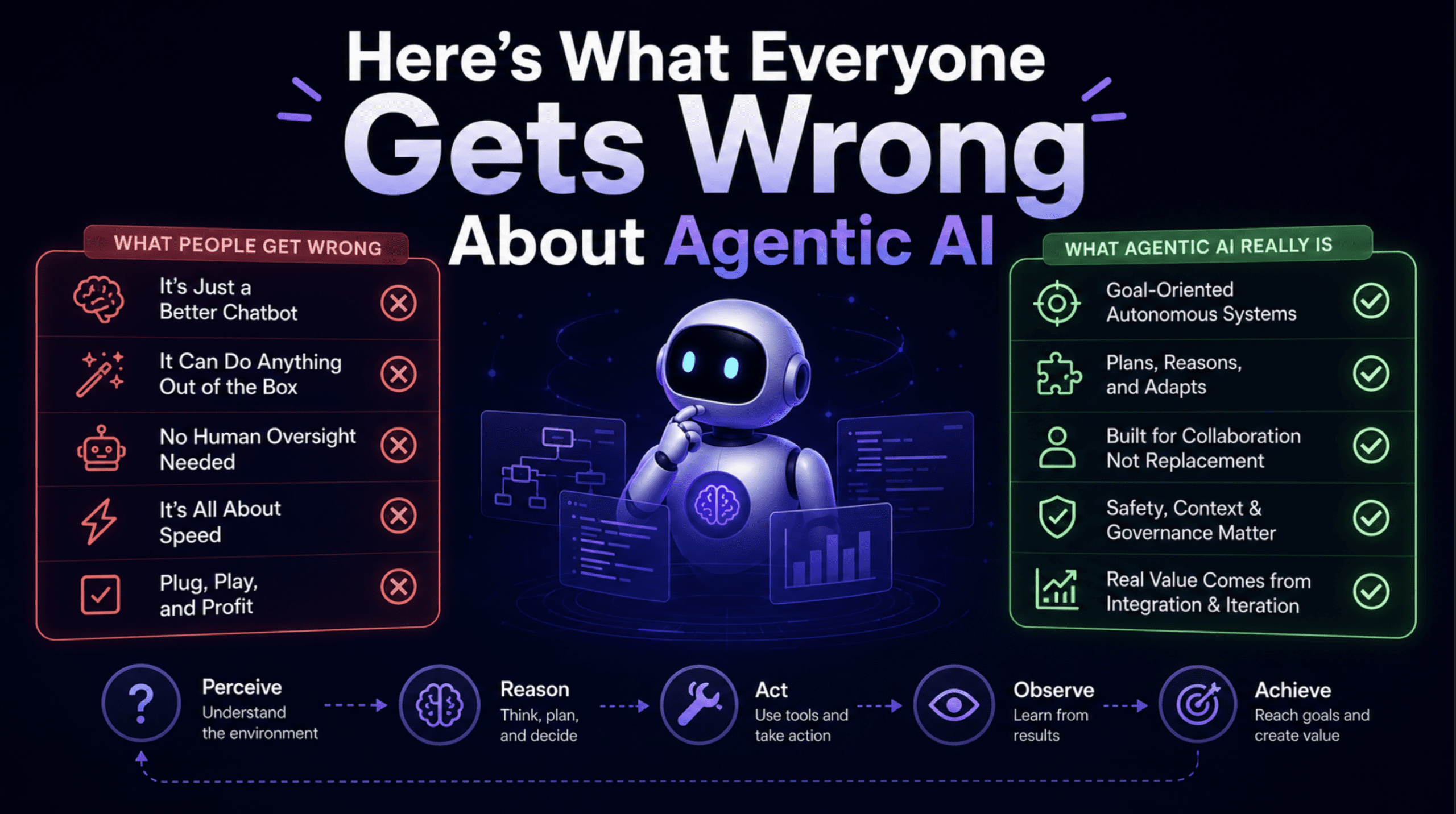
The recent discourse surrounding Agentic AI has taken on a somewhat pessimistic tone, with many declaring it a failed experiment. However, a more nuanced perspective, as articulated in the recent article "Here's What Everyone Gets Wrong About Agentic AI," suggests the narrative is premature. The core argument – that Agentic AI isn't inherently flawed but is faltering due to persistent misconceptions – resonates deeply. We've seen firsthand how ambitious AI deployments can stall when expectations don't align with reality, a challenge particularly evident in sectors like insurance. For instance, achieving demonstrable ROI often requires moving beyond initial pilots, a point explored in detail in How Claims Leaders Move from AI Pilots to Implementation | SnapRefund Podcast with Brandon Littles. Successfully scaling AI, particularly Agentic AI, demands a shift in mindset and a willingness to address these fundamental misunderstandings. The ability to accelerate processes, such as claims handling, is a tangible benefit, but it requires a solid foundation of realistic expectations and iterative development, as demonstrated through methods like those outlined in Accelerating Claims with AI from FNOL to Settlement | A Sutherland Webinar.
The five misconceptions, likely revolving around issues of control, complexity, data requirements, and the perceived need for perfect initial configurations, are all entirely correctable and represent common pitfalls. Historically, many organizations have approached AI with a "set it and forget it" mentality, expecting immediate, transformative results. Agentic AI, with its autonomous decision-making capabilities, requires a more dynamic and adaptive approach. It's not about handing over complete control but rather about establishing clear boundaries, providing robust feedback loops, and continuously refining the agent's behavior. The insistence on bespoke, highly complex initial agents, rather than simpler, more manageable iterations, is another contributing factor to early failures. Progress, as showcased by solutions like those explored in Five Sigma - Clive™ AI Live Demo - Insurtech Insights NY 2025, often comes from incremental improvements and a willingness to experiment.
The broader significance of this perspective lies in its ability to reframe the conversation around Agentic AI. Rather than dismissing it as a failed technology, we can now focus on the practical steps needed to unlock its potential. This shift requires a change in organizational culture—moving away from a fear of relinquishing control to embracing a collaborative partnership between humans and AI. It also necessitates investing in robust monitoring and governance frameworks to ensure that agents operate within ethical and regulatory boundaries. The potential benefits – increased efficiency, improved decision-making, and the ability to tackle increasingly complex challenges – remain substantial, but realizing them demands a commitment to iterative development, continuous learning, and a willingness to address these common misconceptions head-on. It's about empowering teams to guide and refine these agents, rather than attempting to dictate every action.
Ultimately, the current challenges with Agentic AI aren't a reflection of the technology's limitations but rather a consequence of how it's being implemented. The corrective measures provide a clear roadmap for organizations looking to harness the power of agentic systems. The question now is less about whether Agentic AI will succeed and more about which organizations will be agile enough to adapt their strategies and embrace a more nuanced, human-centered approach to its deployment. Can we expect to see a move away from the pursuit of fully autonomous agents towards a model of augmented intelligence, where AI serves as a powerful assistant, amplifying human capabilities rather than replacing them entirely?