How to Build Effective Evals for AI Agents
Our take
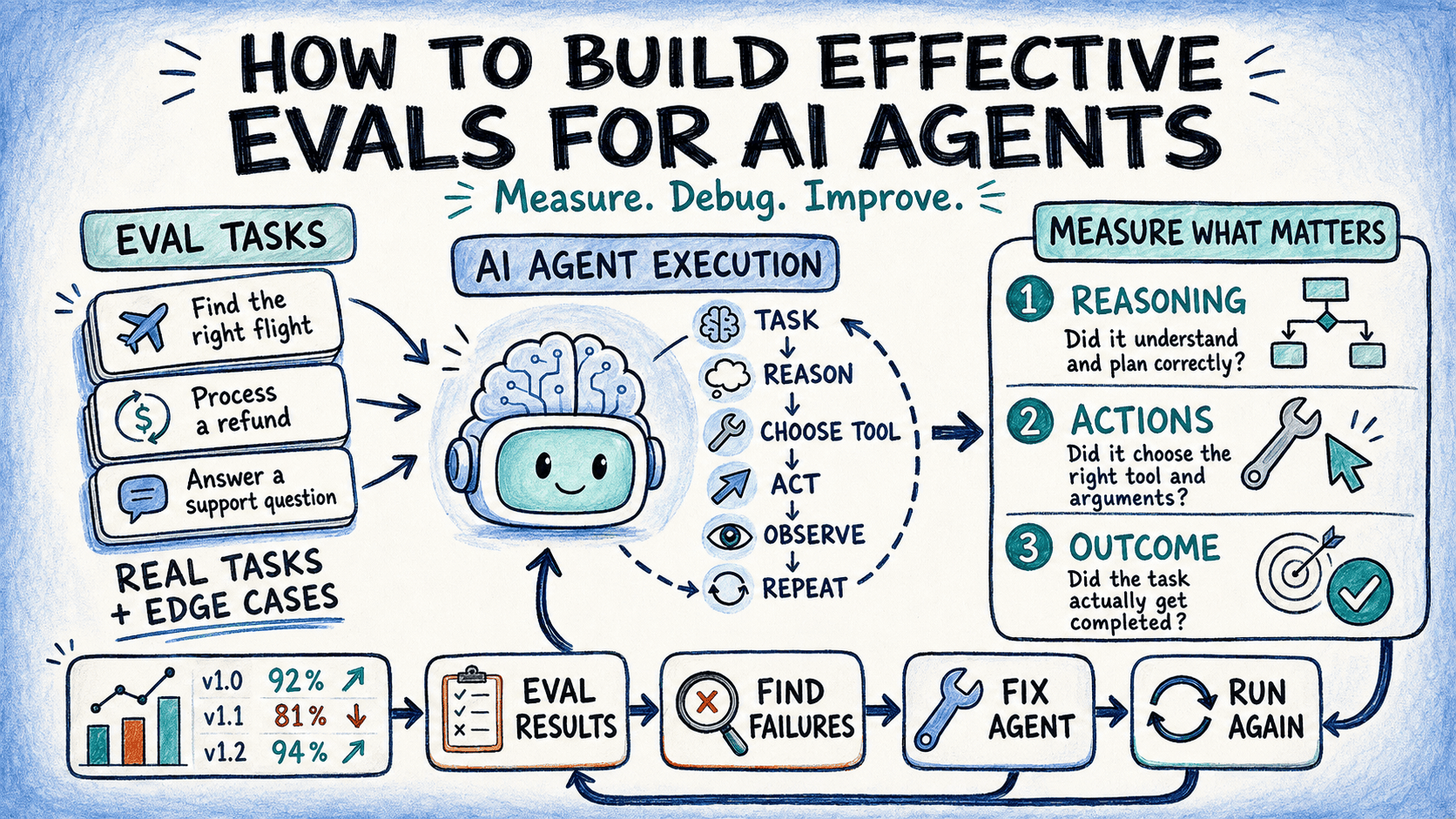
The recent surge in AI agent development demands a parallel evolution in how we assess their performance. The article, "How to Build Effective Evals for AI Agents," rightly focuses on this critical, often-overlooked aspect. While the hype around large language models and their agentic capabilities continues, the ability to rigorously and reliably evaluate these systems remains a significant bottleneck. Traditional spreadsheet-based methods simply aren’t equipped to handle the complexity and nuance of AI agent behavior. This isn't just about scoring accuracy; it's about understanding *how* an agent arrives at a decision, identifying failure modes, and ensuring alignment with intended goals. The need for robust evaluation frameworks is becoming increasingly urgent, especially as agents are deployed in more complex and high-stakes environments. We've previously explored the challenges of prompt engineering The Art of the Prompt and the importance of iterative refinement – effective evaluations are the essential feedback loop that makes that refinement possible. Furthermore, understanding the limitations of current evaluation methods is key, as highlighted in our analysis of benchmark overfitting Benchmark Blindness.
The article's emphasis on clear task design and grader selection is particularly insightful. It’s easy to fall into the trap of creating overly complex evaluation scenarios, but the most effective evaluations are often the simplest – those that isolate specific skills or behaviors. Choosing the right graders, whether human or AI-powered, is equally crucial. Human graders introduce subjectivity, but also the ability to understand context and nuance that automated systems may miss. Conversely, AI graders offer scalability and consistency, but require careful calibration and validation to avoid perpetuating biases. The article’s suggestion of building reliable eval harnesses—structured pipelines for running evaluations and collecting data—is a practical and necessary step towards operationalizing the evaluation process. Moving beyond ad-hoc testing to a standardized, repeatable evaluation framework is a cornerstone of responsible AI development.
The broader significance of this development extends far beyond simply improving individual AI agents. It represents a shift towards a more mature and scientific approach to AI development. The field is moving away from a purely experimental phase, where success is measured by anecdotal evidence and impressive demos, and towards a more rigorous, data-driven approach where performance is systematically measured and optimized. This shift will require investment in tooling and infrastructure for evaluation, as well as a greater emphasis on the skills and expertise needed to design and interpret evaluations. The ability to track changes over time—as the article points out—is vital for understanding the impact of training data, architectural changes, and algorithmic improvements. This longitudinal perspective is essential for building trustworthy and reliable AI systems.
Looking ahead, the evolution of AI evaluation itself will be a fascinating area to watch. We're likely to see the emergence of more sophisticated evaluation techniques that go beyond simple accuracy metrics and incorporate factors such as fairness, robustness, and explainability. The development of self-evaluating agents—agents that can assess their own performance—is another intriguing possibility, although one that raises its own set of challenges. Ultimately, the success of AI agents will depend not only on their ability to perform tasks effectively, but also on our ability to rigorously and reliably evaluate their performance—a challenge that demands constant innovation and refinement. Will we see the rise of dedicated "eval engineers" as a critical role within AI development teams, focused solely on building and maintaining robust evaluation pipelines?
Read on the original site
Open the publisher's page for the full experience