How to Measure Video Similarity: 6 Techniques I Tested (and the One I Shipped)
Our take
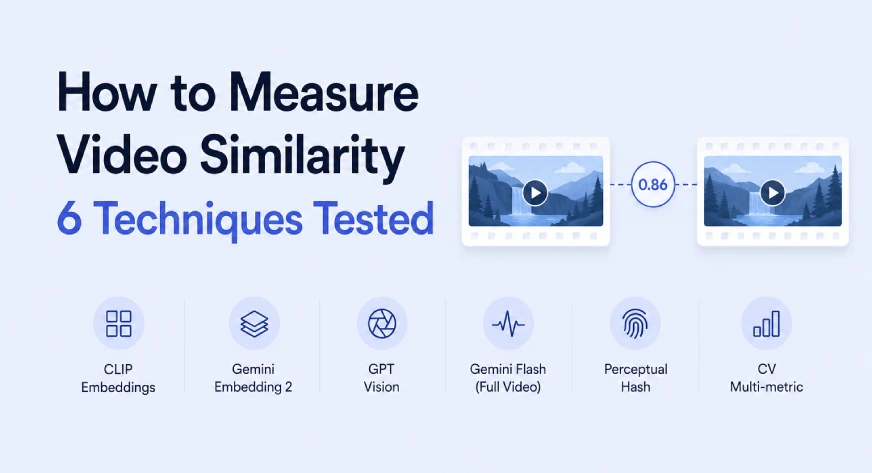
The deceptively simple question – “How alike do two short video clips look?” – highlights a surprisingly complex challenge at the intersection of computer vision and data management. As explored in the recent Analytics Vidhya post, [How to Measure Video Similarity: 6 Techniques I Tested (and the One I Shipped)], the pursuit of an accurate and efficient solution proved far more involved than initially anticipated. The author’s journey, testing six different techniques to rank waterfall videos, underscores a crucial point for anyone working with visual data: seemingly straightforward tasks often demand nuanced approaches and rigorous experimentation. This resonates deeply given the increasing volume of video data across industries, from e-commerce product demonstrations to security surveillance and content recommendation systems. The need to quickly and accurately assess video similarity is not a niche concern; it's a foundational requirement for a growing number of applications, and understanding the practical hurdles involved is paramount. Related challenges in model tuning, as seen in [Obtaining Irregular Learning Curves with Hyberband Tuned ANN model for Price Prediction [P]], demonstrate that even with automated techniques, careful consideration of the underlying algorithms and their performance is essential.
The author’s eventual success in identifying a suitable model – a testament to iterative testing and a willingness to explore different avenues – offers valuable lessons for data scientists and engineers. The sheer number of potential approaches to video similarity measurement is daunting, ranging from frame-by-frame comparisons to more sophisticated feature extraction techniques. The article’s focus on practical implementation, detailing the specific challenges encountered and the rationale behind the chosen solution, makes it particularly compelling. Similarly, the considerations around acceptance criteria within academic conferences, discussed in [How does *ACL conferences acceptance work [D]], highlight the importance of a robust evaluation process when developing and deploying these kinds of AI models. It’s not enough to simply achieve a high accuracy score; the model must also be reliable, efficient, and interpretable. The contrast between the initial expectation of a quick win and the eventual realization of the complexity is a common theme in AI development, reinforcing the need for realistic expectations and a methodical approach.
The broader significance of this work extends beyond the immediate application of waterfall video analysis. The principles and techniques explored – such as feature extraction, dimensionality reduction, and similarity scoring – are broadly applicable to other visual data domains. As the volume of image and video data continues to explode, the ability to efficiently and accurately identify similar content will become increasingly critical. Imagine the implications for personalized content recommendations, automated video tagging, or even the detection of copyright infringement. The author’s experience serves as a practical reminder that successful AI implementations require a deep understanding of the underlying data, a willingness to experiment, and a commitment to rigorous evaluation. The move toward automated hyperparameter tuning, as exemplified in [Hyperparameter tuning approach question [R]], points towards a future where these optimization processes become increasingly streamlined, but the fundamental need for careful model selection and validation remains.
Looking ahead, the development of more sophisticated and computationally efficient video similarity algorithms remains a key area of research. The increasing prevalence of generative AI models raises new questions about how to measure the similarity between generated and real-world video content. Furthermore, the ability to adapt these algorithms to handle diverse video formats, resolutions, and compression techniques will be essential for real-world deployments. The challenge lies not only in achieving high accuracy but also in ensuring that these algorithms are scalable and can operate in real-time, enabling a new generation of intelligent video applications. How will we ensure that similarity metrics accurately reflect perceived similarity, especially as video content becomes increasingly complex and manipulated?
Two short clips. One question: how alike do they look? Sounds trivial, it isn’t, and I learned that the slow way. My setup: one reference clip, eight others to rank against it, all waterfalls (more on why in a second). I figured this was an afternoon job, grab a model, compute a number, move on. […]
The post How to Measure Video Similarity: 6 Techniques I Tested (and the One I Shipped) appeared first on Analytics Vidhya.
Read on the original site
Open the publisher's page for the full experience