I Deployed My Data Pipeline to AWS. Then Everything That Was “Local” Broke.
Our take
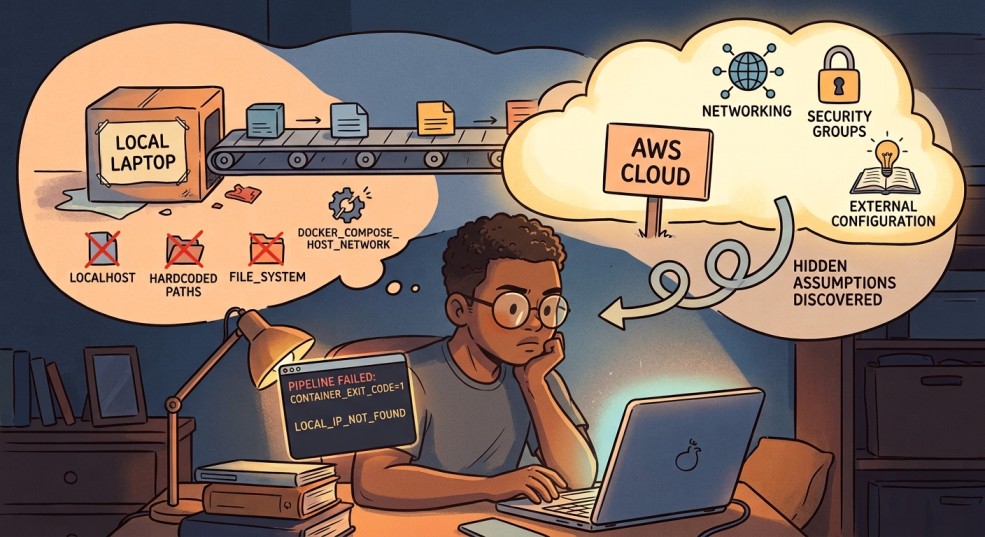
The recent Towards Data Science piece, "I Deployed My Data Pipeline to AWS. Then Everything That Was 'Local' Broke," resonates deeply with anyone who's transitioned from a comfortable local development environment to the complexities of cloud deployment. It’s a familiar story, often glossed over in the hype surrounding cloud services, but crucial for understanding the true challenges of modern data engineering. The author's experience highlights a fundamental truth: replicating a local setup in a cloud environment isn’t simply a matter of pushing containers; it requires a thorough understanding of networking, security, and the often-unacknowledged assumptions baked into local configurations. This echoes lessons learned by many, and provides a valuable reminder of the importance of robust testing and a holistic approach to infrastructure design. For those new to the world of cloud data pipelines, understanding these pitfalls is critical, and resources like Understanding Container Networking offer a deeper dive into the technical nuances involved. Similarly, those grappling with deployment strategies may find Serverless Data Pipelines with AWS Lambda a useful exploration of alternative architectures that can mitigate some of these issues.
The core of the issue, as the author so clearly illustrates, lies in the implicit dependencies and configurations we often take for granted on our local machines. Things like default network settings, environment variables inherited from the shell, and even the order in which services start can all contribute to a working pipeline that immediately fails when deployed to a cloud platform. This isn’t a reflection of the cloud provider's shortcomings, but rather a consequence of the inherent differences between a controlled, isolated local environment and the shared, dynamic nature of the cloud. The anecdote serves as a potent reminder that containerization, while simplifying application packaging, doesn't magically solve all deployment problems. It merely shifts the focus to a different set of complexities – namely, ensuring that containers can communicate effectively, access necessary resources, and operate securely within a larger infrastructure. The experience highlights the need for infrastructure-as-code practices, automated testing, and a culture of continuous integration and continuous deployment (CI/CD) to minimize these types of surprises.
Beyond the technical details, the article also touches on a broader cultural shift in data engineering. The ease of spinning up local development environments has, in some ways, fostered a "works on my machine" mentality. While rapid prototyping is valuable, it can lead to a disconnect between development and operations, resulting in unexpected issues in production. The author’s journey underscores the importance of collaboration between developers and operations teams, and the need for shared responsibility for the entire data pipeline lifecycle. Embracing practices like infrastructure-as-code and automated testing can bridge this gap, enabling teams to build and deploy data pipelines with greater confidence and reliability. Moreover, the rise of platforms designed to simplify cloud data deployment, such as Airflow Cloud, demonstrates a growing recognition of the challenges involved and a desire to provide more user-friendly solutions.
Looking ahead, the increasing adoption of serverless technologies and managed data services will likely further reshape the data engineering landscape. While these platforms abstract away much of the underlying infrastructure, they don't eliminate the need for a strong understanding of networking, security, and data governance. Instead, they shift the focus from managing infrastructure to designing robust and scalable data pipelines. The challenge will be to equip data engineers with the skills and tools they need to thrive in this evolving environment, ensuring that they can build data pipelines that are not only performant and reliable but also secure and compliant. A key question to watch is how the industry will address the growing complexity of observability and debugging in these increasingly distributed and abstracted environments – how can we effectively diagnose and resolve issues when the underlying infrastructure is largely hidden from view?
What moving a Dockerized pipeline off my laptop taught me about containers, networking, and hidden assumptions.
The post I Deployed My Data Pipeline to AWS. Then Everything That Was “Local” Broke. appeared first on Towards Data Science.
Read on the original site
Open the publisher's page for the full experience