Inside Target’s LLM-Based System for Semantic Matching in Marketing Forecast Pipelines
Our take
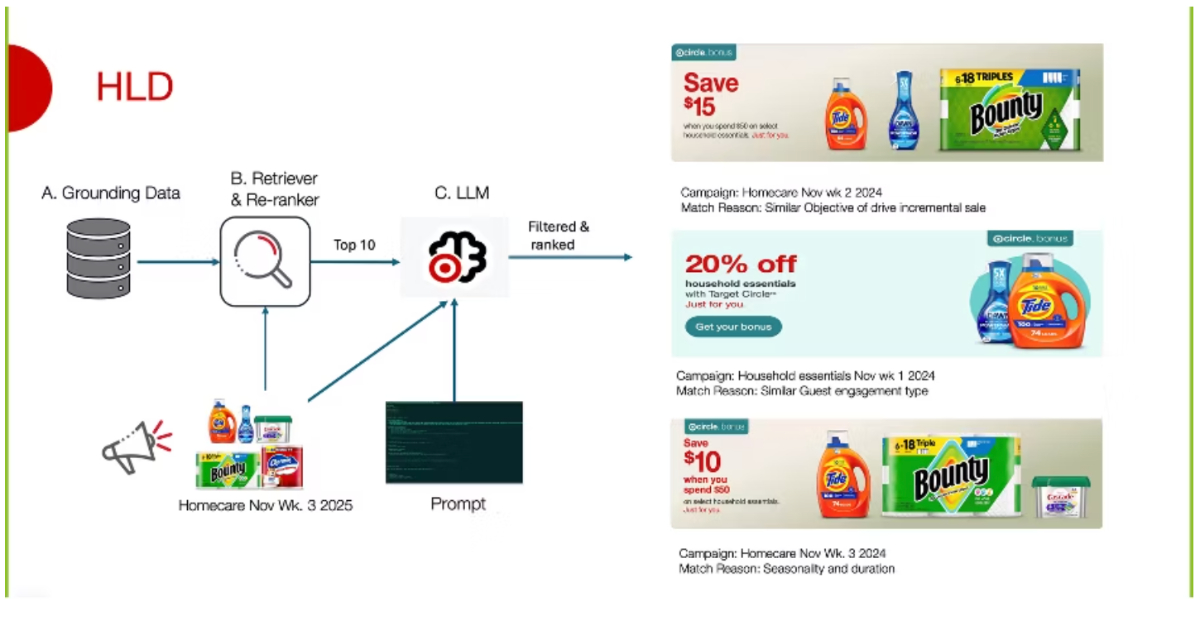
Target's recent deployment of a generative AI system for marketing campaign forecasting offers a compelling glimpse into the future of data-driven decision-making. The shift from rule-based workflows to a system leveraging embeddings, vector search, and LLM ranking is significant. This approach echoes the broader movement towards more nuanced and adaptive AI solutions, moving beyond simple automation to facilitate genuinely insightful analysis. It's particularly interesting to consider this in the context of recent findings from GitLab, who found that while AI tools accelerate coding, overall software delivery isn’t necessarily improved AI Tools Accelerates Coding, but Not Overall Software Delivery, GitLab Research Finds. Target's success in campaign forecasting suggests a different area where AI can deliver tangible, measurable gains, highlighting the importance of applying AI strategically to specific business challenges rather than expecting broad, sweeping improvements. Furthermore, the focus on local-first architectures, as discussed in a recent podcast with Adam Wiggins Podcast: Architectural Patterns: Moving Beyond Cloud-Native to Local-First - Insights from Adam Wiggins, speaks to a growing preference for systems that can be adapted and controlled within existing infrastructures, a consideration likely informing Target’s implementation strategy.
The 75% top-1 and 100% top-3 coverage achieved by Target’s system are impressive results. These metrics indicate a high degree of accuracy in identifying relevant historical campaigns for comparison, significantly reducing the manual effort previously required. The incorporation of feedback loops, utilizing campaign outcomes to refine retrieval, is a crucial element of this system’s long-term viability. It's a clear demonstration of how AI can not only automate tasks but also continually learn and improve its performance over time. This iterative refinement process is essential for maintaining accuracy and relevance as marketing landscapes evolve and new campaign strategies emerge. The fact that Target is willing to publicly share details about this internal system suggests a growing confidence in the value and potential of AI within the retail sector, and a recognition of the need for broader industry knowledge sharing.
Beyond the immediate benefits to Target’s marketing forecasting, this development has broader implications for the future of data management across various industries. The use of embeddings and vector search to represent and compare complex data points—in this case, marketing campaigns—is a powerful technique that can be applied to numerous other scenarios. Consider its potential for improving customer support by identifying similar past interactions, or for optimizing supply chain management by predicting potential disruptions based on historical patterns. This approach underscores a fundamental shift from rigid, rule-based systems to more flexible, AI-powered solutions that can adapt to dynamic environments. It reinforces the idea that the true power of AI lies not in replacing human expertise, but in augmenting it by providing access to relevant data and insights at scale. The Eliya 25 distribution's focus on improving production diagnostics Eliya 25 Brings a JVM-Level Diagnostic Profile to OpenJDK 25 LTS further highlights the increasing importance of robust monitoring and feedback loops to ensure the reliability and performance of AI-driven systems.
Looking ahead, the key question isn't *if* more companies will adopt similar AI-powered forecasting systems, but *how* they will manage the inherent complexity of these systems and ensure they remain aligned with evolving business objectives. The need for clear data governance policies, robust feedback mechanisms, and ongoing monitoring will only intensify as AI becomes increasingly integrated into core business processes. Will we see a standardization of embedding techniques and vector search methodologies across industries, fostering interoperability and accelerating the adoption of AI-driven solutions? Or will each company continue to build bespoke systems, potentially leading to fragmentation and limiting the overall impact of this transformative technology?
Target built a generative AI system to improve marketing campaign forecasting by retrieving and ranking similar historical campaigns. Using embeddings, vector search, and LLM ranking, it replaces rule-based workflows. Evaluation shows 75% top-1 and 100% top-3 coverage. The system reduces manual effort, improves consistency, and uses feedback loops to refine retrieval using campaign outcomes.
By Leela KumiliRead on the original site
Open the publisher's page for the full experience