Local Agentic Programming on the Cheap: Claude Code + Ollama + Gemma4
Our take
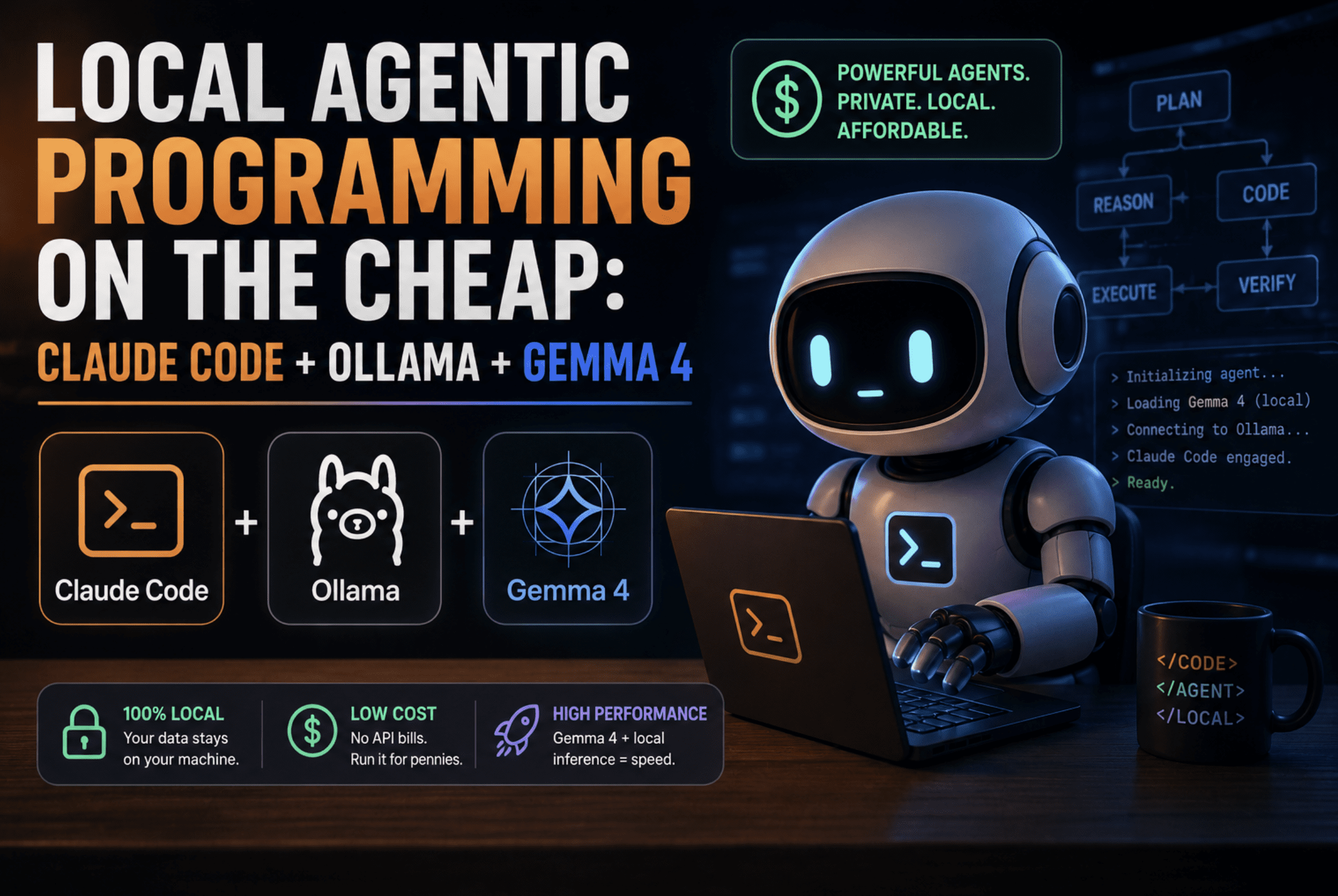
The recent emergence of accessible, locally-run agentic programming stacks represents a significant shift in how developers and data professionals will interact with AI. The article detailing a build using Ollama, Gemma 4, and Claude Code exemplifies this trend beautifully. It’s no longer a future aspiration; it’s a present reality achievable with relatively modest resources. This contrasts sharply with the previous landscape where powerful AI agent capabilities were largely confined to cloud-based platforms, often requiring significant investment and raising concerns about data privacy and control. As we've highlighted in our previous coverage, like [Understanding Pytorch better and Moving forward from papers [D]], the accessibility of foundational technologies is crucial for broader adoption and innovation, and this development takes that principle a step further by bringing sophisticated agentic capabilities directly onto the user’s machine. The ability to build, test, and iterate on these systems without reliance on external infrastructure opens up immense possibilities for experimentation and specialized application development.
The combination of Claude Code's coding prowess with the lightweight efficiency of Gemma 4 and the streamlined deployment of Ollama creates a compelling and practical solution. While the concept of agentic programming – where AI systems autonomously perform tasks – has been discussed extensively, the practical barriers to entry have historically been high. This setup significantly lowers those barriers. It’s also interesting to consider this in the context of our earlier exploration of [Routing LLMs by task verifiability: a small experiment (n=120, 3 models)], where we explored techniques for optimizing LLM performance through task-specific routing. Integrating these routing strategies within a local agentic framework could unlock even greater efficiency and precision. Furthermore, the open-source nature of many of these components encourages community contribution and rapid advancement, a spirit championed by initiatives like [Introducing Papers Without Code [P]], which aims to bridge the gap between academic research and practical implementation.
The broader significance of this development extends beyond individual developers. Businesses, particularly those handling sensitive data or requiring highly customized solutions, will increasingly find value in local AI agents. The ability to process data securely within their own infrastructure, without transmitting it to third-party cloud services, is a major advantage. This trend is likely to accelerate the adoption of edge computing and on-premise AI deployments, particularly in sectors like finance, healthcare, and government. While cloud-based AI will remain a dominant force, the rise of local agentic programming offers a compelling alternative for organizations seeking greater control, security, and customization. The ease of setting up this stack also democratizes access to sophisticated AI capabilities, allowing smaller organizations and independent researchers to compete with larger, better-resourced players.
Ultimately, the ability to create powerful AI agents on relatively inexpensive hardware signifies a broader shift towards decentralized and democratized AI. It’s a move away from a centralized, cloud-dominated model and towards a more distributed and accessible landscape. The convergence of open-source models, streamlined deployment tools, and powerful coding assistants is driving this transformation, and we’re only beginning to see its potential. As these technologies mature and become even more accessible, one key question remains: how will the rise of local agentic programming reshape the software development lifecycle, and what new paradigms of human-AI collaboration will emerge as a result?
Read on the original site
Open the publisher's page for the full experience