Netflix Serves 84% of Query Results from Cache with Interval-Aware Caching in Apache Druid
Our take
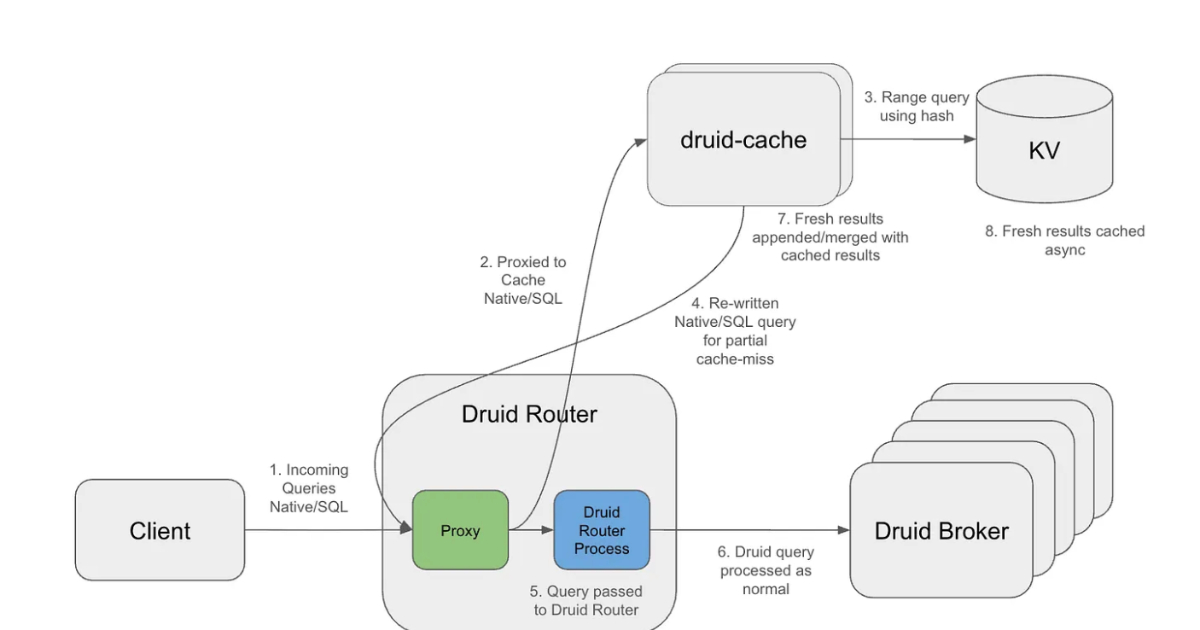
Netflix’s latest tweak to Apache Druid reads like a masterclass in turning a well‑understood bottleneck into a strategic advantage. By introducing interval‑aware caching, the streaming giant now serves 84 % of analytics results directly from cache and cuts query load by a third. The approach is simple enough to explain—rolling‑window queries are broken into reusable time slices, and only the most recent slice is recomputed—yet the impact reverberates across every data‑driven decision at Netflix. It also offers a compelling contrast to other industry moves, such as the way Google adds Gemini‑powered Dictation to Gboard, which could be bad news for dictation startups is reshaping user‑experience pipelines, or how TikTok now wants to be the place you book the trip you just saw on TikTok is expanding its commerce layer. In each case, the underlying theme is the same: a shift from brute‑force processing toward smarter, more reusable data primitives that empower real‑time insight without overwhelming infrastructure.
What makes interval‑aware caching particularly noteworthy is its alignment with a progressive, human‑centered view of data work. Traditional cache strategies treat each query as an atomic unit; a change in the time window forces a full recompute, even when 95 % of the underlying data remains identical. Netflix’s solution recognizes that analysts care about the *trend* more than the exact mechanics of each window. By decomposing a rolling query into fixed intervals—say, daily or hourly blocks—the system can pull cached results for the historical portion and only calculate the newest slice. This partial reuse slashes scan volume, improves the 90th‑percentile latency, and, crucially, frees up compute cycles for higher‑value workloads such as anomaly detection or personalized recommendation refreshes.
From an operational perspective, the benefits cascade beyond performance metrics. Reducing query load by 33 % translates into lower cloud spend, a quieter network, and a smaller carbon footprint—outcomes that resonate with any organization seeking sustainable scale. More importantly, the technique democratizes access to near‑real‑time analytics. Teams that previously hesitated to run intensive windowed queries because of cost or latency concerns can now explore richer dashboards without waiting for batch pipelines. The result is a more agile decision‑making culture, where data‑driven hypotheses are tested and iterated on the fly, keeping product cycles tight and user experiences continuously refined.
The broader implication for the analytics ecosystem is a reminder that innovation often lies in rethinking *how* we use existing tools rather than in chasing ever‑larger hardware. Apache Druid already offers a powerful columnar store and fast aggregation; interval‑aware caching simply extracts more value from those capabilities by adding a layer of temporal intelligence. Other platforms—whether they are built on Snowflake, BigQuery, or emerging lakehouse architectures—can adopt a similar philosophy: identify repeatable query patterns, cache at the granularity that matches business rhythm, and recompute only the delta. In doing so, they empower analysts to focus on insight generation rather than on the mechanics of data retrieval.
Looking ahead, the real test will be how this caching model adapts to increasingly complex analytical workloads, such as multi‑dimensional cohort analyses that span irregular time frames or event‑driven streams with variable latency. Will interval‑aware caching evolve to handle non‑uniform windows, or will complementary techniques like predictive pre‑warming become necessary? As data platforms continue to blend batch, streaming, and AI‑native processing, the ability to *discover* and *transform* query patterns into reusable assets will be a decisive factor in staying ahead of the performance curve. Netflix has set a clear benchmark—now the question is whether the rest of the industry will explore it with the same confidence.
Netflix improves Apache Druid performance with interval aware caching, serving 84% of analytics results from cache and reducing query load by 33%. The system decomposes rolling window queries into reusable time segments, enabling partial cache reuse and recomputation only for recent data. At scale, it reduces scan volume, improves P90 latency, and optimizes real time analytics workloads.
By Leela KumiliRead on the original site
Open the publisher's page for the full experience