OpenAI Introduces Websocket-Based Execution Mode to Reduce Latency in Agentic Workflows
Our take
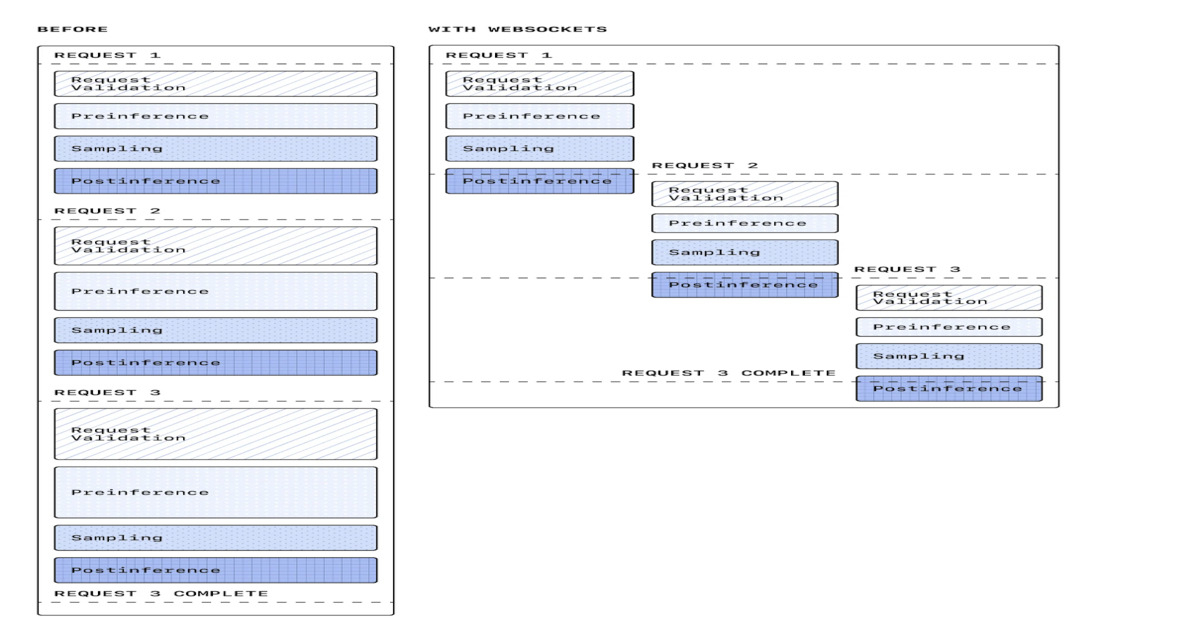
OpenAI has taken a significant step toward solving one of the most persistent challenges in agentic AI development: latency. The company recently introduced a WebSocket-based execution mode for its Responses API, a move that promises to reduce latency by up to 40 percent in coding agents and real-time AI systems. This update replaces the traditional HTTP request-response cycle with persistent connections, fundamentally changing how AI systems communicate and execute multi-step workflows. For developers building autonomous agents, this isn't merely an incremental improvement—it represents a structural shift in how agentic systems can operate at production scale. The timing is notable as well, arriving shortly after OpenAI extended the Responses API to serve as a foundation for autonomous agents, signaling a coordinated strategy to make agentic development more viable for real-world deployment.
The technical distinction between HTTP and WebSocket connections deserves attention because it illuminates why this change matters so much. HTTP, the backbone of web communication for decades, operates on a request-response model where each interaction requires establishing a connection, sending data, receiving a response, and then closing that connection. For single queries, this overhead is negligible. But in agentic workflows where an AI system might need to execute dozens or hundreds of tool calls, coordinate across multiple steps, and maintain context throughout a complex task, that connection overhead compounds dramatically. WebSockets establish a persistent channel that remains open, allowing data to flow bidirectionally without the repeated cost of connection establishment. The result is faster streaming, more responsive tool execution, and smoother orchestration of multi-step processes—capabilities that directly address the friction points developers have encountered when trying to deploy agentic systems in production environments.
What makes this development particularly significant is its implications beyond raw performance metrics. Latency has been one of the primary barriers preventing agentic AI from moving beyond experimental prototypes into reliable production systems. When every tool call incurs meaningful delay, the cumulative effect undermines the user experience and limits the practical scenarios where agents can be deployed effectively. By reducing latency substantially, OpenAI is effectively expanding the viable use cases for agentic workflows. Real-time coding assistants, interactive data analysis tools, and dynamic automation systems become more feasible when the underlying infrastructure can support responsive, continuous interaction. This isn't just about making existing workflows slightly faster—it's about enabling entirely new categories of AI-powered applications that were previously impractical.
The broader context here is an industry-wide push toward making AI agents production-ready. OpenAI's investment in the Responses API as a foundation for autonomous agents, combined with this WebSocket execution mode, suggests a deliberate strategy to provide the infrastructure that developers need to build reliable agentic systems. Other players in the space are pursuing similar paths, recognizing that the next frontier in AI development lies not in individual model capabilities but in the systems that orchestrate those capabilities into coherent, multi-step workflows. For organizations evaluating AI investments, this update signals that the infrastructure supporting agentic AI is maturing rapidly, making now a strategic time to explore how these capabilities might transform their workflows. The question worth watching is not whether agentic systems will become production-ready, but how quickly developers will build novel applications that leverage this reduced latency to deliver experiences that were previously impossible.
OpenAI introduces a WebSocket-based execution mode for its Responses API to improve agentic workflow performance in coding agents and real-time AI systems. The update reduces latency by up to 40 percent by replacing HTTP request-response cycles with persistent connections, improving streaming, tool execution, and multi-step orchestration in production-scale AI systems.
By Leela KumiliRead on the original site
Open the publisher's page for the full experience