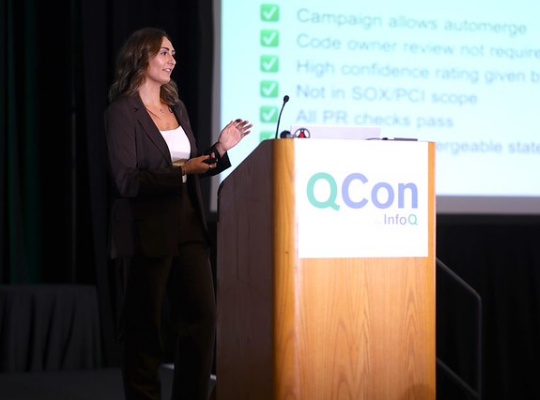
Casey Bleifer’s presentation on automating code changes at Netflix offers a compelling blueprint for organizations grappling with increasingly complex software deployments. The sheer scale of Netflix’s fleet – a diverse collection of services constantly evolving – makes their approach particularly valuable. Bleifer’s emphasis on an event-driven orchestration platform built from composable, "Lego-like" steps is a powerful shift away from monolithic, tightly coupled deployment processes. This modularity allows for greater flexibility, faster iteration, and crucially, easier rollback in case of issues. It’s a philosophy that resonates with the broader industry's move towards microservices and cloud-native architectures, and complements discussions around managing AI systems at scale, as explored in [Presentation: Beyond Prompting: Context Engineering and Memory Management for AI Systems at Scale]. The ability to rapidly and reliably deploy changes across such a vast system is a significant competitive advantage, and Bleifer’s insights provide a roadmap for others to pursue a similar level of agility.
The core innovation, however, lies not just in the architecture of the orchestration platform, but in the Netflix team’s rigorous automation of validation and compliance. The automated canary validation, coupled with custom compliance checks and a "confidence metric," directly addresses the “long tail” of manual engineering migrations – those unpredictable, often time-consuming interventions that can derail even the most carefully planned deployments. This focus on eliminating manual intervention is key to achieving true continuous delivery. Furthermore, the modular nature of their system aligns well with the challenges outlined in [Presentation: Building and Scaling UI Systems for Internal Tools at Meta], where consistency and automated updates across a large number of interconnected components are paramount. The Netflix approach implies a significant investment in tooling and automation, but the return – in terms of reduced risk, faster deployments, and freed-up engineering resources – is likely substantial.
Beyond the specific technologies and techniques employed, Bleifer’s presentation highlights a crucial cultural shift: embracing automation not as a replacement for engineers, but as a tool to empower them. The confidence metric, in particular, seems to be a clever mechanism for providing engineers with data-driven reassurance before pushing changes into production. It’s a move away from gut feeling and towards a more objective assessment of risk. This shift mirrors a broader trend in the industry, where DevOps and SRE practices are increasingly focused on creating systems that are both reliable and manageable, allowing engineers to focus on higher-value tasks rather than repetitive manual processes. The emphasis on composability also suggests a deep understanding of the importance of maintainability and scalability – qualities that are increasingly essential in today’s rapidly evolving technological landscape.
Ultimately, Netflix’s experience underscores the critical importance of investing in robust automation infrastructure, particularly as software fleets grow in size and complexity. The combination of event-driven architecture, automated validation, and a data-driven "confidence metric" represents a significant advancement in deployment practices. As organizations continue to adopt cloud-native technologies and embrace continuous delivery, the lessons learned from Netflix’s journey will become increasingly relevant. The question now is: how can organizations with less extensive resources and experience begin to implement similar principles, and what new tools and frameworks will emerge to facilitate this transformation?