Presentation: Trustworthy Productivity: Securing AI-Accelerated Development
Our take
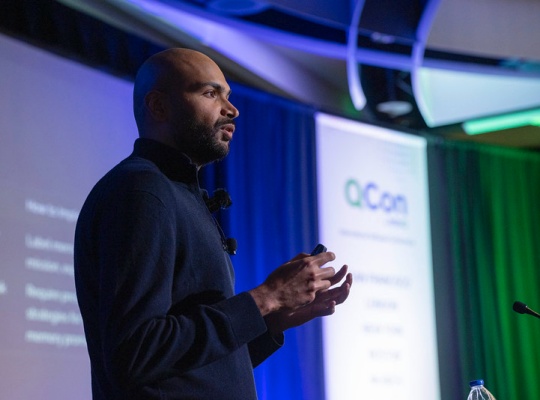
The rise of autonomous AI agents, powered by Large Language Models (LLMs), promises a significant leap in productivity across numerous sectors. However, as Sriram Madapusi Vasudevan’s presentation highlights, this progress isn't without substantial security risks. The vulnerabilities inherent within the ReAct loop – the cycle of reasoning, action, and observation – demand immediate and rigorous attention. We’re seeing a convergence of concerns, not unlike the debate around accessibility, which is increasingly understood as an operational capability, not a mere feature Why Accessibility Is An Operational Capability, Not A Feature. Just as accessibility requires ongoing investment and integration, securing AI agents necessitates a proactive, defense-in-depth approach. The potential for memory poisoning and rogue tool execution, as outlined by Madapusi Vasudevan, underscores the need to move beyond reactive security measures toward architectures that anticipate and mitigate threats. This is particularly relevant given the rapid proliferation of AI services, some of which are being offered at surprisingly competitive price points, as seen in comparisons of ChatGPT Plus, Claude Pro, and Gemini Pro The Best $20 AI Plan: ChatGPT Plus vs Claude Pro vs Gemini Pro. The increased accessibility shouldn't come at the cost of security.
Madapusi Vasudevan's proposed solutions – LLM-as-a-judge critics and MAESTRO threat modeling – offer a promising roadmap. The concept of using an LLM to scrutinize the reasoning and actions of another LLM is particularly insightful, creating a layered security approach that mirrors best practices in software development. Threat modeling, specifically leveraging MAESTRO, provides a structured framework for identifying and addressing potential vulnerabilities before they can be exploited. The fact that these strategies are converging into industry-standard patterns speaks to the growing recognition of the importance of AI security. It's not about halting innovation; it’s about ensuring that the power of AI is harnessed responsibly. We’ve recently seen examples of this need for robust agent isolation, with AWS launching Lambda MicroVMs designed to isolate agent and user code execution AWS Launches Lambda MicroVMs for Isolated Agent and User Code Execution, highlighting the practical implications of securing these environments.
The implications of inadequate AI agent security extend far beyond individual applications. A compromised autonomous agent could be leveraged to launch sophisticated attacks, manipulate data, or even disrupt critical infrastructure. The shift towards increasingly autonomous systems, particularly in areas like finance, healthcare, and transportation, amplifies the potential impact of these risks. Organizations deploying AI agents must adopt a security-first mindset, integrating robust safeguards into every stage of the development lifecycle. This requires not only technical expertise but also a cultural shift that prioritizes security over speed and convenience. The costs of a security breach, both financially and reputationally, far outweigh the investment in preventative measures.
Looking ahead, the evolution of AI security will likely involve a greater emphasis on formal verification techniques and the development of specialized security tools tailored to the unique challenges of LLMs. As AI agents become more complex and integrated into our lives, the need for verifiable safety and reliability will only intensify. A critical question remains: how can we effectively balance the pursuit of innovative AI capabilities with the imperative of ensuring their trustworthiness and security? The answers to this question will shape the future of AI and its impact on society.
Sriram Madapusi Vasudevan discusses industry-converging patterns for securing autonomous AI agents in production. He explains the critical vulnerabilities hidden inside the ReAct loop across context, reasoning, and tool execution. He shares how to mitigate risks like memory poisoning and rogue tool execution using defense-in-depth strategies, LLM-as-a-judge critics, and MAESTRO threat modeling.
By Sriram Madapusi VasudevanRead on the original site
Open the publisher's page for the full experience