RAG precision tuning can quietly cut retrieval accuracy by 40%, putting agentic pipelines at risk
Our take
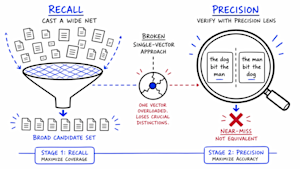
The recent research from Redis sheds light on a critical, yet often overlooked, challenge in fine-tuning Retrieval-Augmented Generation (RAG) embedding models. The findings indicate that efforts to enhance precision can inadvertently compromise retrieval quality, resulting in significant accuracy drops—up to 40% in some cases. This issue is especially pertinent for enterprise teams relying on agentic AI pipelines, where the integrity of retrieval directly influences the entire reasoning process. Such revelations align with ongoing discussions about the evolving landscape of enterprise RAG, as highlighted in pieces like The retrieval rebuild: Why hybrid retrieval intent tripled as enterprise RAG programs hit the scale wall.
The heart of the matter lies in the nuanced balance between precision and generalization. When teams train models for compositional sensitivity—the ability to discern subtle differences in sentence meaning—they may inadvertently hinder the broader retrieval capabilities that underpin effective AI-driven applications. This regression can easily go unnoticed, as traditional metrics focus on the task at hand, failing to scrutinize the model’s performance across diverse topics and contexts. As Srijith Rajamohan, an AI Research Leader at Redis, articulates, there’s a misconception that high semantic similarity guarantees accurate intent. This misunderstanding can lead to a cascade of errors in decision-making processes, particularly in sensitive environments where precision is paramount.
The research highlights a crucial architectural consideration: the need for a two-stage retrieval process. By separating the recall and precision tasks, teams can enhance retrieval quality without sacrificing the foundational benefits of embedding models. This approach not only emphasizes the importance of context but also provides a more robust framework for addressing structural mismatches that standard models often overlook. As organizations strive to optimize their AI pipelines, understanding this distinction becomes vital. The implications extend beyond mere technical adjustments; they challenge existing assumptions about model readiness and effectiveness, urging teams to rigorously evaluate their metrics and operational outcomes.
Looking ahead, the research underscores an urgent need for enterprise teams to rethink their approaches to embedding models and retrieval systems. The two-stage architecture proposed offers a promising pathway, but it also introduces complexities related to latency and implementation. As businesses navigate these changes, the question remains: How will they balance the pursuit of precision with the operational demands of their applications? The evolving nature of data management and AI integration will continue to present both challenges and opportunities for innovation. As we observe these developments, it’s vital for teams to remain vigilant, adaptable, and proactive in their pursuit of reliable, effective AI solutions that truly empower their workflows.
Enterprise teams that fine-tune their RAG embedding models for better precision may be unintentionally degrading the retrieval quality those pipelines depend on, according to new research from Redis.
The paper, "Training for Compositional Sensitivity Reduces Dense Retrieval Generalization," tested what happens when teams train embedding models for compositional sensitivity. That is the ability to catch sentences that look nearly identical but mean something different — "the dog bit the man" versus "the man bit the dog," or a negation flip that reverses a statement's meaning entirely. That training consistently broke dense retrieval generalization, how well a model retrieves correctly across broad topics and domains it wasn't specifically trained on. Performance dropped by 8 to 9 percent on smaller models and by 40 percent on a current mid-size embedding model teams are actively using in production. The findings have direct implications for enterprise teams building agentic AI pipelines, where retrieval quality determines what context flows into an agent's reasoning chain. A retrieval error in a single-stage pipeline returns a wrong answer. The same error in an agentic pipeline can trigger a cascade of wrong actions downstream.
Srijith Rajamohan, AI Research Leader at Redis and one of the paper's authors, said the finding challenges a widespread assumption about how embedding-based retrieval actually works.
"There's this general notion that when you use semantic search or similar semantic similarity, we get correct intent. That's not necessarily true," Rajamohan told VentureBeat. "A close or high semantic similarity does not actually mean an exact intent."
The geometry behind the retrieval tradeoff
Embedding models work by compressing an entire sentence into a single point in a high-dimensional space, then finding the closest points to a query at retrieval time. That works well for broad topical matching — documents about similar subjects end up near each other. The problem is that two sentences with nearly identical words but opposite meanings also end up near each other, because the model is working from word content rather than structure.
That is what the research quantified. When teams fine-tune an embedding model to push structurally different sentences apart — teaching it that a negation flip which reverses a statement's meaning is not the same as the original — the model uses representational space it was previously using for broad topical recall. The two objectives compete for the same vector. The research also found the regression is not uniform across failure types. Negation and spatial flip errors improved measurably with structured training. Binding errors — where a model confuses which modifier applies to which word, such as which party a contract obligation falls on — barely moved. For enterprise teams, that means the precision problem is harder to fix in exactly the cases where getting it wrong has the most consequences.
The reason most teams don't catch it is that fine-tuning metrics measure the task being trained for, not what happens to general retrieval across unrelated topics. A model can show strong improvement on near-miss rejection during training while quietly regressing on the broader retrieval job it was hired to do. The regression only surfaces in production.
Rajamohan said the instinct most teams reach for — moving to a larger embedding model — does not address the underlying architecture. "You can't scale your way out of this," he said. "It's not a problem you can solve with more dimensions and more parameters."
Why the standard alternatives all fall short
The natural instinct when retrieval precision fails is to layer on additional approaches. The research tested several of them and found each fails in a different way.
Hybrid search. Combining embedding-based retrieval with keyword search is already standard practice for closing precision gaps. But Rajamohan said keyword search cannot catch the failure mode this research identifies, because the problem is not missing words — it is misread structure. "If you have a sentence like 'Rome is closer than Paris' and another that says 'Paris is closer than Rome,' and you do an embedding retrieval followed by a text search, you're not going to be able to tell the difference," he said. "The same words exist in both sentences."
MaxSim reranking. Some teams add a second scoring layer that compares individual query words against individual document words rather than relying on the single compressed vector. This approach, known as MaxSim or late interaction and used in systems like ColBERT, did improve relevance benchmark scores in the research. But it completely failed to reject structural near-misses, assigning them near-identity similarity scores.
The problem is that relevance and identity are different objectives. MaxSim is optimized for the former and blind to the latter. A team that adds MaxSim and sees benchmark improvement may be solving a different problem than the one they have.
Cross-encoders. These work by feeding the query and candidate document into the model simultaneously, letting it compare every word against every word before making a decision. That full comparison is what makes them accurate — and what makes them too expensive to run at production scale. Rajamohan said his team investigated them. They work in the lab and break under real query volumes.
Contextual memory. Also sometimes referred to as agentic memory, these systems are increasingly cited as the path beyond RAG, but Rajamohan said moving to that type of architecture does not eliminate the structural retrieval problem. Those systems still depend on retrieval at query time, which means the same failure modes apply. The main difference is looser latency requirements, not a precision fix.
The two-stage fix the research validated
The common thread across every failed approach is the same: a single scoring mechanism trying to handle both recall and precision at once. The research validated a different architecture: stop trying to do both jobs with one vector, and assign each job to a dedicated stage.
Stage one: recall. The first stage works exactly as standard dense retrieval does today — the embedding model compresses documents into vectors and retrieves the closest matches to a query. Nothing changes here. The goal is to cast a wide net and bring back a set of strong candidates quickly. Speed and breadth are what matter at this stage, not perfect precision.
Stage two: precision. The second stage is where the fix lives. Rather than scoring candidates with a single similarity number, a small learned Transformer model examines the query and each candidate at the token level — comparing individual words against individual words to detect structural mismatches like negation flips or role reversals. This is the verification step the single-vector approach cannot perform.
The results. Under end-to-end training, the Transformer verifier outperformed every other approach the research tested on structural near-miss rejection. It was the only approach that reliably caught the failure modes the single-vector system missed.
The tradeoff. Adding a verification stage costs latency. The latency cost depends on how much verification a team runs. For precision-sensitive workloads like legal or accounting applications, full verification at every query is warranted. For general-purpose search, lighter verification may be sufficient.
The research grew out of a real production problem. Enterprise customers running semantic caching systems were getting fast but semantically incorrect responses back — the retrieval system was treating similar-sounding queries as identical even when their meaning differed. The two-stage architecture is Redis's proposed fix, with incorporation into its LangCache product on the roadmap but not yet available to customers.
What this means for enterprise teams
The research does not require enterprise teams to rebuild their retrieval pipelines from scratch. But it does ask them to pressure-test assumptions most teams have never examined — about what their embedding models are actually doing, which metrics are worth trusting and where the real precision gaps live in production.
Recognize the tradeoff before tuning around it. Rajamohan said the first practical step is understanding the regression exists. He evaluates any LLM-based retrieval system on three criteria: correctness, completeness and usefulness. Correctness failures cascade directly into the other two, which means a retrieval system that scores well on relevance benchmarks but fails on structural near-misses is producing a false sense of production readiness.
RAG is not obsolete — but know what it can't do. Rajamohan pushed back firmly on claims that RAG has been superseded. "That's a massive oversimplification," he said. "RAG is a very simple pipeline that can be productionized by almost anyone with very little lift." The research does not argue against RAG as an architecture. It argues against assuming a single-stage RAG pipeline with a fine-tuned embedding model is production-ready for precision-sensitive workloads.
The fix is real but not free. For teams that do need higher precision, Rajamohan said the two-stage architecture is not a prohibitive implementation lift, but adding a verification stage costs latency. "It's a mitigation problem," he said. "Not something we can actually solve."
Read on the original site
Open the publisher's page for the full experience