Seizing the Moment: The Hidden Silhouette of Data
Our take
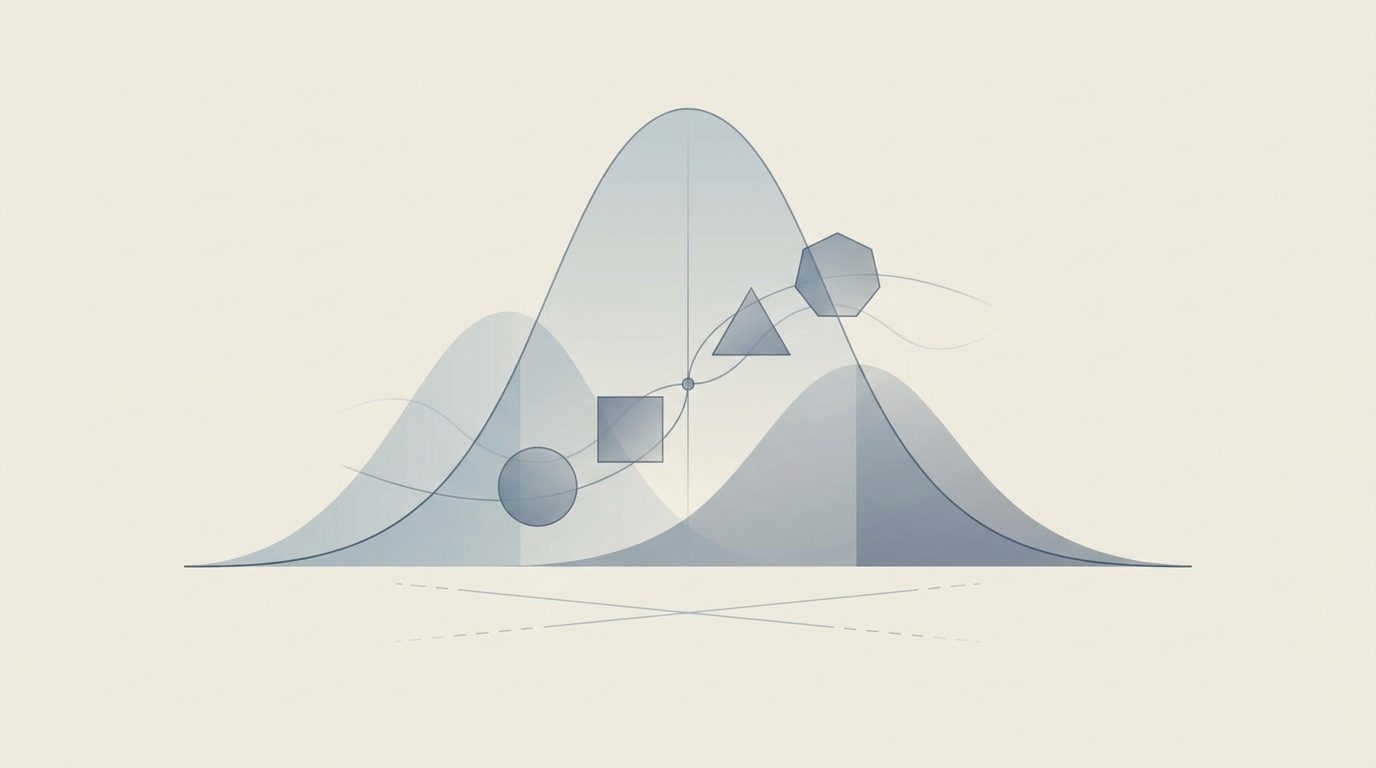
The recent Towards Data Science piece, "Seizing the Moment: The Hidden Silhouette of Data," offers a valuable, albeit somewhat technical, refresher on statistical moments. It’s a reminder that the seemingly disparate concepts of mean, variance, and even higher-order statistical measures are fundamentally interconnected, forming a cohesive framework for understanding data distributions. While the article dives into the mathematical underpinnings, its core message resonates strongly with anyone working with data – from analysts building predictive models to business leaders seeking actionable insights. This understanding is crucial, particularly as we move towards increasingly complex datasets and AI-driven decision-making. For those seeking a broader perspective on statistical analysis, exploring articles like Understanding Statistical Moments from NIST can provide a more detailed historical context, and for those looking to apply these concepts in practical machine learning scenarios, Moments and Data Distribution offers a helpful guide. The article’s strength lies in highlighting that these moments aren't isolated calculations; they are pieces of a larger puzzle that, when assembled, paint a much richer picture of the data’s characteristics.
The significance of this isn't merely academic. The ability to accurately characterize a data distribution – to understand its central tendency, its spread, and its shape – is foundational to nearly every data-driven endeavor. Consider anomaly detection: a robust understanding of the data's moments allows for the creation of more accurate thresholds for identifying outliers. Similarly, in model building, knowing the moments of the input data can inform feature engineering choices and model selection. Traditional spreadsheet tools often treat these calculations as separate functions, obscuring this underlying connection. Our approach to AI-native spreadsheets is to inherently reveal this interconnectedness, allowing users to intuitively grasp the relationships between these key statistical measures and leverage them for deeper insights. The “hidden silhouette,” as the article aptly puts it, is a critical element in transforming raw data into actionable intelligence. We believe that democratizing this understanding – making it accessible to a wider audience – is a key step in unlocking the full potential of data.
Furthermore, the concept of statistical moments extends beyond simple descriptive statistics. Higher-order moments, such as skewness and kurtosis, provide insights into the asymmetry and "tailedness" of a distribution, which are crucial for assessing the validity of assumptions in many statistical tests and modeling techniques. Ignoring these higher-order moments can lead to inaccurate conclusions and flawed decision-making. The article’s emphasis on the interconnectedness of these moments underscores the importance of a holistic approach to data analysis. It’s a reminder that superficial analysis can be misleading and that true understanding requires delving deeper into the underlying statistical properties of the data. The current trend towards automated data exploration tools often glosses over these nuances, presenting users with pre-packaged insights without providing the underlying statistical context. We champion a different approach: empowering users to explore and understand the data themselves, providing the tools and knowledge to interpret the results with confidence.
Looking ahead, we anticipate a growing need for tools that can automatically calculate and visualize statistical moments in real-time, particularly as datasets become increasingly complex and high-dimensional. The ability to dynamically adjust parameters and observe the impact on the data distribution will be essential for iterative model building and exploratory data analysis. A key question to watch is how these statistical concepts will be integrated into the burgeoning field of generative AI. Will models be trained to explicitly understand and manipulate data moments to generate more realistic and controllable synthetic datasets? Or will these moments remain a largely implicit factor in the generative process? The answers to these questions will undoubtedly shape the future of data science and the way we interact with information.
How statistical moments connect the mean, the variance, and higher powers of a distribution
The post Seizing the Moment: The Hidden Silhouette of Data appeared first on Towards Data Science.
Read on the original site
Open the publisher's page for the full experience