Slack Eliminates SSH in EMR Pipelines, Migrates 700+ Jobs to Rest-Based Architecture
Our take
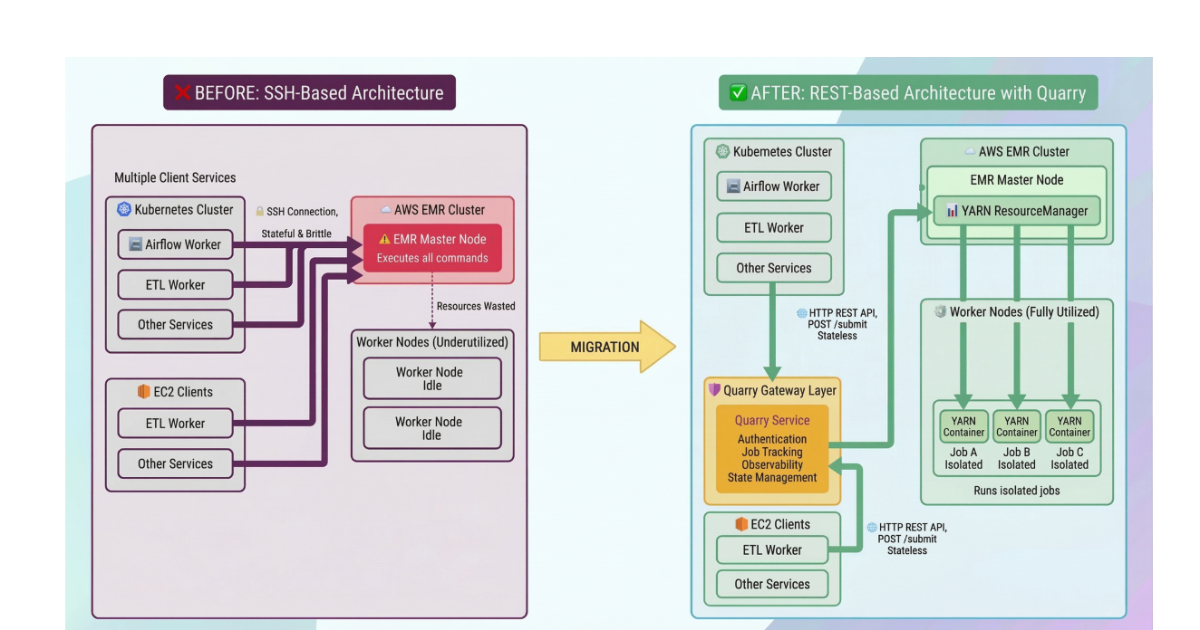
Slack’s recent migration away from SSH-based execution in their Amazon EMR pipelines to a REST-driven architecture, dubbed Quarry, is a significant development deserving of closer examination. The sheer scale of the undertaking – 700+ Airflow operators – underlines both the complexity of their data platform and the ambition of their modernization efforts. This move isn’t just about swapping out a technology; it’s a strategic shift towards enhanced security, reliability, and observability, all critical factors in a data-intensive environment. It echoes a broader trend within organizations grappling with the legacy of SSH access for data processing, often a source of security vulnerabilities and operational headaches. The move aligns with similar efforts in the AI space, as demonstrated by Google’s recent launch of the Colab CLI [Google Launches Colab CLI for Developers, Automation, and AI Agents] which allows for more streamlined automation and interaction with AI agents, signaling a move toward more accessible and programmable data workflows. Understanding this shift requires acknowledging that while SSH provided initial flexibility, its inherent risks and limitations are increasingly outweighing its benefits in modern, large-scale data pipelines.
The benefits outlined in the article – improved security by eliminating direct SSH access, enhanced reliability through a server-side job lifecycle model, and increased observability – are all compelling. Security is paramount, and removing the attack surface presented by SSH is a crucial step. The shift to a REST-based architecture enables more granular control over job execution, allowing for better monitoring, error handling, and resource management. This resonates with the increasing importance of robust and auditable data governance practices. Interestingly, this mirrors discussions around the broader implications of humanoid robots [The Impact Of Humanoid Robots On Humanity] and their increasing role in automation; both represent a move toward more controlled and actively managed systems, leaving behind the ad-hoc nature of earlier approaches. The ability to implement a server-side job lifecycle, in particular, suggests a move towards a more declarative, repeatable, and ultimately more trustworthy data processing environment.
What’s truly noteworthy is Slack’s commitment to modernizing its infrastructure at such a substantial scale. Many organizations shy away from large-scale migrations, opting for incremental improvements instead. Slack’s decision demonstrates a willingness to embrace a more transformative approach, acknowledging that maintaining legacy systems can ultimately hinder innovation and increase operational costs. The success of Quarry highlights the feasibility of migrating complex, established data pipelines to more modern architectures, which is an encouraging sign for others facing similar challenges. The technical implementation details, while not fully explored in the article, likely involved significant refactoring and automation efforts, emphasizing the importance of investing in the right tools and expertise. It’s a testament to the power of thoughtful orchestration and clearly defined architectural principles. The development and release of projects like hubert.cpp [hubert.cpp, a C++ implementation of distilHuBERT [P]] further underscores the broader movement towards more efficient and customizable data-processing tools.
Looking ahead, the success of Slack’s Quarry migration raises an important question: how can organizations effectively balance the need for flexibility and agility with the imperative of security and reliability in their data pipelines? The move towards REST-driven orchestration and server-side job lifecycles represents a significant step in that direction, but it’s likely just the beginning. We can anticipate further innovation in data orchestration tools and techniques, driven by the increasing demands of AI-powered applications and the need for more transparent, auditable, and secure data processing environments. The future likely holds more sophisticated approaches to data pipeline management, blurring the lines between infrastructure and application logic, and requiring new skillsets for data engineers and architects.
Slack modernized its data platform by replacing SSH based execution in Amazon EMR pipelines with a REST driven orchestration layer called Quarry. The migration covered 700 plus Airflow operators, improving security, reliability, and observability while eliminating direct SSH access across production clusters and enabling a server side job lifecycle model.
By Leela KumiliRead on the original site
Open the publisher's page for the full experience