Stop Writing Loops in Pandas: 7 Faster Alternatives to Try
Our take
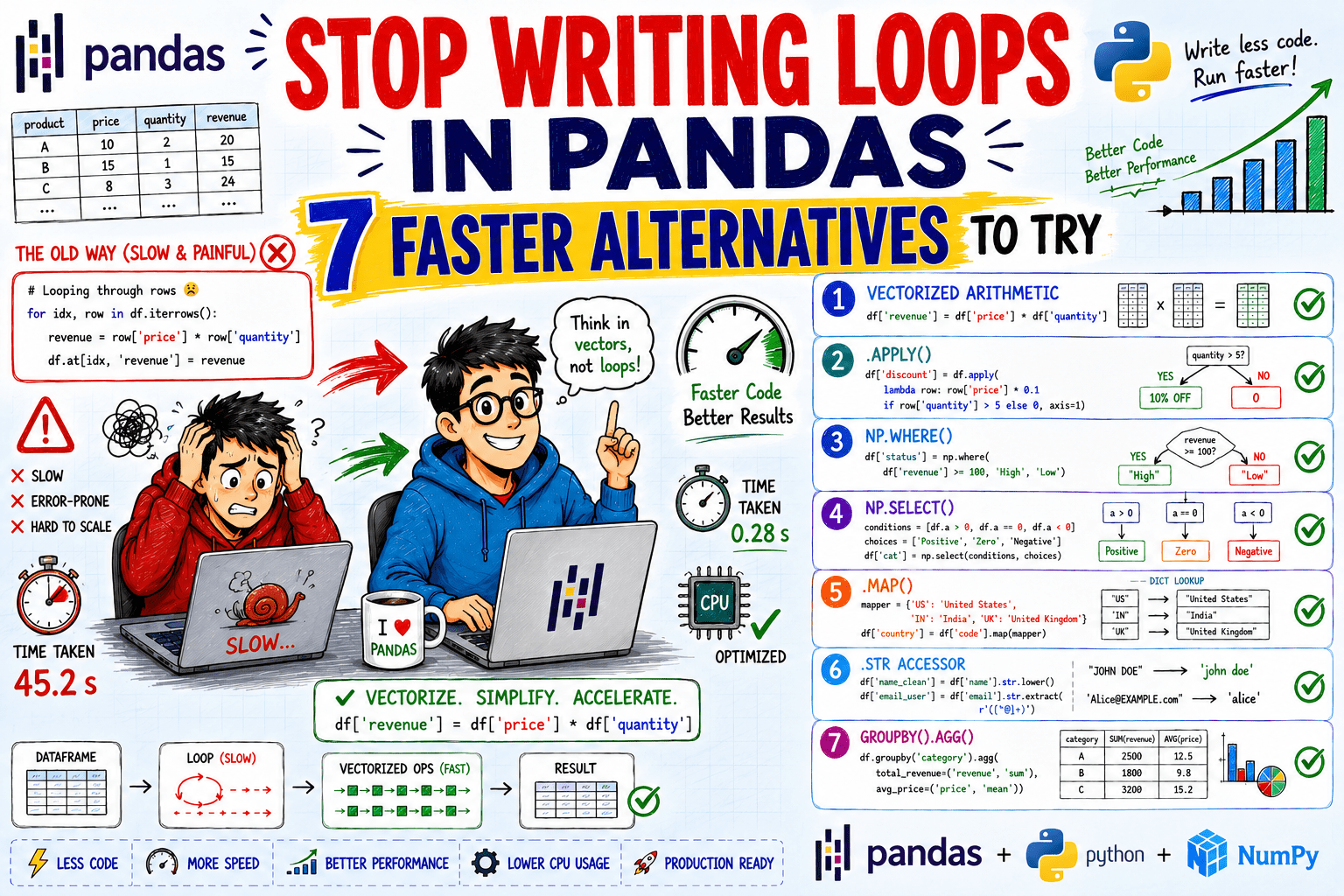
The relentless pursuit of efficiency in data processing is a constant undercurrent in the world of data science, and the recent article, "Stop Writing Loops in Pandas: 7 Faster Alternatives to Try," speaks directly to that imperative. For many data professionals, especially those transitioning from more traditional programming backgrounds, the instinct to use loops within Pandas for data manipulation is natural. However, as the article rightly points out, this practice often becomes a significant bottleneck. The performance gains offered by leveraging Pandas’ built-in vectorized operations, or exploring alternatives like `apply`, `transform`, `map`, `vectorize`, `numba`, and `cython`, are simply too substantial to ignore. It's a reminder that while Pandas provides a familiar interface, truly unlocking its power requires embracing its vectorized nature and understanding the underlying computational principles. This shift aligns with broader trends; we’re seeing a significant focus on optimizing AI workflows, as evidenced by recent news like [ChatGPT’s market share slips below 50% for first time], demonstrating the increasing competition and demand for more efficient AI tools – a need that extends to the foundational data processing tasks Pandas handles.
The significance of this advice isn't merely about shaving off milliseconds in a single script. It’s about scaling operations to handle increasingly large datasets, a reality for most modern data science projects. The ability to process terabytes of data efficiently is becoming a baseline expectation, not a luxury. The article's focus on alternatives to loops directly addresses this scalability challenge. Consider, too, the context of rapidly evolving database technologies. The recent announcement of [PostgreSQL 19 Beta Introduces SQL Graph Queries and Concurrent Table Repacking] highlights the advancements being made in database performance and scalability, forcing data scientists to critically evaluate their data processing strategies across the entire data pipeline. As data volumes continue to increase and the demand for real-time insights grows, optimizing Pandas workflows will become even more crucial. Furthermore, the potential for integrating AI components into these workflows is amplified when data can be processed faster, a point reflected in the news about [SpaceX to acquire Cursor for $60B in stock, days after blockbuster IPO] – a move intended to bolster AI capabilities, which inherently relies on efficient data management.
Beyond the immediate performance benefits, this shift toward vectorized operations reflects a broader paradigm change in how we approach data manipulation. It moves away from an imperative, line-by-line approach towards a more declarative style, where you specify *what* you want to achieve rather than *how* to achieve it. This declarative style not only improves performance but also often leads to more readable and maintainable code. The article's exploration of `numba` and `cython` is particularly noteworthy, as it acknowledges the need for even deeper optimization in certain scenarios. While these tools introduce a slightly steeper learning curve, the potential for dramatic performance improvements makes them worthwhile investments for data scientists working with computationally intensive tasks. The key takeaway is adopting a mindset of continuous optimization, constantly evaluating and refining your data processing techniques to ensure they align with the evolving demands of the field.
Looking ahead, the emphasis on efficient data processing will only intensify. We can anticipate further advancements in vectorized operations within Pandas, as well as the emergence of new tools and techniques designed to accelerate data manipulation. The rise of specialized hardware, such as GPUs and TPUs, will also play a role, potentially requiring data scientists to adapt their workflows to leverage these capabilities. The question then becomes: how will these advancements reshape the skillset required of data scientists, and what new paradigms will emerge to further streamline the data processing pipeline? It's a landscape ripe for innovation, and one that demands a proactive and adaptive approach from anyone working with data.
Read on the original site
Open the publisher's page for the full experience