The modern data stack was built for humans asking questions. Google just rebuilt its for agents taking action.
Our take
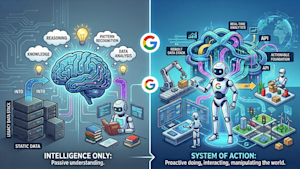
Enterprise data stacks were built for humans running scheduled queries. As AI agents increasingly act autonomously on behalf of businesses around the clock, that architecture is breaking down — and vendors are racing to rebuild it. Google's answer, announced at Cloud Next on Wednesday, is the Agentic Data Cloud.
The architecture has three pillars:
Knowledge Catalog. Automates semantic metadata curation, inferring business logic from query logs without manual data steward intervention
Cross-cloud lakehouse. Lets BigQuery query Iceberg tables on AWS S3 via private network with no egress fees
Data Agent Kit. Drops MCP tools into VS Code, Claude Code and Gemini CLI so data engineers describe outcomes rather than write pipelines
"The data architecture has to change now," Andi Gutmans, VP and GM of Data Cloud at Google Cloud, told VentureBeat. "We're moving from human scale to agent scale."
From system of intelligence to system of action
The core premise behind Agentic Data Cloud is that enterprises are moving from human‑scale to agent‑scale operations.
Historically, data platforms have been optimized for reporting, dashboarding, and some forecasting — what Google characterizes as “reactive intelligence.” In that model, humans interpret data and decide what to do.
Now, with AI agents increasingly expected to take actions directly on behalf of the business, Gutmans argued that data platforms must evolve into systems of action. "We need to make sure that all of enterprise data can be activated with AI, that includes both structured and unstructured data," Gutmans said. "We need to make sure that there's the right level of trust, which also means it's not just about getting access to the data, but really understanding the data."
The Knowledge Catalog is Google's answer to that problem. It is an evolution of Dataplex, Google's existing data governance product, with a materially different architecture underneath. Where traditional data catalogs required data stewards to manually label tables, define business terms and build glossaries, the Knowledge Catalog automates that process using agents.
The practical implication for data engineering teams is that the Knowledge Catalog scales to the full data estate, not just the curated subset that a small team of data stewards can maintain by hand. The catalog covers BigQuery, Spanner, AlloyDB and Cloud SQL natively, and federates with third-party catalogs including Collibra, Atlan and Datahub. Zero-copy federation extends semantic context from SaaS applications including SAP, Salesforce Data360, ServiceNow and Workday without requiring data movement.
Google's lakehouse goes cross cloud
Google has had a data lakehouse called BigLake since 2022. Initially it was limited to just Google data, but in recent years has had some limited federation capabilities enabling enterprises to query data found in other locations.
Gutmans explained that the previous federation worked through query APIs, which limited the features and optimizations BigQuery could bring to bear on external data. The new approach is storage-based sharing via the open Apache Iceberg format. That means whether the data is in Amazon S3 or in Google Cloud , he argued it doesn't make a difference. "This truly means we can bring all the goodness and all the AI capabilities to those third-party data sets," he said.
The practical result is that BigQuery can query Iceberg tables sitting on Amazon S3 via Google's Cross-Cloud Interconnect, a dedicated private networking layer, with no egress fees and price-performance Google says is comparable to native AWS warehouses. All BigQuery AI functions run against that cross-cloud data without modification. Bidirectional federation in preview extends to Databricks Unity Catalog on S3, Snowflake Polaris and the AWS Glue Data Catalog using the open Iceberg REST Catalog standard.
From writing pipelines to describing outcomes
The Knowledge Catalog and cross-cloud lakehouse solve the data access and context problems. The third pillar addresses what happens when a data engineer actually sits down to build something with all of it.
The Data Agent Kit ships as a portable set of skills, MCP tools and IDE extensions that drop into VS Code, Claude Code, Gemini CLI and Codex. It does not introduce a new interface.
The architectural shift it enables is a move from what Gutmans called a "prescriptive copilot experience" to intent-driven engineering. Rather than writing a Spark pipeline to move data from source A to destination B, a data engineer describes the outcome — a cleaned dataset ready for model training, a transformation that enforces a governance rule — and the agent selects whether to use BigQuery, the Lightning Engine for Apache Spark or Spanner to execute it, then generates production-ready code.
"Customers are kind of sick of building their own pipelines," Gutmans said. "They're truly more in the review kind of mode, than they are in the writing the code mode."
Where Google and its rivals diverge
The premise that agents require semantic context, not just data access, is shared across the market.
Databricks has Unity Catalog, which provides governance and a semantic layer across its lakehouse. Snowflake has Cortex, its AI and semantic layer offering. Microsoft Fabric includes a semantic model layer built for business intelligence and, increasingly, agent grounding.
The dispute is not over whether semantics matter — everyone agrees they do. The dispute is over who builds and maintains them.
"Our goal is just to get all the semantics you can get," he explained, noting that Google will federate with third-party semantic models rather than require customers to start over.
Google is also positioning openness as a differentiator, with bidirectional federation into Databricks Unity Catalog and Snowflake Polaris via the open Iceberg REST Catalog standard.
What this means for enterprises
Google's argument — and one echoed across the data infrastructure market — is that enterprises are behind on three fronts:
Semantic context is becoming infrastructure. If your data catalog is still manually curated, it will not scale to agent workloads — and Gutmans argues that gap will only widen as agent query volumes increase.
Cross-cloud egress costs are a hidden tax on agentic AI. Storage-based federation via open Iceberg standards is emerging as the architectural answer across Google, Databricks and Snowflake. Enterprises locked into proprietary federation approaches should be stress-testing those costs at agent-scale query volumes.
Gutmans argues the pipeline-writing era is ending. Data engineers who move toward outcome-based orchestration now will have a significant head start.
Read on the original site
Open the publisher's page for the full experience
Related Articles
- Google and AWS split the AI agent stack between control and executionThe era of enterprises stitching together prompt chains and shadow agents is nearing its end as more options for orchestrating complex multi-agent systems emerge. As organizations move AI agents into production, the question remains: "how will we manage them?" Google and Amazon Web Services offer fundamentally different answers, illustrating a split in the AI stack. Google’s approach is to run agentic management on the system layer, while AWS’s harness method sets up in the execution layer. The debate on how to manage and control gained new energy this past month as competing companies released or updated their agent builder platforms—Anthropic with the new Claude Managed Agents and OpenAI with enhancements to the Agents SDK—giving developer teams options for managing agents. AWS with new capabilities added to Bedrock AgentCore is optimizing for velocity—relying on harnesses to bring agents to product faster—while still offering identity and tool management. Meanwhile, Google’s Gemini Enterprise adopts a governance-focused approach using a Kubernetes-style control plane. Each method offers a glimpse into how agents move from short-burst task helpers to longer-running entities within a workflow. Upgrades and umbrellas To understand where each company stands, here’s what’s actually new. Google released a new version of Gemini Enterprise, bringing its enterprise AI agent offerings—Gemini Enterprise Platform and Gemini Enterprise Application—under one umbrella. The company has rebranded Vertex AI as Gemini Enterprise Platform, though it insists that, aside from the name change and new features, it’s still fundamentally the same interface. “We want to provide a platform and a front door for companies to have access to all the AI systems and tools that Google provides,” Maryam Gholami, senior director, product management for Gemini Enterprise, told VentureBeat in an interview. “The way you can think about it is that the Gemini Enterprise Application is built on top of the Gemini Enterprise Agent Platform, and the security and governance tools are all provided for free as part of Gemini Enterprise Application subscription.” On the other hand, AWS added a new managed agent harness to Bedrock Agentcore. The company said in a press release shared with VentureBeat that the harness “replaces upfront build with a config-based starting point powered by Strands Agents, AWS’s open source agent framework.” Users define what the agent does, the model it uses and the tools it calls, and AgentCore does the work to stitch all of that together to run the agent. Agents are now becoming systems The shift toward stateful, long-running autonomous agents has forced a rethink of how AI systems behave. As agents move from short-lived tasks to long-running workflows, a new class of failure is emerging: state drift. As agents continue operating, they accumulate state—memory, too, responses and evolving context. Over time, that state becomes outdated. Data sources change, or tools can return conflicting responses. But the agent becomes more vulnerable to inconsistencies and becomes less truthful. Agent reliability becomes a systems problem, and managing that drift may need more than faster execution; it may require visibility and control. It’s this failure point that platforms like Gemini Enterprise and AgentCore try to prevent. Though this shift is already happening, Gholami admitted that customers will dictate how they want to run and control any long-running agent. “We are going to learn a lot from customers where they would be using long-running agents, where they just assign a task to these autonomous agents to just go ahead and do,” Gholami said. “Of course, there are tricks and balances to get right and the agent may come back and ask for more input.” The new AI stack What’s becoming increasingly clear is that the AI stack is separating into distinct layers, solving different problems. AWS and, to a certain extent, Anthropic and OpenAI, optimize for faster deployment. Claude Managed Agents abstracts much of the backend work for standing up an agent, while the Agents SDK now includes support for sandboxes and a ready-made harness. These approaches aim to lower the barrier to getting agents up and running. Google offers a centralized control panel to manage identity, enforce policies and monitor long-running behaviors. Enterprises likely need both. As some practitioners see it, their businesses have to have a serious conversation on how much risk they are willing to take. “The main takeaway for enterprise technology leaders considering these technologies at the moment may be formulated this way: while the agent harness vs. runtime question is often perceived as build vs. buy, this is primarily a matter of risk management. If you can afford to run your agents through a third-party runtime because they do not affect your revenue streams, that is okay. On the contrary, in the context of more critical processes, the latter option will be the only one to consider from a business perspective,” Rafael Sarim Oezdemir, head of growth at EZContacts, told VentureBeat in an email. Iterating quickly lets teams experiment and discover what agents can do, while centralized control adds a layer of trust. What enterprises need is to ensure they are not locked into systems designed purely for a single way of executing agents.
- AWS Quick's personal knowledge graph is making orchestration decisions most control planes can't seeEnterprise AI teams running centralized orchestration stacks now have a new variable to account for: AWS Quick, which expanded this week to a desktop-native agent that builds a persistent personal knowledge graph and executes actions across local files and SaaS tools — outside the visibility of most control planes. Unlike chat-based copilots that reset with each session, Quick now maintains a continuously updated knowledge graph built from the user's local files, calendar, email and connected SaaS apps. It uses it to proactively trigger actions without waiting to be asked. AWS launched Quick in October last year as an alternative to AI workflow and productivity platforms coming from Google, OpenAI and Anthropic. It was a way for enterprise employees to access insights from connected applications, an agent builder, deep research, and workflow automation. Now, it’s grown beyond a simple AI assistant and acts more as a proactive workflow agent with a stateful, real-time knowledge graph of the user. It integrates with third-party apps like Google Workspace, Microsoft 365, Zoom, Salesforce and Slack — and now local files — so the agent can gather context and take actions. “What we’ve been hearing is that many enterprises have not been happy with how difficult it is to get context from their legacy tools,” Jigar Thakkar, vice president of Quick Suite at AWS, told VentureBeat in an interview. “Our vision is that Quick is a desktop experience that is the one place where people can go to get all their information and tasks.” Governance blindspots Enterprises often put orchestration layers at the center to help guide and manage agents. Context is pulled in, decisions are made, and then actions are executed within defined system boundaries. Recent releases like Anthropic’s Claude Managed Agents or updates to OpenAI’s Agent SDK also push for more stateless, autonomous agents within enterprise workflows, but still operate within defined orchestration boundaries. Quick still operates under enterprise controls, something that AWS has always underscored with its AI products, so actions taken on Quick remain bound by permissions, identity and security. Integrations remain managed by either an API or an MCP connection. However, this evolution of Quick introduces a more subtle shift in the decision layer. AWS updated Quick to build a personal knowledge graph that learns more about the user the more they interact with the platform. It builds a profile based on how they use local files, calendar, email or third-party app integrations to proactively suggest actions such as reminding a team leader to set up check-ins. Enterprises should be wary that a kind of shadow orchestration could arise in a system like this. The personalized context means the decision layer focuses on implicit triggers rather than set workflows, user-specific interpretations, and different action timings. Practitioners are rightfully wary of this much autonomy, understanding that shadow orchestration may not be something completely under their control. Upal Saha, co-founder and CTO of Bem, told VentureBeat in an email that platforms like AWS Bedrock AgentCore, its managed agent runtime, and similar ones from Salesforce "maximize autonomy rather than accountability" so enterprises are not losing agent visibility by accident. "When you deploy an agent that reasons its way to a decision across multiple steps, you have already accepted that you will not be able to fully explain what happened after the fact," Saha said. "That is fine for a demo. It is not fine for a claims processing pipeline or a financial workflow where a regulator can ask you to produce a complete audit trail for every automated decision made in the last three years." AWS said the platform's governance model is designed to address these concerns. “Users can set up different agents and automated workflows tailored to their role — things like monitoring tickets, pulling data from connected systems, or drafting docs — all managed within a governed environment where IT retains control over what's connected and what data flows where. It's designed to give individual users flexibility while keeping enterprise-level oversight in place,” an AWS spokesperson said. A possible blueprint Quick’s evolution from an AI assistant to something more proactive represents a possible approach some enterprise software providers will take to deep AI agent integration into workflows. While what AWS wants to accomplish with Quick—better context from apps and local files and a strong understanding of what its users actually want to do—is not unique, it isn’t focusing on traditional orchestration. Instead, it’s relying on context-driven agent management. This market tension is growing, as evidenced by the release of similar platforms. Mistral, for example, announced Workflows the same day as the updates to Quick. That platform uses a more traditional orchestration framework. Stateful and personalized agents continue to evolve, and so do the questions around how enterprises govern them.