Top 7 Coding Models You Can Run Locally in 2026
Our take
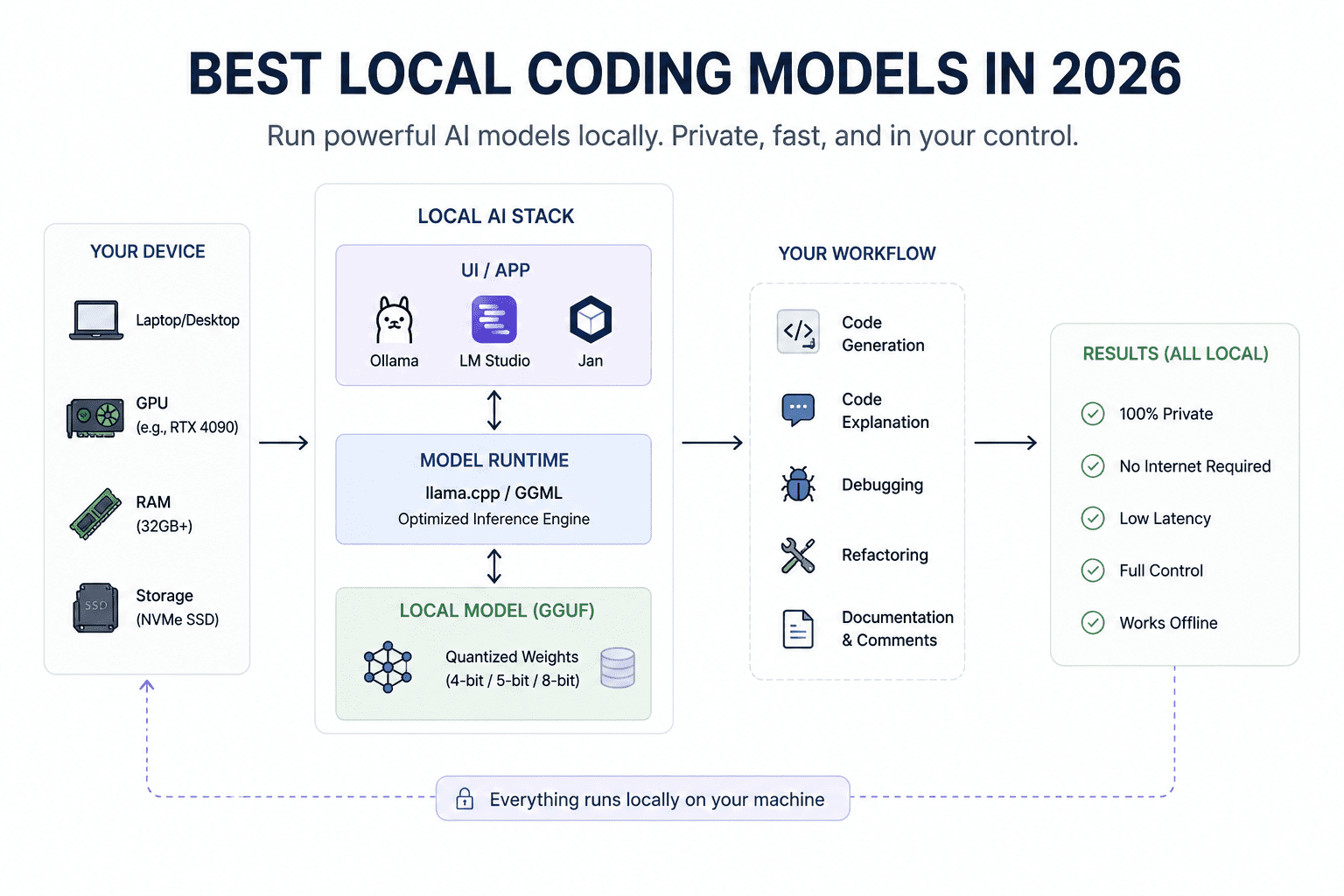
The emergence of powerful coding models capable of running locally is a significant shift, particularly as we look toward 2026. The article highlighting the top 7 models signals a move away from solely cloud-dependent AI development and towards greater user control and privacy. This aligns with a growing need for data security and customization, especially as organizations grapple with the complexities of AI governance. The ability to execute these models on personal hardware—specifically, leveraging GPUs—democratizes access to advanced AI capabilities, removing barriers for smaller teams and individual developers who may not have the resources to consistently access expensive cloud compute. This transition also directly addresses concerns highlighted in GPU access in 2026 is still fragmented — is there a better market structure for compute?, where the uneven allocation of high-end GPUs like the H100 remains a bottleneck for many operating at the model layer. The push towards local execution alleviates this pressure somewhat, offering a viable alternative for those seeking greater autonomy.
The focus on GGUF inference, agentic workflows, and multimodal development within these models further underscores the evolving landscape of AI coding. GGUF, in particular, represents a practical pathway for efficient local deployment, enabling faster and more accessible experimentation. Agentic workflows, where AI models autonomously execute tasks, promise to streamline development processes and automate repetitive coding activities. The integration of multimodal capabilities – the ability to process and generate code alongside other data types like images or audio – opens doors to entirely new forms of creative expression and problem-solving. It’s worth noting that advancements in alternative architectural approaches, like those explored in An Update on Matrix Recurrent Units, an Attention Alternative, could influence the design and efficiency of these local coding models, potentially offering even more streamlined and innovative solutions. The ability to run these powerful open models locally directly empowers developers to fine-tune and adapt them to specific needs, fostering a more iterative and customized development process.
The broader significance of this trend lies in its potential to reshape the software development lifecycle. Moving beyond the traditional, often siloed, coding processes, we anticipate a rise in collaborative AI-human workflows, where developers leverage these local models as powerful coding assistants. The ability to experiment with different models and configurations without incurring significant cloud costs will fuel innovation and accelerate the development of new applications and services. This localized approach also has implications for education, enabling students and aspiring developers to learn and experiment with AI coding tools regardless of their access to cloud resources. Furthermore, the rise of local models presents unique opportunities for specialized industries with stringent data security requirements; the ability to keep code and data within a controlled environment provides a level of assurance that’s often difficult to achieve with cloud-based solutions. The focus on private AI coding reflects a growing awareness of the importance of data ownership and control in an increasingly interconnected world.
Looking ahead, the convergence of local coding models with increasingly sophisticated hardware will continue to drive innovation. The question becomes: How will these models evolve to seamlessly integrate with existing development environments and workflows? Will we see the emergence of standardized APIs and deployment tools that simplify the process of incorporating local AI coding capabilities into everyday development practices? As research continues to refine architectural approaches and optimize inference performance, we can expect to see even more powerful and accessible local coding models emerge, further blurring the line between human and AI-driven code creation. The ongoing discussions around academic peer review processes, as illustrated by ECCV 2026 Paper Decision Appeals Discussion, will also naturally influence how these models are evaluated and improved, ensuring a steady stream of innovation and refinement within the field.
Read on the original site
Open the publisher's page for the full experience