Video: US Forces Board ‘Stateless’ Tanker Tifani Carrying Iranian Oil In Indian Ocean
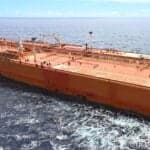


US forces have boarded an oil tanker linked to Iranian crude shipments in the Indian Ocean, according to the Pentagon, as Washington continues its effort to track and stop vessels connected to Tehran.
The US Department of Defence said the operation involved a “right-of-visit maritime interdiction” on the M/T Tifani and was carried out without incident.
The boarding took place in the Indo-Pacific region, with officials indicating the vessel was operating between South Asia and Southeast Asia.
One US defence official said the tanker was in the Bay of Bengal and was carrying Iranian oil at the time.
The same official said a decision will be taken within the next four days on what to do with the vessel, including whether it will be towed to the United States or handed over to another country.
The Pentagon described the Tifani as a “stateless” vessel, even though it was sailing under the flag of Botswana.
Ship-tracking data shows the tanker had loaded around two million barrels of crude oil from Iran’s Kharg Island earlier this month and passed through the Strait of Hormuz days later, heading towards Southeast Asia.
Maritime data firms have linked the vessel to repeated ship-to-ship oil transfers near Singapore and Malaysia, and to voyages between Iran and China.
Such movements are often associated with what shipping analysts describe as Iran’s “ghost fleet”, used to move oil despite sanctions.
This is the second such action by US forces in recent days. Earlier, the US targeted an Iranian-flagged cargo ship that it said was trying to evade a blockade on Iranian ports.
US President Donald Trump said at the time that an American destroyer struck the vessel’s engine room.
The US maintains a naval blockade aimed at stopping ships tied to Iran or carrying goods that could support its government.
Overnight, U.S. forces conducted a right-of-visit, maritime interdiction and boarding of the stateless sanctioned M/T Tifani without incident in the INDOPACOM area of responsibility.⁰⁰As we have made clear, we will pursue global maritime enforcement efforts to disrupt illicit… pic.twitter.com/EGwDe3dBI3
— Department of War
(@DeptofWar) April 21, 2026
Officials have said the focus is not only on oil, but also on materials such as metals, electronics and other cargo considered useful in conflict.
Senior US military officials have also made it clear that these operations are no longer limited to the Gulf region.
General Dan Caine, Chairman of the Joint Chiefs of Staff, said enforcement would extend beyond areas under US Central Command, including into the Pacific and Indian Oceans.
He added that US forces would pursue any Iranian-flagged vessel or any ship providing support to Iran, even if it had left before the blockade began.
A recent US military notice also expanded what is considered contraband. It stated that goods intended for an enemy and capable of being used in armed conflict can be seized anywhere outside neutral territory.
The notice added that US forces would board, search and take control of such cargo regardless of location..
Iran has criticised the US actions, calling the blockade a violation of the ceasefire. Iranian Foreign Minister Abbas Araghchi said that attacking commercial vessels and detaining crews would amount to a serious breach.
Iran has also approached the United Nations, asking the Security Council and Secretary-General António Guterres to condemn earlier US actions against another vessel and its crew.
Some legal experts say the situation remains unclear because there is no detailed ceasefire agreement.
One view is that the US considers the conflict still active, which allows it to continue enforcing a blockade and carrying out interdictions at sea.
Others argue that if the ceasefire was meant to stop the use of force, then such actions could be difficult to justify under international law.
Analysts have also pointed out that proving whether a commercial vessel is directly contributing to military operations is not always straightforward, which adds to the legal uncertainty.
Another defence analyst said the ceasefire mainly focused on stopping air strikes, not naval enforcement, suggesting the US may still see the blockade as valid.
At the same time, others noted that without clearly defined terms, whether the ceasefire has been broken depends on how each side interprets it.
Shipping data indicates that several vessels linked to Iran have continued to operate despite the blockade, with reports suggesting that at least 26 ships managed to move through trade routes after restrictions were imposed.
The Strait of Hormuz remains a key route for global energy shipments, but US enforcement is now being seen far beyond that region, including in the Indian Ocean and parts of Southeast Asia.
References: AP News, MoneyControl
Want to read more?
Check out the full article on the original site