backpropagation
13 stories filed under backpropagation on Beyond Market Intelligence. The newest of them: “Neural networks can grow their own learning rules from simple wiring”, “Explore AI Learning Without Backpropagation Through Physics-Inspired Methods”, and “Explore machine learning in a focused math community, free for all”. Randomly wired neural networks can grow their own learning rules from scratch. A physicist and mathematician who builds neural networks from scratch wants to know if backpropagation, the dominant training method, can be meaningfully replaced by local learning rules like predictive coding and… Acme AI is the next-generation, AI-powered spreadsheet platform built to replace Excel and redefine how analysts, data scientists, and enterprise teams work… The list below is every backpropagation story on Beyond Market Intelligence, newest first.
Neural networks can grow their own learning rules from simple wiring
Randomly wired neural networks can grow their own learning rules from scratch. MIT researchers showed that simple, shared plasticity rules, not a pre-designed algorithm, let these networks assemble learning motifs and match backpropagation's performance on image classification. That's a different approach: specify local rules, let the machinery organize itself. The authors aren't claiming the brain works this way, but the biological plausibility is compelling. It invites us to explore how learning emerges from wiring, not just code.
Explore AI Learning Without Backpropagation Through Physics-Inspired Methods
A physicist and mathematician who builds neural networks from scratch wants to know if backpropagation, the dominant training method, can be meaningfully replaced by local learning rules like predictive coding and Hebbian learning. These alternatives update weights using locally available information rather than global error gradients. That's a compelling challenge to the status quo. His questions about unsupervised learning, continual adaptation, and biological plausibility cut to the heart of where AI might evolve next, especially for complex systems like molecular dynamics.

Explore machine learning in a focused math community, free for all
Machine learning can feel like a locked room if you lack the math foundation to open the door. This workshop, hosted on the (blue) Math Discord server, changes that. Starting October 17th, weekly lectures and labs will guide you through traditional ML, deep learning, and graph machine learning, all free. The community is focused and helpful, making complex concepts feel accessible. If you know Python and basic calculus, you are ready to join.

Watch Neural Networks Learn in Real Time Right in Your Browser
Watching neural networks train often feels like peering into a black box. *OpenTrainDNN* pulls back the curtain. This open-source tool runs entirely in your browser, rendering backpropagation, activation flows, and weight updates in real time, no server, no hardware drivers, no installation required. It makes the invisible mechanics of deep learning visible and approachable. If you prefer a more structured path, our *Build AI from the ground up* series offers 523 hands-on lessons to deepen that understanding.
Visualize Neural Network Training Directly in Your Browser
Watching neural networks train often feels like staring at a black box, but OpenTrainDNN changes that by putting the process directly in your browser. This open-source, client-side app visualizes backpropagation, activation flows, and weight updates in real-time, no servers or special hardware required. It's a practical way to see the mechanics behind deep learning, not just theorize about them. For those wanting to dig deeper into model behavior, our related piece on real-world computer vision deployments offers a useful companion perspective.
Accelerate Local LLM Learning: A New Prototype for Faster Fact Correction
Watching a toddler learn taught Kavanutz something about AI. Jayce, his new prototype, skips the heavy lifting of RAG pipelines and fine-tuning entirely. Instead, it shifts raw context vectors across a fixed pool of 4,048 prototype slots, correcting mistakes in real time. The benchmarks are telling: faster updates, better sample efficiency on sequential tests, and a strict memory ceiling. It's a lean, framework-free proof of concept built on NumPy and Java.

Visualize Neural Network Training: A Step-by-Step Interactive Tool
Watching weights adjust in real time is the difference between memorizing backprop and actually feeling it. OpenTrainDNN strips away setup friction, letting anyone tweak learning rates or network depth and see convergence or collapse happen live. That's the kind of hands-on clarity theoretical guides often miss. For a tool built to demystify training mechanics, it hits a practical sweet spot. If you're curious about broader model deployment challenges, our related piece on real-world computer vision offers a useful follow-up.
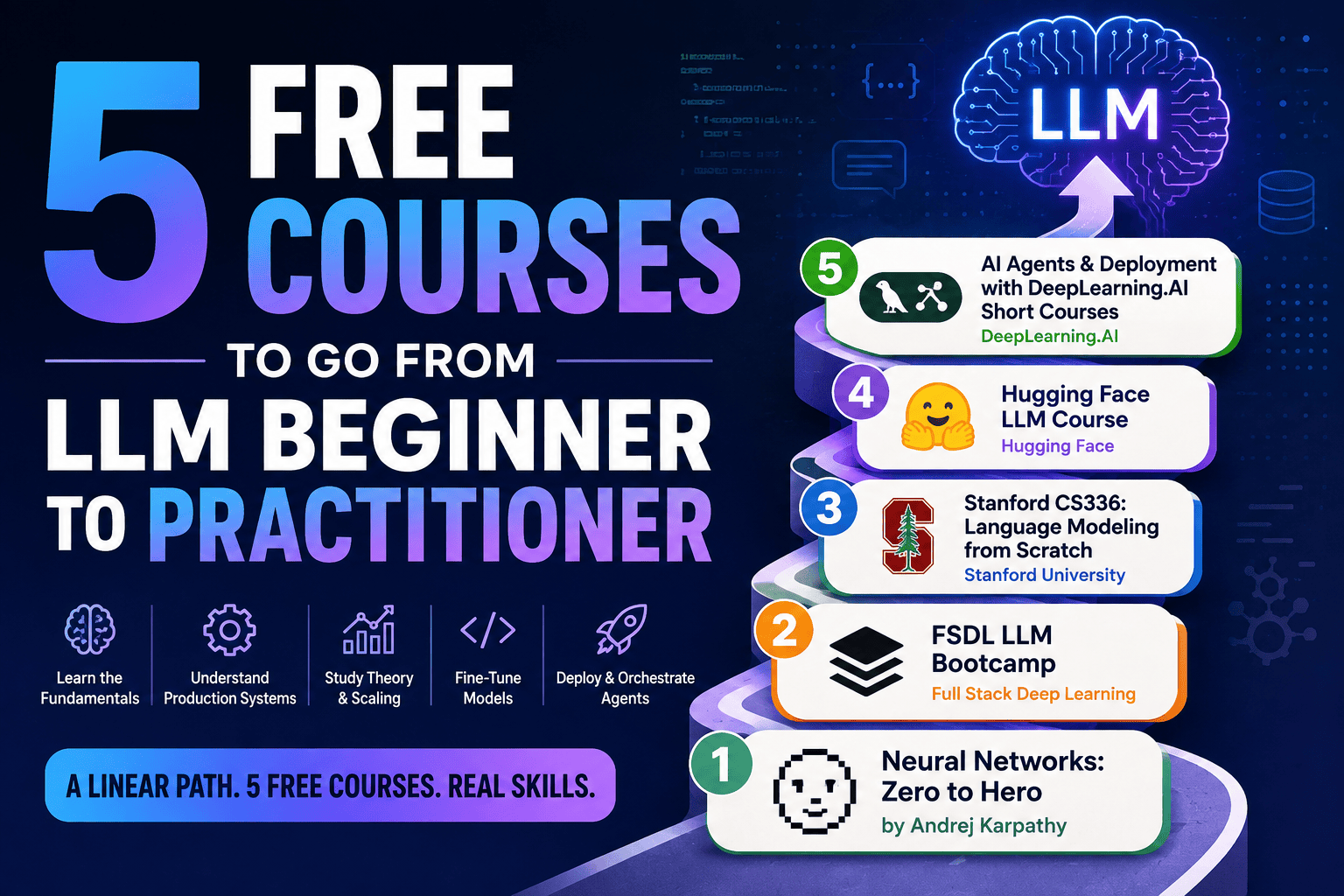
Explore a free path from LLM basics to building production-ready applications
The path from backpropagation basics to production-grade LLM applications doesn't have to be cluttered with endless tabs and half-finished tutorials. These five free courses form a deliberate, linear pipeline that respects your time and builds real competence. It's a focused route, not a buffet. If you're also curious about the infrastructure behind scaling these models, our guide on distributed algorithms pairs well with this track. Start here, move deliberately, and let the work itself teach you.
Discover How Predictive Coding Networks Achieve Near-Perfect Accuracy at Speed
Backpropagation has dominated deep learning for decades, but Deepity makes a compelling case that it's not the only path forward. This C++ library's Predictive Coding Networks hit 97.73% on MNIST in under a minute, edging close to PyTorch's 98.27% while offering biological plausibility and continual learning potential. The trick lies in algorithmic caching and recent feedback alignment research, closing the performance gap on CPU.
How evaluation resolution reshapes our view of brain-like learning rules
A common claim in model-brain comparisons is that untrained CNNs can match backprop-trained ones at V1. This new preprint shows that conclusion is largely an artifact of evaluation resolution. The gap between untrained and trained models widens monotonically as resolution increases, from near zero at 32 pixels to a clear edge at 224. That's a sharp, testable correction to a widely repeated result. For a hands-on look at training dynamics, OpenTrainDNN offers a useful complement to this kind of analysis.

From One Gradient to Every Gradient: How Backpropagation Connects the Dots
Backpropagation often feels like a leap from theory to math, but this guide closes that gap with clarity. The guide walks you from a single gradient to the full chain, showing how errors flow backward through each layer. It is practical, grounded, and surprisingly intuitive for such a technical topic. If you are ready to move past intuition and see the mechanics clearly, this is the right next step.

Discover the core insight that makes backpropagation truly work.
If you've ever watched a neural network struggle through training, you know the feeling: there has to be a better way. This second part of our beginner's guide gets to the heart of that intuition, unpacking the core idea that makes backpropagation possible. The guide offers a clear, accessible look at a concept that often feels abstract, and it does a fine job keeping the explanation grounded. For those ready to push further, our guide on distributed algorithms offers a natural next step.

How Neural Networks Learn: Building Intuition for Backpropagation
Backpropagation often feels like a black box, but this guide pulls back the curtain without drowning you in math. The author builds intuition step by step, showing how neural networks learn by adjusting weights through error feedback. It's a practical starting point for anyone ready to move past surface-level understanding. If you're curious about how these concepts scale, our related guide, "Unlock LLM Training: A Practical Guide to Distributed Algorithms," offers a natural next step.