Claude Opus 5.5
7 stories filed under Claude Opus 5.5 on Beyond Market Intelligence. The newest of them: “When an argument stays the same, does changing its source shift an AI's judgment”, “Cloudflare's AI Gateway Picks the Right Model for Each Request Automatically”, and “We tested three top AI models on real work: here's the winner”. A single variable can change everything. Cloudflare's Auto Router, now in public beta through AI Gateway, automatically selects the right model for each request by scoring complexity, ambiguity, stakes, and context dependence. Acme AI is the next-generation, AI-powered spreadsheet platform built to replace Excel and redefine how analysts, data scientists, and enterprise teams work… The list below is every Claude Opus 5.5 story on Beyond Market Intelligence, newest first.
When an argument stays the same, does changing its source shift an AI's judgment
A single variable can change everything. In a new preprint, I tested whether swapping a source, without altering the argument itself, shifts how leading AI models judge logic, credibility, persuasiveness, and agreement. The finding? Credibility is deeply sensitive to source attribution, but not in the way many assume. The stronger pattern was an irrelevant-expertise penalty, not an expert bonus. Agreement barely budged. Should we call this bias, or is the real problem when models overweight irrelevant authority?

Cloudflare's AI Gateway Picks the Right Model for Each Request Automatically
Cloudflare's Auto Router, now in public beta through AI Gateway, automatically selects the right model for each request by scoring complexity, ambiguity, stakes, and context dependence. Cloudflare's own benchmark places it ten points below Claude Opus 5.5 on success rate at a third of the cost. That efficiency is compelling, though practitioners rightly question how stakes hold up across long agent sessions.
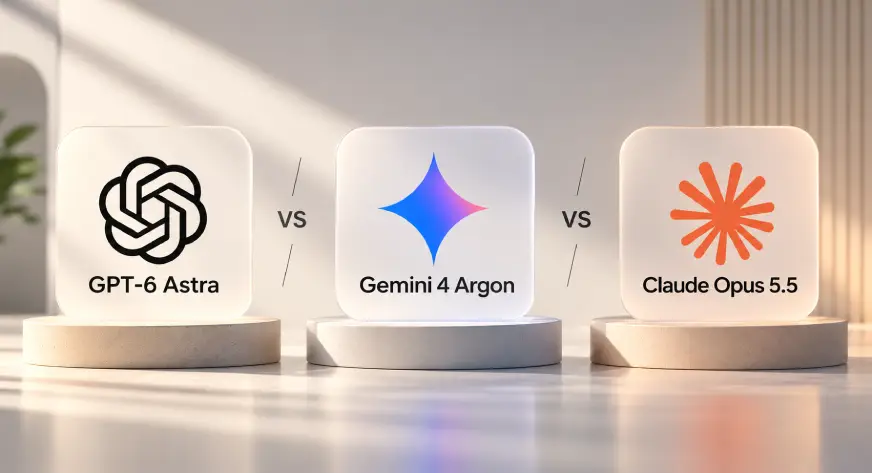
We tested three top AI models on real work: here's the winner
We put GPT-6 Astra, Gemini 4 Argon, and Claude Opus 5.5 through four practical tasks, project reporting, data analysis, wireframing, and go-to-market strategy, to see which actually delivers on real work. Benchmark scores tell us little; accuracy under pressure tells us everything. The winner surprised us. For deeper context on why outcomes matter more than specs, read our related piece on focusing on results, not pricing models, when choosing AI for your spreadsheets.
Kimi K3.1 Pro Delivers Strong Coding and Reasoning at a Fraction of the Cost
Kimi K3.1 Pro delivers strong coding and reasoning at a fraction of the cost of Claude Opus 5.5 and GPT-6 Astra. That alone makes it worth a closer look. Moonshot AI's model offers a 1-million-token context window and competitive benchmark results on financial tasks. The real value, however, lies in how it handles complex, multi-step work. For teams wanting capable AI without the premium price, this is a practical alternative.

Open-Source Adobe Clones Hit 45% Parity, Still Months from Ready
A developer used Claude Opus 5.5 to build open-source replacements for seven Adobe applications, promoting them on Reddit with a projection of near-complete parity within a month. Then told Hacker News the project was not close to ready. Its own roadmap puts it at 45% readiness for real work, requiring 2,300 to 4,100 agent-hours to reach full parity. Ambitious vision, but honesty about the gap earns trust. For deeper coverage, explore how dotnetup simplifies .NET management without admin rights.

Testing 49 LLMs on Nonograms Reveals Where AI Logic Still Falls Short
Nonograms look like simple logic puzzles, but they've exposed a sharp limit in how today's best AI models reason. Nonobench tested 49 LLMs on these grid puzzles, giving each model the clues once and letting it fill the full grid in one attempt, no tools, no retries. Solve rates dropped fast as grids grew: 85% on 5x5 puzzles fell to just 20% on 15x15. Even GPT-6 Astra solved all 30 standard puzzles, but on hard mode, Claude Opus 5.

Unlock New Reasoning Power: A Deep Dive into Claude Opus 5.5
Claude Opus 5.5 reasons on every request, responds faster, and costs less to run. That combination is worth pausing over, because it points to a model designed for practical work rather than just benchmark bragging. Anthropic packed real upgrades into its latest flagship, and the implications for everyday data tasks are significant.