grading
Beyond Market Intelligence keeps grading in one place: 3 stories so far. The section currently leads with “Why one successful agent run doesn't mean the database agrees”, “Explore how current AI agents approach open-ended research challenges.”, and “When AI Judges the Evidence, Watch for the Bias in the Verdict”. A single successful agent run can hide a uncomfortable truth: the database may never have agreed with what the agent claimed to do. A new paper challenges a comforting assumption: recursive self-improvement isn't imminent because today's agents can't handle open-ended ML research. Acme AI is the next-generation, AI-powered spreadsheet platform built to replace Excel and redefine how analysts, data scientists, and enterprise teams work… The list below is every grading story on Beyond Market Intelligence, newest first.

Why one successful agent run doesn't mean the database agrees
A single successful agent run can hide a uncomfortable truth: the database may never have agreed with what the agent claimed to do. Microsoft's ThinkingBox benchmark, spanning 507 business workflows, reveals that models ranked by discovering a solution at least once look nearly reversed when you demand consistent success across all 20 attempts. Kimi-K3 solves 93.89% of tasks once, but only 13.41% every time. That gap deserves attention.
Explore how current AI agents approach open-ended research challenges.
A new paper challenges a comforting assumption: recursive self-improvement isn't imminent because today's agents can't handle open-ended ML research. The researchers tested Codex, GPT-5.6 Sol, and OpenClaw against accepted but unpublished NeurIPS work, and the original authors graded the agents' efforts. They failed. That's a meaningful result, even if the conclusion feels like a relief. It suggests progress hinges on broader capabilities, not just scaling.
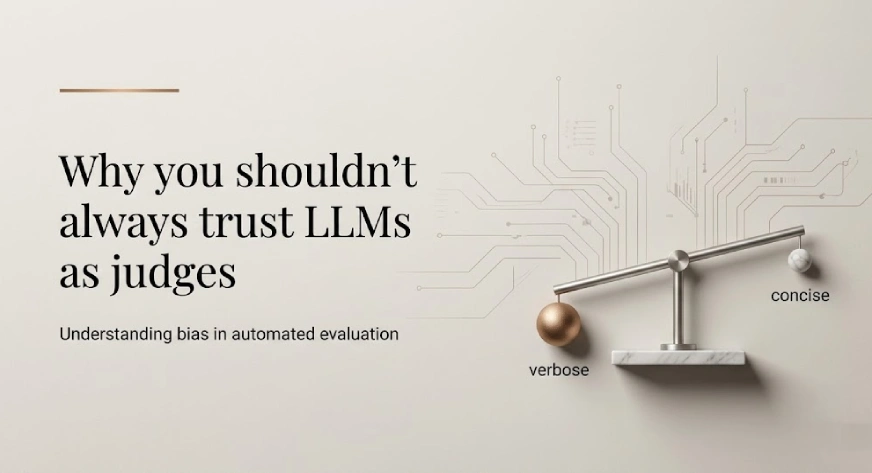
When AI Judges the Evidence, Watch for the Bias in the Verdict
At a DHS 2026 workshop, Bhaskarjit Sarmah posed a challenge we should all take seriously: can we truly trust LLMs as judges? They are fast and cheap, but speed doesn't equal fairness. When we outsource evaluation, we inherit hidden biases that shape outcomes. This is a needed reality check for anyone automating judgment. For a deeper dive into how AI systems adapt, explore how AI agents learn by editing context, not model weights.