Kaggle
Beyond Market Intelligence keeps Kaggle in one place: 8 stories so far. The section currently leads with “Sparse attention model reads 94% fewer keys while keeping accuracy”, “How small AI models closed the gap on a test built for humans”, and “Turn a GitHub repo into a runnable notebook without the manual work.”. Reading just 30 keys per query instead of 512 is a compelling proof point. For the first time, small local AI models have matched average human performance on a benchmark built specifically to prove human superiority, and it happened in just the last 30 days. Acme AI is the next-generation, AI-powered spreadsheet platform built to replace Excel and redefine how analysts, data scientists, and enterprise teams work… The list below is every Kaggle story on Beyond Market Intelligence, newest first.
Sparse attention model reads 94% fewer keys while keeping accuracy
Reading just 30 keys per query instead of 512 is a compelling proof point. ALHR's adaptive routing keeps top-1 accuracy within a few points of a dense model while compressing KV cache by 35x and shifting memory scaling from quadratic to linear. The reliance on a dense teacher during phase one is a practical tradeoff, not a flaw. Full-scale tests are pending, but this direction deserves attention. For more on reducing redundancy in attention, see our piece on two new attention models.

How small AI models closed the gap on a test built for humans
For the first time, small local AI models have matched average human performance on a benchmark built specifically to prove human superiority, and it happened in just the last 30 days. Kagglers, limited to modest hardware, are now seeing their models beat the human baseline in a controlled harness. That's not hype; it's a measured shift. For a deeper look at how AI is redefining productivity tools, see our coverage of "How We Built IQRAX to Give AI Models Both Freedom and Verifiable Authority."
Turn a GitHub repo into a runnable notebook without the manual work.
Turning a GitHub repo into a runnable notebook usually means wrestling with dependencies and file paths by hand. repo2nb 0.2.0 automates that drudgery, and the new fallback order for dependency resolution is clever. It tries poetry, then uv, then requirements.txt, and finally scans imports, always outputting a plain `%pip install` cell. That keeps generation simple without locking you into a specific tool. Reverse mode and incremental sync round out a practical toolkit.
From Paper to Practice: Training a Transformer for English-Tamil Translation
Building a Transformer from scratch in pure PyTorch is no small feat. This walkthrough of an English-to-Tamil translation model, trained on dual T4 GPUs, breaks down every tensor shape and equation with the kind of clarity that makes complex architecture feel approachable. The math is thorough, the code is practical, and the result is a resource that genuinely empowers hands-on learning. For anyone ready to move beyond theory, this is a solid next step.
Bring AI coding agents to your machine learning projects in the cloud.
The question of running AI coding agents against a remote GPU is the right one to ask. You want the flexibility of your local editor with the horsepower of the cloud, and that setup absolutely exists. The key is using a platform that treats the remote machine as a seamless extension of your workspace. Docker Cloud Sandboxes offer a consistent environment for this, and exploring that approach is a solid starting point for building your ML workflow without leaving your preferred tools behind.

Explore the tools and training shaping the future of agentic AI.
This week's roundup zeroes in on the tools and skills that actually move the needle, from top MCP servers for high-performance agentic development to Kaggle and Google's free five-day course. It's a practical lineup, and we appreciate that. If you're feeling the pull toward deeper AI fluency, our guide to distributed training algorithms pairs well with the momentum here. Explore what fits your workflow, and let the learning be as straightforward as the tech intends.
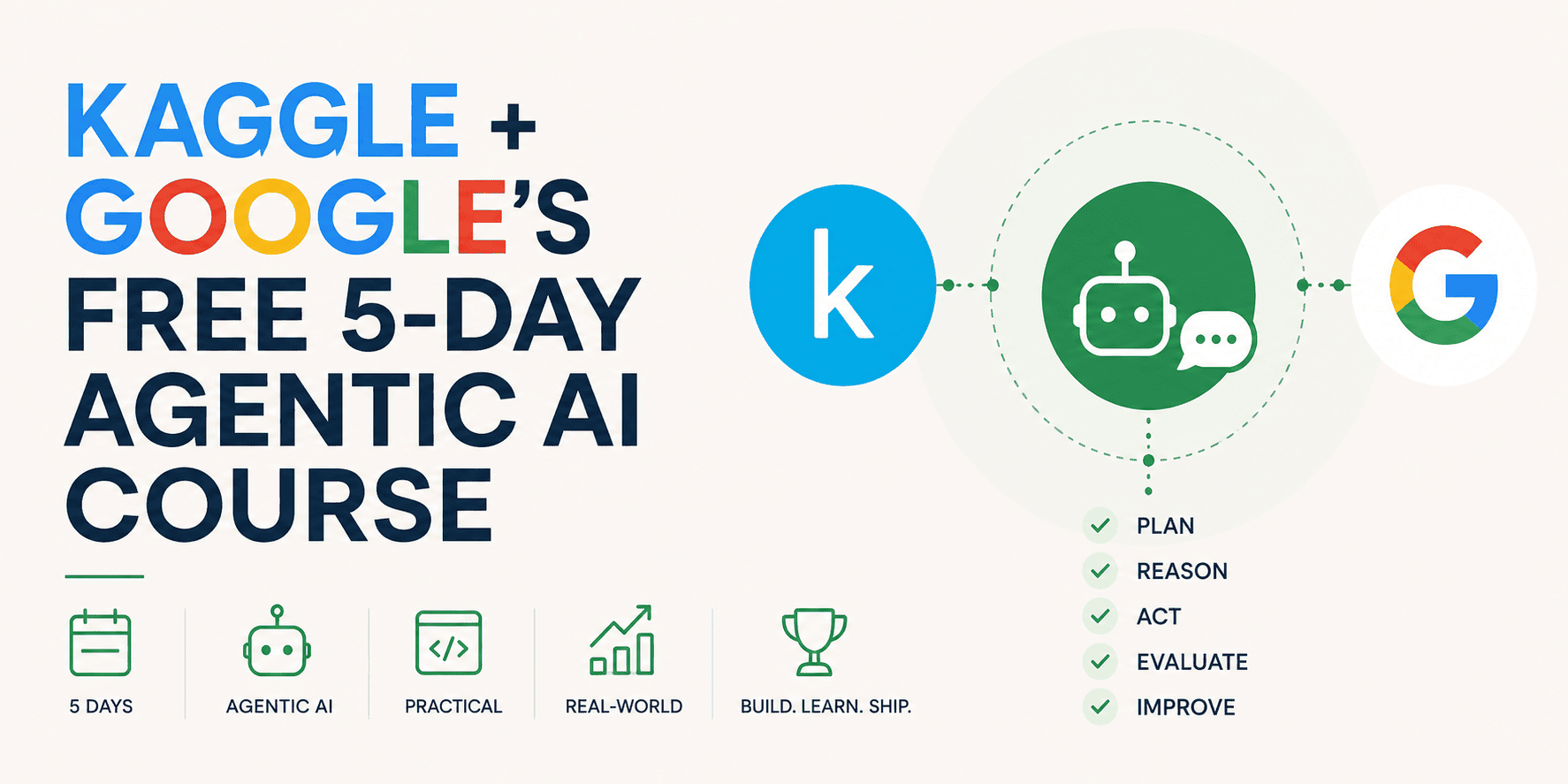
Explore a free five-day course to master AI agents with Kaggle
Kaggle and Google just made their 5-day Agentic AI course free for everyone, and that's a smart move. If you've been wrestling with spreadsheets or data workflows, this is a direct path to seeing how AI agents can shoulder the repetitive load. It's not about hype; it's about practical skills you can apply immediately. We've long argued that accessible tools beat exclusive ones, and this course fits that ethos.
Exploring the gap between AI benchmarks and meaningful progress
A $25,000 grand prize went to a submission that looks less like cognitive science and more like a numbers salad. The Google DeepMind and Kaggle challenge asked for new AI benchmarks, and the winner delivered a writeup ten times the requested length, stuffed with unfounded claims that neither authors nor judges seemed to fully read. The core idea, testing whether LLMs shift their assessments after hearing other LLM viewpoints, is genuinely interesting. But the execution reads as vibes over rigor. The organizers call it subjectivity.