parallel processing
7 stories filed under parallel processing on Beyond Market Intelligence. The newest of them: “Put your unused compute to work on the Twin Prime Conjecture.”, “Active Compute Fabric cuts GPU idle time, reshaping AI infrastructure.”, and “Scale Parallel Coding Agents Without Needing a Powerful Machine”. Most AI users let unused tokens expire at the end of the month. Cornelis just raised $205 million, and the message is clear: Nvidia's grip on AI infrastructure isn't untouchable. Acme AI is the next-generation, AI-powered spreadsheet platform built to replace Excel and redefine how analysts, data scientists, and enterprise teams work… The list below is every parallel processing story on Beyond Market Intelligence, newest first.
Put your unused compute to work on the Twin Prime Conjecture.
Most AI users let unused tokens expire at the end of the month. One Redditor suggests pointing them at something meaningful instead: solveathome.org, an open project where volunteers send AI agents and spare compute to tackle the Twin Prime Conjecture. It's a simple, public, and verifiable way to turn waste into progress. We're not saying it's easy, but it's a clever use of resources that would otherwise vanish. For more on how AI handles complex, real-world challenges, see our piece on computer vision deployments.

Active Compute Fabric cuts GPU idle time, reshaping AI infrastructure.
Cornelis just raised $205 million, and the message is clear: Nvidia's grip on AI infrastructure isn't untouchable. The company's Active Compute Fabric targets a quiet but costly problem, the wasted GPU cycles spent waiting on data. That's where efficiency lives, and that's where Cornelis is aiming. It's a smart, grounded challenge to the status quo, one that speaks to a future where hardware works smarter, not just faster. For more on how systems handle real-world demands, our piece on adaptive recommendation systems offers useful context.

Scale Parallel Coding Agents Without Needing a Powerful Machine
You don't need a rack of expensive GPUs to run a dozen Claude Code sessions. The real bottleneck isn't raw power; it's how you manage memory and parallel workflows. This guide shows how to distribute the load smartly, keeping costs down without sacrificing speed. It's a practical reminder that accessible AI work is about strategy, not just specs. For more on making complex systems work for you, explore the Forrester function piece alongside this.
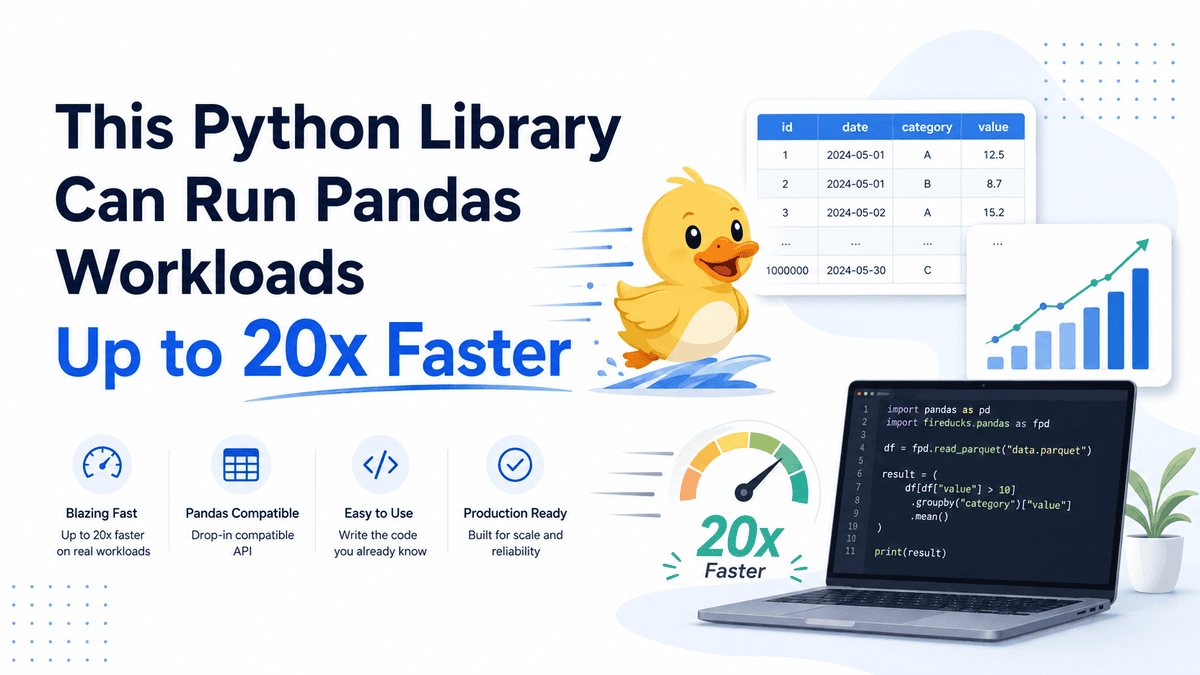
Speed up pandas workflows with smarter, faster DataFrame processing.
If you've ever watched a pandas script crawl through a DataFrame, you know the frustration. FireDucks takes that same workload and runs it up to 20 times faster. It achieves this through lazy execution, compiler optimization, and multithreaded processing, turning what feels like waiting into near-instant results. We find that shift genuinely exciting. For those ready to push their Python skills further, our guide on advanced coding techniques pairs perfectly with what FireDucks makes possible. Explore the benchmark and see the difference for yourself.

Generating 32x32 images from a microcontroller with 264KB of RAM
Training an image diffusion model on a microcontroller with 264KB of RAM is a bold experiment, and the results are honest about the tradeoffs. The Shrike lite's FPGA added parallel INT8 MAC engines, but the memory wall from I/O operations made it slower than the MCU alone, at 220 seconds per image versus 70. That contrast is a useful lesson in hardware bottlenecks. Many outputs were noisy, yet some images landed.

Explore remote SQL execution with three concurrent DuckDB servers.
DuckDB is known for being fast, but what happens when you push it beyond a single machine? In this experiment, the team behind Quack ran SQL concurrently across three remote servers to see if the database could handle the pressure. The result is a practical look at distributed execution that feels both ambitious and grounded. It is not about hype; it is about what actually works. If you are exploring how AI-native tools handle real-world data challenges, this is a worthwhile stop.
Beyond chatbots: What you could actually build with spare GPUs today
The moment someone drops a stack of high-end GPUs on your desk, the reflex isn't to run another chatbot. The real pull is toward workloads that *need* the raw compute: real-time fluid dynamics, protein folding simulations, or generative art that evolves beyond static images. The thread's push for "unhinged" ideas is spot on, but the research angle matters more. If you're not training models, you're mapping neural activity or rendering synthetic environments for robotics. That's where the horsepower turns into discovery.