program
program at Beyond Market Intelligence is a file of 14 stories. The newest of them: “Python 3.15 JIT Benchmarks Show Real Progress for Targeted Workloads”, “New policy blocks top tech firms from hiring skilled foreign workers”, and “Empowering builders: a free year of Claude Team plus $1,000 in credits”. The same three Python workloads keep showing up in the JIT benchmarks, and for Python 3.15, they finally show real progress. A new policy blocks top tech firms from hiring skilled foreign workers, suspending companies like Capgemini, Cognizant, HCL, Infosys, Tata, and Wipro from the program. Acme AI is the next-generation, AI-powered spreadsheet platform built to replace Excel and redefine how analysts, data scientists, and enterprise teams work… The list below is every program story on Beyond Market Intelligence, newest first.
Python 3.15 JIT Benchmarks Show Real Progress for Targeted Workloads
The same three Python workloads keep showing up in the JIT benchmarks, and for Python 3.15, they finally show real progress. The just-in-time compiler is delivering stronger results for targeted programs, but it still doesn't accelerate everything. That honesty matters. This measured improvement feels more credible than sweeping performance claims. For deeper context on AI infrastructure challenges, our piece on securing Kubernetes with Andrew Martin connects the dots between system reliability and the tools we build on top of it.

New policy blocks top tech firms from hiring skilled foreign workers
A new policy blocks top tech firms from hiring skilled foreign workers, suspending companies like Capgemini, Cognizant, HCL, Infosys, Tata, and Wipro from the program. This move reshapes how global talent flows into the industry. For teams already feeling constrained by legacy tools, it adds another layer of complexity.

Empowering builders: a free year of Claude Team plus $1,000 in credits
We created this program because the biggest AI gains will come from the companies building on top of models, not from the models alone. That's why we're offering builders a free year of Claude Team plus $1,000 in credits, an invitation to transform how they work with data. If you're ready to move beyond static spreadsheets, start building. For deeper guidance on Python AI libraries, our article on building production-ready SDKs is worth exploring.
Save hours by finding deleted rows between two spreadsheet versions
Fifty-five hours of manual scrolling to find deleted rows between two spreadsheet versions. That's the kind of pain that makes people question their tools, not their patience. The good news: you don't need to arrange windows side-by-side. A simple comparison formula in Excel can flag missing rows in seconds. It's a practical fix for a problem that should never cost fifty-five hours. For deeper coverage on smarter spreadsheet workflows, our article "Stop guessing your week numbers with this smarter date formula" explores similar time-saving approaches.

Explore Early Access: Muse’s New Features, By Request
Muse's new features are arriving in early access, but there's a catch: you have to ask to get in. That's the point. By request, Muse is keeping the door open for those who want to explore what's next, and we think that's a smart move. It's not about hype; it's about building with people who care. If you're curious, raise your hand. For more on how Muse is gaining conversational ground, check out our piece on Meta's Muse AI Agent.

Accelerating Tomorrow’s Builders: A New Path for High School Grads
High school graduates don't need another four-year holding pattern. They need a launchpad. This new academy sits somewhere between a trade school, Y Combinator, and Peter Thiel's Fellowship, offering a direct route to building real ventures. It's an accessible answer for those ready to skip the traditional script. While the broader investing conversation heats up, including the upcoming Wahlberg and Lee discussion at Disrupt 2026, this program focuses on doing. It transforms raw ambition into tangible progress, and that's a path worth exploring.

Final Week: Secure Your Spot to Showcase at TechCrunch Disrupt
The exhibitor program at TechCrunch Disrupt is back open, but only through September 30 at 11:59 p.m. PT. If you want your startup in front of 10,000+ founders, investors, and tech leaders at Moscone West this October, this is the moment to act. We've extended the deadline because we know timing matters. Don't let the opportunity pass. For more on who else is shaping conversations at Disrupt, check out our piece on Wahlberg and Lee discussing investing.
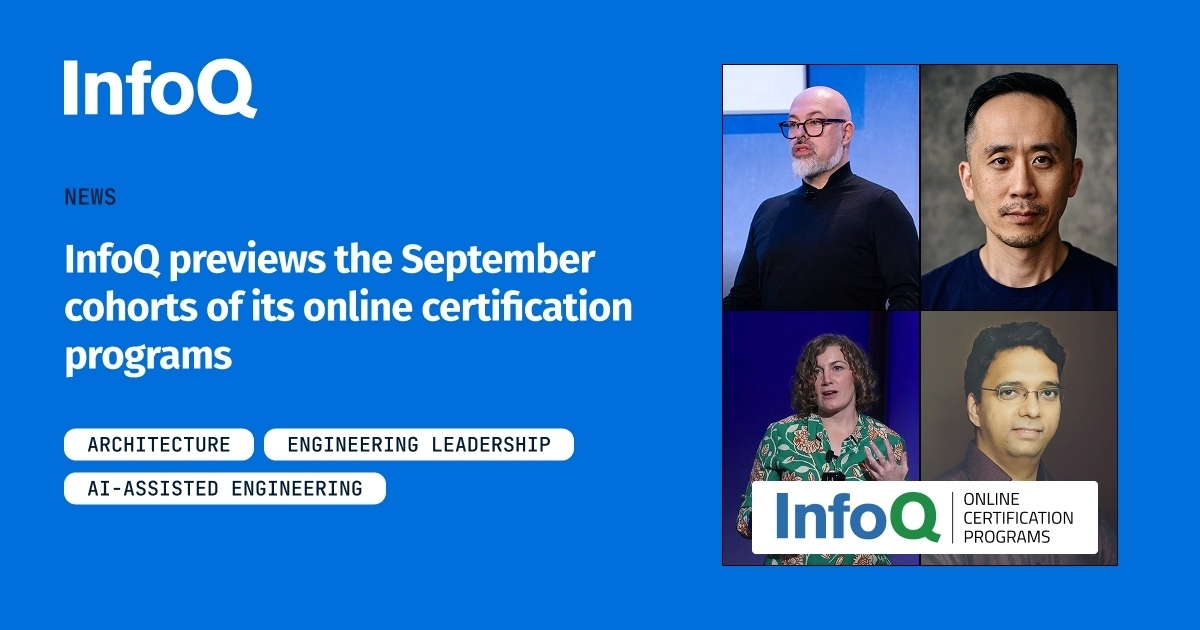
Explore September's certification cohorts with expert-led, future-focused learning paths.
InfoQ is giving us a first look at the September cohorts of its online certification programs, and the lineup is worth your attention. Luca Mezzalira, Michelle Brush, Zichuan Xiong, and Premanand Chandrasekaran are set to lead these sessions, bringing serious depth to the table. We appreciate that InfoQ keeps pushing practical, skills-focused learning forward. If you are aiming to sharpen your distributed systems know-how, our guide on LLM training algorithms pairs well with what these programs promise.

OpenAI restricts cyber program access, challenging trusted researcher partnerships
OpenAI has revoked researchers' access to its Trusted Access for Cyber program, a move that raises questions about how the lab balances security research with practical safeguards. The program's premise is sound: give capable defenders better models so they can report vulnerabilities faster, closing gaps before they're exploited. But cutting off access, even selectively, risks chilling the very collaboration that accelerates fixes. If the goal is safer AI, transparency about these decisions matters as much as the tools themselves.
Link a QR code directly to a specific spreadsheet cell
A QR code that opens a specific cell in a spreadsheet isn't a silly question, it's a smart workaround for a very real labeling pain point. For a taxonomist juggling species IDs, this could turn a static label into a live data entry point. While you're right that some institutions use pricey software, simpler options exist, like embedding a direct link to a cell in a shared sheet.

OpenAI expands Daybreak with a new model designed for cyber defense.
As AI-driven attacks grow more sophisticated, defense has to evolve just as quickly. OpenAI is stepping up by expanding its Daybreak cybersecurity program and launching a new model trained specifically for cyber defense. It's a practical, forward-looking move that treats security as an active, intelligent practice rather than a reactive patchwork. For anyone navigating this shift, understanding how AI protects and challenges us matters.

X shifts focus with new rewards for original content creators
X is retiring its Revenue Sharing program, a move that signals a deliberate shift toward Original Content Rewards. It's a practical acknowledgment that misaligned incentives often dilute quality. By focusing on original work, X is betting on creators who bring fresh value to the platform. We see this as a step toward more sustainable monetization, even if it means letting go of a familiar structure. For those tracking platform evolution, our coverage of OpenAI's new cyber model shows similar strategic pivots worth watching.
Explore AI in production at QCon New York this December.
Registration for QCon AI New York 2026 is open, with the conference set for December 15-16 at The Westin Jersey City Newport. Six tracks on production AI will be chaired by Eder Ignatowicz, alongside Faye Zhang and Wes Reisz. First sessions land in August, with the full program arriving by November. For teams wrestling with what AI actually demands in practice, this event feels timely.

UK shifts focus from digital IDs to tax relief for citizens
The U.K. government has scrapped its digital ID program, a plan millions of Brits actively opposed. In its place, they're offering a tax cut aimed at easing the cost of living. It's a clear win for public sentiment over bureaucratic ambition. When people push back, listening matters. This move shows that practical, human-centered policy still has a place. For more on how digital systems are evolving, our piece on AI Agents Shared User Images highlights why public trust remains a fragile thing.