ranking
10 stories filed under ranking on Beyond Market Intelligence. The newest of them: “Explore how LLMs fit into recommender systems with Kim Falk's new guide”, “Gemini Argon Tops the Charts but Skips the Test That Counts”, and “Cut Through the ML Paper Clutter with AI-Powered Research.”. Adding an LLM to a recommender system sounds promising until you ask whether the complexity is actually justified. Gemini Argon tops the charts, yet it skips the test that counts. Acme AI is the next-generation, AI-powered spreadsheet platform built to replace Excel and redefine how analysts, data scientists, and enterprise teams work… The list below is every ranking story on Beyond Market Intelligence, newest first.

Explore how LLMs fit into recommender systems with Kim Falk's new guide
Adding an LLM to a recommender system sounds promising until you ask whether the complexity is actually justified. Kim Falk's new guide treats recommendation as a full pipeline, not a single trick, examining where LLMs earn their place in candidate generation, reranking, and signal extraction. The real question isn't whether the system works. It's whether the improvement justifies the cost. For deeper context on the operational challenges, our related article "Taming AI's Real-World Demands: Agents, Evals, and Rising Token Costs" explores similar trade-offs in production.
Gemini Argon Tops the Charts but Skips the Test That Counts
Gemini Argon tops the charts, yet it skips the test that counts. That distinction matters. Benchmarks can dazzle, but real-world validation is where trust is built. We see this pattern across the industry, from physics solvers to distributed databases. The lesson is consistent: look past the headline numbers. Explore what a tool does when the pressure is on, not just when it's performing for a score. That's the metric that empowers your actual work.

Cut Through the ML Paper Clutter with AI-Powered Research.
Reading papers as they drop sounds noble until you're drowning in arXiv alerts and can't tell a novel method from a rehash. This developer felt that pain and built an AI agent to handle the grunt work: filtering, deduping, ranking against your interests, and producing a structured report in English and Portuguese. It's refreshingly practical. The scheduler is a smart touch, too. For anyone tired of the research grind, this feels less like another tool and more like a relief.
Explore how machine learning ranks 1.18 million horse racing runners
A 43.5% strike rate on the first live day of a rebuilt model is a strong opening statement. This project, called Hoofs, tackles British and Irish horse racing with 1.18 million historical runner records and a firm respect for the market baseline. Beating the price is harder than building a decent model, a candid observation. For those exploring similar predictive challenges, this is a practical case study.
Explore how AI uncovers exactly where world models break down.
World-model evaluation has a blind spot, and it's not where you'd expect. When a "predict nothing changes" baseline scores 0.983 SSIM on real robot video, and the error stays flat across six steps, the metric isn't lying; the setup is. The usable ranking window sits between 8 and 24 steps on DROID footage, bookended by ties. That's a measurement worth stealing for your own data.
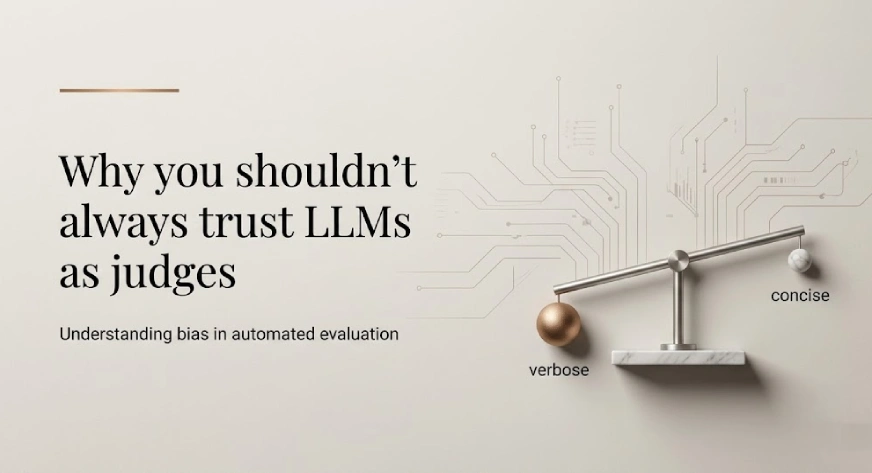
When AI Judges the Evidence, Watch for the Bias in the Verdict
At a DHS 2026 workshop, Bhaskarjit Sarmah posed a challenge we should all take seriously: can we truly trust LLMs as judges? They are fast and cheap, but speed doesn't equal fairness. When we outsource evaluation, we inherit hidden biases that shape outcomes. This is a needed reality check for anyone automating judgment. For a deeper dive into how AI systems adapt, explore how AI agents learn by editing context, not model weights.

Three Retrieval Baselines Tested on a Standard Laptop
Reproducing BM25, dense retrieval, and SPLADE on a 16GB MacBook sounds like a rite of passage until the first out-of-memory crash. This practical walkthrough tracks the real stumbles, the fixes that followed, and the score checks that actually matter for RAG systems. It's a grounded look at what breaks when resources are tight, and what holds up. For readers ready to connect retrieval fundamentals to broader AI workflows, the related piece on bridging retrieval and action offers a natural next step.
Choosing Your Research Fit Over University Prestige for AI Futures
Choosing a master's program in ML/DL is rarely about picking the shiniest name. It's about the people you'll actually work beside. Prestige opens doors, but research alignment builds your thesis, your network, and your reputation. A strong lab with an engaged professor beats a famous university where you're left to navigate alone. Don't choose hoping to join a specific professor unless you've confirmed they're taking students. For a PhD track, the research environment is the product. Prestige is just packaging.

Smarter RAG Generation: Choosing the Right Candidates for Every Query
Retrieving top-k candidates is only half the battle; the real question is how you feed them to the generator. This piece tackles that head-on, detailing two regimes for sending retrieved chunks and the sufficiency signal that tells you which to use. It's a practical, per-question dispatch that keeps things cheap and efficient. We appreciate the focus on iteration over brute force.

New focus on mutual connections reshapes your social feed experience
X just tweaked its algorithm to prioritize posts from mutual followers, aiming to shift the feed away from battleground dynamics and toward a more communal feel. It's a sensible move, acknowledging that connection often beats confrontation. We're curious whether this actually softens the experience or just reshuffles the noise. For more on how platforms handle content shifts, check out our piece on Meta reversing course on ads for a Musk documentary.