research papers
research papers at Beyond Market Intelligence is a file of 13 stories. The newest of them: “When machine learning papers grow longer, clarity gets lost in the word count”, “From Classroom to Conference A Beginner's Roadmap to Publishing in Top AI Venues”, and “Exploring Smarter Paths to Text Clustering With Large Language Models”. Machine learning research papers have ballooned into 20- to 40-page monoliths where clarity drowns in verbosity. You're an AI engineer with two years of experience, but you're asking the right question: where would an undergraduate start to publish in a top venue? Acme AI is the next-generation, AI-powered spreadsheet platform built to replace Excel and redefine how analysts, data scientists, and enterprise teams work… The list below is every research papers story on Beyond Market Intelligence, newest first.
When machine learning papers grow longer, clarity gets lost in the word count
Machine learning research papers have ballooned into 20- to 40-page monoliths where clarity drowns in verbosity. One recent LLM paper stretches to 70 pages of dense text, yet mathematical explanations are vanishing, replaced by block diagrams that leave critical details to guesswork. Meanwhile, some authors mix casual phrases like "it feels like" into scientific writing, making already bloated papers even harder to parse. For a deeper look at how complexity hides instability, explore our article on *The Hidden Instability Beneath LLM Temperature Zero*.
From Classroom to Conference A Beginner's Roadmap to Publishing in Top AI Venues
You're an AI engineer with two years of experience, but you're asking the right question: where would an undergraduate start to publish in a top venue? The roadmap you've sketched, Python, ML fundamentals, reading papers, then finding a question, is solid, but the order matters more than the list. Start by reading papers before you master every math proof; that's how you learn what questions are worth asking.
Exploring Smarter Paths to Text Clustering With Large Language Models
Traditional clustering methods like K-means and DBSCAN often reduce documents to word-by-word matching, leaving procedural similarities undiscovered. That is the exact gap this researcher is targeting by turning to large language models for text clustering. It is a practical reframing of an old problem, and the ambition is clear: group documents by meaning, not just vocabulary. For anyone wrestling with messy, template-heavy datasets, this exploration feels timely. It may not promise perfection, but it points toward a smarter path worth watching.

Cut Through the ML Paper Clutter with AI-Powered Research.
Reading papers as they drop sounds noble until you're drowning in arXiv alerts and can't tell a novel method from a rehash. This developer felt that pain and built an AI agent to handle the grunt work: filtering, deduping, ranking against your interests, and producing a structured report in English and Portuguese. It's refreshingly practical. The scheduler is a smart touch, too. For anyone tired of the research grind, this feels less like another tool and more like a relief.

When research output outpaces human capacity, it's time to explore smarter filters.
On September 9, 2026, arxiv's cs.LG saw 447 new machine learning papers in a single day. That is several times what any human, or even a dedicated reading group, could meaningfully absorb in a year. Zachery Lipton suggests the system may need to burn before it can rebuild. He might be right. The volume isn't slowing; it's the new baseline. For those exploring practical paths forward, our guide to distributed algorithms offers one way to ground the noise.
The Hidden Cost of Community Service in AI Reviewing
Signing up to review for AAAI felt like an obligation, but the reciprocity was absent. The regret is understandable, yet the self-criticism feels misplaced. Sacrificing personal time to reject papers is a thankless task, but the hidden value is real. Reading outside your field sharpens critical thinking, a skill that transfers beyond academia. It is not about feeling important; it is about honing judgment. If you are weighing the cost, consider the learning payoff.
Three Research Papers That Sharpen Your Scientific Writing Skills
A PhD student asking which papers to read for writing skills is really asking how to make complex ideas feel inevitable. The best texts do not hide behind jargon; they walk you through the problem, the method, and the reasoning as if leading you by the hand. Seek out researchers who treat clarity as a form of respect for the reader.

Explore how hybrid search transforms discovery on Papers with Code
Building a better search engine for research papers rarely comes down to a single clever trick. On Papers with Code, Niels Rogge shows how combining PostgreSQL's pgvector with Qwen3 embeddings creates a hybrid system that outperforms keyword or semantic search alone. What stands out is the pragmatic stack: batch embeddings via Hugging Face Jobs, storage in Buckets, and a live model on Inference Endpoints. That same infrastructure drives related-paper recommendations. It's a thoughtful, reproducible approach.
Navigating NeurIPS and ICLR Deadlines with a Clearer Review Process
September 24th is a long wait, especially when five of six reviewers ignored your rebuttals. That silence is frustrating, and it's fair to question whether the discussion phase has stretched too thin. Still, the real stress is the ICLR deadline landing the very next day. You are not alone in prepping a fallback submission; that is smart planning, not pessimism. When timelines collide, having a second option keeps your momentum steady.
From text to ASCII art, an accessible AI model you can build
Turning a text prompt like "build a cat" into a precise ASCII rendering is a clever twist on generative modeling, and it's exactly the kind of hands-on experiment that deepens your grasp of diffusion. You've got the right foundation from CS229 and CS230, but the leap from standard image generation to symbolic, grid-based output is where the real learning lives. Start with character-level tokenization and a simple U-Net backbone. For guidance, look into DALL-E's discrete VAE work and the original DDPM paper.
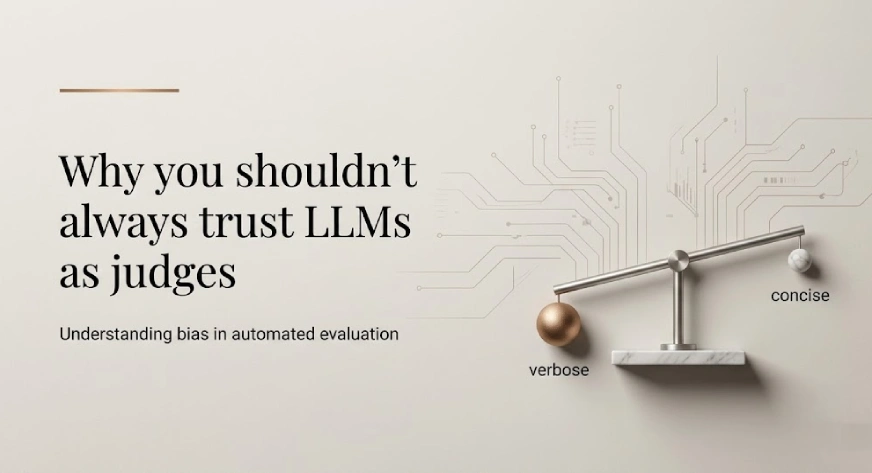
When AI Judges the Evidence, Watch for the Bias in the Verdict
At a DHS 2026 workshop, Bhaskarjit Sarmah posed a challenge we should all take seriously: can we truly trust LLMs as judges? They are fast and cheap, but speed doesn't equal fairness. When we outsource evaluation, we inherit hidden biases that shape outcomes. This is a needed reality check for anyone automating judgment. For a deeper dive into how AI systems adapt, explore how AI agents learn by editing context, not model weights.
Explore papers by selecting any passage, formula, or figure for instant AI clarity.
Reading interp papers often means juggling passages between tabs just to make sense of a single formula. This project cuts through that friction. The tool lets you select any passage, figure, or citation and get an explanation grounded in the full paper's context, no context-switching required. It's a practical, honest solution built on a real pain point. Running it on a personal API key is refreshingly humble.
Explore the agent-driven repositories reshaping AI development this July
If you've spent time on GitHub Trending this July, you've seen the shift: it's not research papers turning into repositories anymore, it's agents. Coding agents, pentesting agents, trading agents, and the infrastructure holding them together. We tracked star growth and real-world impact to surface the ten repos that mattered most. The momentum is tangible, and it points toward a more accessible AI workflow. For a deeper look at how these tools shape behavior, our piece on AI agents learning by editing context pairs well here.