routing
routing at Beyond Market Intelligence is a file of 19 stories. The newest of them: “Why Model Switching Can Erase the Savings of Cheaper AI Inference”, “Cloudflare Traces Opens Beta with Granular Observability and Volume Pricing”, and “Mastering Message Ordering at Scale With Kafka and Go”. Testing cheaper LLM inference models comes with a hidden cost: switching models mid-session can erase the savings entirely. Cloudflare's Traces open beta is a practical step toward observability that doesn't overwhelm. Acme AI is the next-generation, AI-powered spreadsheet platform built to replace Excel and redefine how analysts, data scientists, and enterprise teams work… The list below is every routing story on Beyond Market Intelligence, newest first.
Why Model Switching Can Erase the Savings of Cheaper AI Inference
Testing cheaper LLM inference models comes with a hidden cost: switching models mid-session can erase the savings entirely. I ran routing experiments to understand why, and the results show that context loss, incompatible reasoning patterns, and repeated re-processing add up fast. The math on model switching is clear, cheaper per token means nothing when you pay the switching tax repeatedly. For deeper context on what keeps LLMs in check, see our related piece on spec-driven test automation.

Cloudflare Traces Opens Beta with Granular Observability and Volume Pricing
Cloudflare's Traces open beta is a practical step toward observability that doesn't overwhelm. By extending automatic tracing from Workers to security rules, caching, and routing, all as OpenTelemetry spans, it gives teams granular control without the noise. Volume-based pricing, starting December 1, keeps costs predictable. For those digging into distributed systems, our piece on mastering message ordering with Kafka and Go offers complementary depth.

Mastering Message Ordering at Scale With Kafka and Go
Strict message ordering across thousands of independent channels is a hard problem, and Apache Kafka's partition model alone doesn't solve it. Joshua Oluikpe's custom implementation tackles this head-on with application-level routing, consistent hashing, and contiguous watermark commits. This is practical engineering backed by serious performance testing. For teams wrestling with similar architectural decisions, our piece on model routing as a design choice offers another angle on building reliable, cost-effective distributed systems.

Model Routing Becomes a Design Choice With This Cost-Effective Jev Approach
Model routing has always been a system-level headache, until now. A new Jev approach treats it as a design choice, not an engineering patch. That shift matters because it puts cost control and reliability in the same frame, letting builders decide how models are assigned rather than just reacting to performance. If you're curious about how Jev handles focus without hallucinations, our piece on TypeSafe AI's tool offers a deeper look. This is practical AI architecture, finally made intentional.

Explore how LARA makes frozen LLMs adaptable with lightweight modular behaviors
Most post-training work assumes you must bolt new weights onto a model. LARA challenges that by training small, low-rank residual adapters at selected layers, leaving the frozen LLM untouched. The result is a library where behaviors like coding, maths, or medical reasoning are separate, lightweight files. You can load them, blend them, or route them per token. The Mixture of Behaviors demo shows a single model switching between Hemingway and Fitzgerald styles. It is practical, modular research.

Beyond Content Generation Inside JONIs Agent Orchestration Engine
Most teams treat AI agents like autocomplete with permissions. JONI does not. Its orchestration layer runs persistent runtimes, routes across multiple models, and executes real work instead of just generating text. That is the difference between a demo and a system. We have spent time on related checks, like verifying AI understanding in tax season. Here, the focus is simpler: reliability is a feature, not a side effect. Explore how JONI turns scattered model calls into a dependable workflow.

Explore adaptive model routing to make multi-agent AI more efficient
Static model assignment is the default in multi-agent systems, but it is also the most expensive. Assigning every task to a frontier model, regardless of complexity, inflates inference costs without improving output quality. Adaptive model routing changes that by matching each task to the right LLM at the moment it arrives. It is a smarter, more accessible approach to cost control. For teams already wrestling with distributed systems, this practical strategy is worth exploring.
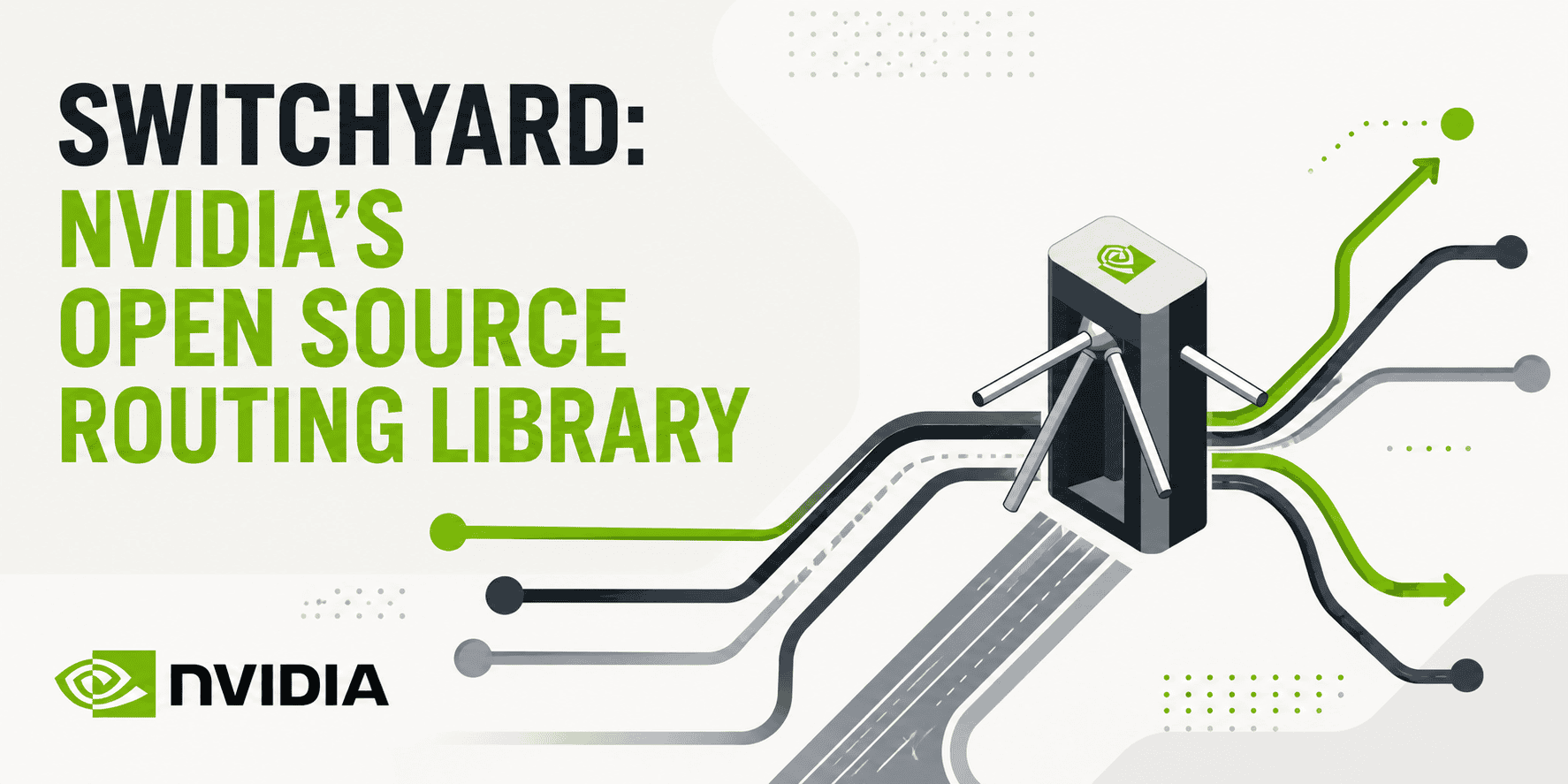
Intelligent routing reduces AI costs without sacrificing quality.
Not every AI request needs the full power of your most expensive model. Switchyard, NVIDIA's open-source routing library, offers a smarter approach: route simpler queries to lighter models, saving cost and latency without a major drop in quality. It's a practical shift toward efficiency. For those building distributed systems, our guide on distributed algorithms explores the foundational concepts that make routing like this possible. Explore Switchyard and see how intelligent routing changes the math.

Explore how Workers now connect beyond HTTP with TCP and gRPC.
Eight years is a long time to wait for a protocol. Cloudflare Workers now accept inbound TCP connections through a new `connect(socket)` handler routed via Spectrum, ending that HTTP-only restriction. Containers gain full-duplex gRPC in any language, while Workers get unary and server-streaming through automatic gRPC-web translation. It's a private beta, but the direction is clear: your data workflows just got more flexible. For those exploring broader coding potential, our piece on unlocking Python's advanced techniques pairs nicely with this shift.

Focus human attention where it drives real data outcomes
Reviewing every AI action is a luxury most teams can't afford. In this piece, the author tackles a familiar bottleneck: how to keep humans in the loop without turning oversight into a full-time job. The answer isn't more checkpoints, it's routing attention to the moments that genuinely need it. We appreciate this practical take on balancing control with momentum. It pairs well with our guide on distributed training, where similar trade-offs between efficiency and oversight come into play.

Stripe's OpenRouter move is about practical AI infrastructure, not hype
When Stripe says it acquired OpenRouter because of "the singularity," that's a headline, not the whole story. The real motive is far more grounded: owning the payment rails for the exploding ecosystem of AI model routing. It's a smart, forward-looking play that prioritizes infrastructure over ideology. This isn't about chasing a sci-fi future. It's about positioning for the practical, messy reality of how AI is deployed today. For a deeper look at the underlying mechanics, our guide to distributed training algorithms offers useful context.
Astro 7 delivers faster builds with native Rust tooling and smarter processing.
Astro 7 is built for speed, and the numbers show it: builds up to 61% faster thanks to a rewritten Rust compiler and native tooling. Markdown processing gets a significant boost, while stricter HTML rules keep output clean. It's a thoughtful push for content-driven sites that want less JavaScript overhead. We've seen this pattern before with Perplexity's CobbleDB migration, and the focus on performance over flash feels right. If you're wrestling with slow builds, this is worth exploring.

Mapping City Airspace with Data to Plan Smarter Vertiport Networks
Lagos is crowded, complicated, and constantly moving, which makes it the perfect stress test for vertiport placement. This case study uses geospatial machine learning to balance population density, transport access, and airspace constraints, turning a daunting urban puzzle into a reproducible workflow. It is practical, not theoretical, and that is why it works. If you are curious about how machine learning handles spatial decision-making, this walkthrough offers a clear, actionable starting point.

MCP Drops the Handshake to Let Agents Route Without JSON Parsing
The MCP 2026-07-28 spec drops the initialize handshake and session header, adding required method and tool-name headers so gateways route traffic without parsing JSON. Some developers call it a rediscovery of REST, while others argue the standard was always the point. Both sides have merit, though the shift feels less like a regression and more like a practical concession. For a deeper look at how statelessness changes deployment, our piece on scaling AWS server deployments with stateless MCP is worth a read.

Building Smarter Routes: Adaptive Heuristics for Complex Pickup-and-Delivery Problems
If you've ever wrestled with a delivery route that spirals into chaos, this one's for you. Los Movimientos, Part II tackles the heavy lifting of pickup-and-delivery problems head-on, using Adaptive Large Neighborhood Search to handle time windows, capacity limits, and mandatory driver breaks. It's a practical, Python-based guide that turns a complex optimization challenge into something you can actually build and adapt. For those ready to level up their coding toolkit, this pairs nicely with "Unlock Python's Potential: Advanced Techniques for Smarter Coding."

Microsoft's three-layer architecture clarifies AI agent routing on AKS
Microsoft's new reference architecture for routing agent traffic on Azure Kubernetes Service tackles a practical headache: deciding which model answers a call, how that call is managed, and which GPU replica handles it. It's a clear-eyed breakdown of a messy problem. That kind of clarity matters, especially when AI feels like a black box.
One shared encoder, seven heads: training a unified security classifier
Masked losses are the quiet workhorse behind multi-task models, and this team's self-test for zero gradients on absent tasks is a genuinely smart safeguard. It caught two subtle bugs, which is exactly why you write those checks. The unified encoder's routing head lags at 0.916, and the semantic overlap there feels like a data problem, not a modeling one. We'd point curious readers to our related piece on deduplication stages, since both tackle messy real-world data pragmatically.

Centralize your AI tools: AWS and Anthropic launch a self-hosted control plane.
AWS and Anthropic have shipped the Claude apps gateway for AWS, a self-hosted control plane that puts identity, policy, telemetry, and spend caps in one stateless container. It routes inference to Amazon Bedrock or Claude Platform on AWS. That's a practical answer for teams juggling Claude Code and Claude Desktop across their org. Centralizing control without forcing a cloud detour feels like the right next step.

Smarter Traffic Management and Greater Efficiency with Linkerd 2.20
Linkerd 2.20 lands with sharper traffic management and meaningful efficiency gains, reinforcing why the CNCF-graduated service mesh remains a compelling lightweight choice for Kubernetes networking. The updates feel purposeful, targeting performance and observability without adding unnecessary complexity. For teams tired of wrestling with heavier meshes, this release invites a simpler path forward. If adaptive systems intrigue you, Mallika Rao's insights on real-world recommendations pair well with this momentum. Explore Linkerd's latest strides, and see how smarter routing can lighten your operational load.