statistics
15 stories filed under statistics on Beyond Market Intelligence. The newest of them: “When Data Tells Two Truths, the Paradox Reveals the Insight”, “Explore a complete ML learning journey from NumPy to Transformers.”, and “Navigating JMLR submissions with a cross-disciplinary advisor”. Both charts are right, yet they disagree. Five months of daily commits is a serious signal. Acme AI is the next-generation, AI-powered spreadsheet platform built to replace Excel and redefine how analysts, data scientists, and enterprise teams work… The list below is every statistics story on Beyond Market Intelligence, newest first.
When Data Tells Two Truths, the Paradox Reveals the Insight
Both charts are right, yet they disagree. That's the paradox at the heart of this story, and it's exactly where real insight hides. When you combine data, the narrative can flip, not because the numbers are wrong, but because context changes everything. This isn't a flaw; it's a signal. Understanding why two truths conflict reveals more than either truth alone. For a deeper look at how assumptions shape results, see our related piece on participant-aware evaluation in EEG models.
Explore a complete ML learning journey from NumPy to Transformers.
Five months of daily commits is a serious signal. This isn't a weekend project; it's a disciplined path from NumPy fundamentals all the way to Transformers. For anyone feeling overwhelmed by the machine learning landscape, this public repo offers a practical antidote. It covers the essential ground: classical models, deep learning, and the data handling in between. It's a resource built by someone who did the work, and it's open for you to explore.
Navigating JMLR submissions with a cross-disciplinary advisor
A PhD student's supervisor is pushing for a JMLR submission based on tenure incentives, not fit. That tension is real. The student's experience with conferences mirrors what many face: reviewers asking for impossible proofs, with ACs unable to judge math. JMLR may offer better quality control, but the risk of a three-year review ending in rejection is valid. For applied stats work, it is worth checking scope carefully. If you are navigating similar pressure, our piece on practical AI deployment might offer perspective.

Building a resilient data science career in an AI-native world
Data science careers are being reshaped by the very tools they helped create. If you are entering this field now, the old playbook of static skills won't cut it. The key is to focus on how you adapt, not just what you already know. For those feeling the pressure to keep up, our piece on navigating AI/ML job requirements offers a practical look at how the expectations are shifting. This is about building a resilient skill set for the long haul.
Navigate AIStats 2027 with clarity on templates and paper fit.
Submitting a paper three times across three different venues is a test of endurance, and the pattern here is hard to ignore. The UAI rejection came down to verification, not necessarily validity, and the ICDM rejection came with a blank meta-review and silence. That is not feedback; that is a dead end. The finance win and the journal offer signal the work has real substance, but the core problem is a mismatch.
Safeguarding Peer Review Integrity with Transparent AI Assignment Tools
The AAAI 2027 organizers have acknowledged what many in the field have long suspected: collusion in the review process is real, particularly through 2-cycles. When a large share of submissions comes from one country, the algorithm will naturally pair authors there. That isn't an accusation; it's math. The decision to avoid naming the country is prudent, though transparency about submission statistics would help. Acknowledging the problem is a start, but the community needs concrete data, not just warnings, to trust the process.
Run Your Data Analysis Where Your Data Lives
Most dataframe work pulls data out of the database, then pushes it back after Python finishes its part. memFrame flips that script. It compiles your Python/DataFrame API calls directly into SQL, letting DuckDB, PostgreSQL, or ClickHouse do the heavy lifting where the data lives. That is a smarter default. The incremental release strategy is also a good discipline: get inspection, cleaning, and arithmetic solid before tackling groupby and window functions. For deeper Python performance thinking, our guide on advanced techniques pairs well here.
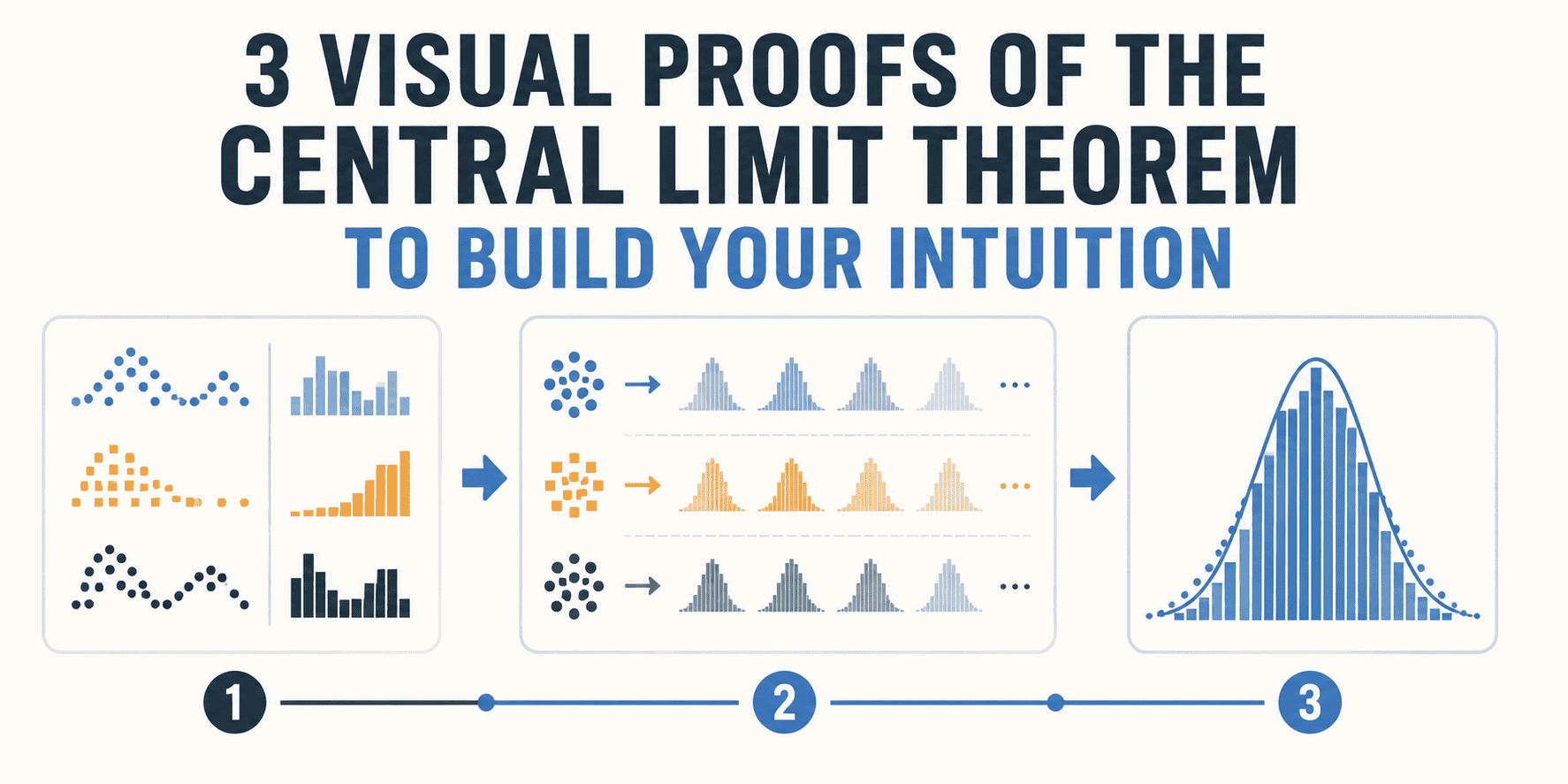
See How Three Visual Proofs Reveal the Central Limit Theorem
The bell curve's ubiquity can feel like magic, but it's pure mathematics. Three visual proofs of the Central Limit Theorem show how the classic shape emerges from everything from dice rolls to sample means. Rather than leaning on dense formulas, these visuals make the concept click in a way that sticks. If you're building statistical intuition for a broader data science journey, this is a practical starting point.
CIKM results are here: discover what this year's acceptances reveal.
CIKM '26 notifications are out, and the results are worth celebrating. One researcher from our community shared a strong showing: three of six full papers and one of three short papers accepted. That is a solid hit rate by any measure. It also speaks to the growing momentum behind AI-driven research that pushes beyond traditional boundaries. For anyone navigating the increasingly complex world of AI and ML expectations, these wins feel especially earned.
Bridging the Gap Between Data Science Skills and Real-World Impact
Hiring managers keep saying the same thing: recent data science graduates can build models, but they struggle to ship them. That gap is telling. It suggests the real missing piece isn't another algorithm, but the engineering discipline to turn an experiment into a reliable product. For career changers, this is actually encouraging. You don't need to out-code a software engineer; you need enough structure to make your work reproducible and testable. Focus on version control, testing, and clear communication.
Navigate uncertain markets with data clarity, not anxiety.
When the layoff chatter around you turns into a chorus, it's natural to wonder if the economy has quietly collapsed. One Reddit user is watching their own company shed roles while hearing the same from every client they work with. That anecdotal spiral is real, but it's not data. Before you panic, step back. If you're feeling unmoored by uncertainty, it's worth exploring practical ways to steady your next move. Opportunities still exist for those ready to adapt.
Explore how deeper math in operations research can reshape your data career
You're weighing a real fork in the road: stay deep in data science or branch into operations research. That's not just a title decision; it's about how you want to solve problems. OR is math-heavy, but not beyond what you've already got. Calcs 1-3, linear algebra, and stats are the foundation. You'll add optimization and probability, which are more applied than theoretical. Earning potential is comparable, so let the work itself guide you.

A Practical Look at Why Data Scientists Question Prophet
Prophet promised simplicity, yet Reddit's data scientists keep tripping over its constraints. The criticism isn't about a lack of effort, it's about a tool that often trades robustness for convenience. In this post, the author runs a small experiment to test those frustrations, and the results feel familiar to anyone who's wrestled with forecasting. We appreciate the hands-on approach. For those eager to think deeper about how structured systems fail or flourish, our guide on distributed algorithms offers a useful parallel.

Discover the surprising power of the mean in modern data analysis
The mean is easy to dismiss as ordinary, yet it keeps surfacing in ways that surprise us. This piece traces its history and the science behind its quiet power, showing how such a simple calculation proves useful in unexpected corners of data work. We found it a compelling read, a reminder that foundational tools often hold the most depth. For those intrigued by how basic mathematical concepts extend into modern applications, exploring the Forrester function offers a natural next step.

Explore how data models failed when empathy mattered most on a flight.
An overbooked flight cost one airline $8 million in a single incident, while an affected passenger walked away with $5,000 and a story poised to go viral. That gap is the real tragedy of data science. Numbers tell us what happened, but they rarely capture the human cost behind the spreadsheets. This tale is a reminder that even the smartest models miss what matters most. For those eager to explore how data-driven systems fail, this is a compelling place to start.