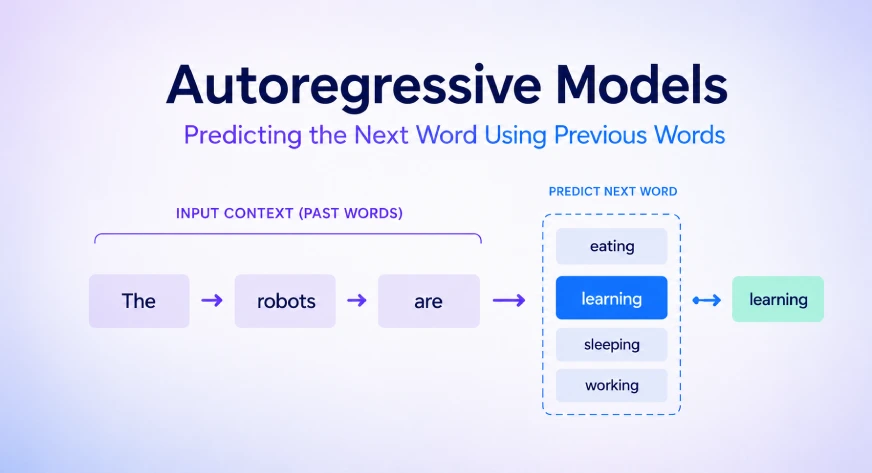
The exploration of autoregressive models, as detailed in Satya Nadella warns that AI could hollow out entire industries, echoing the damage done by globalization, highlights a crucial shift in how we understand and leverage data. While the concept—predicting future values based on historical trends—appears straightforward, its implications ripple through numerous fields, from financial forecasting to weather prediction. Analytics Vidhya’s piece effectively demystifies the technique, making it accessible to a broader audience. It’s a valuable reminder that powerful AI solutions don't always require overwhelming complexity; sometimes, the most elegant approaches are rooted in fundamental principles. Understanding these models is increasingly important as the volume and velocity of data continue to accelerate, and the ability to extract meaningful insights from time series becomes paramount. The simplicity of the core idea belies the sophistication of its applications and the predictive power it unlocks.
The beauty of autoregressive models lies in their adaptability. They’re not a one-size-fits-all solution, but rather a foundational building block that can be tailored to a wide range of scenarios. Consider the implications for industries facing rapid change, particularly as discussed in SpaceX is public: Everything you need to know post-IPO. Accurately forecasting demand, resource allocation, and even potential disruptions becomes significantly easier with a robust autoregressive model. Moreover, the increasing accessibility of these techniques, facilitated by platforms and libraries that abstract away much of the underlying complexity, is empowering a new generation of data scientists and analysts. This democratization of predictive modeling capabilities has the potential to drive innovation across various sectors. The Java news roundup Java News Roundup: A2A Java SDK 1.0, Jakarta EE 12, JNoSQL, GraalVM, Micrometer, OpenXava, Gradle also demonstrates a broader trend of accessible and powerful tools for data manipulation and analysis, furthering the application of techniques like autoregressive modeling.
However, it's crucial to acknowledge the limitations. Autoregressive models are inherently reliant on historical data; their predictive accuracy diminishes when faced with unprecedented events or structural shifts in the underlying patterns. They excel at capturing cyclical trends and short-term fluctuations but may struggle to anticipate entirely new phenomena. Furthermore, careful feature engineering and model validation are essential to avoid overfitting and ensure reliable predictions. The choice of lag variables – the number of previous values considered – is a critical parameter that significantly impacts performance, and requires thoughtful experimentation and analysis. Failing to address these nuances can lead to misleading forecasts and flawed decision-making.
Looking ahead, we anticipate seeing autoregressive models increasingly integrated with other AI techniques, such as neural networks and reinforcement learning, to create even more sophisticated predictive systems. Hybrid models that combine the strengths of different approaches offer the potential to overcome the limitations of individual techniques and achieve higher levels of accuracy and robustness. The question then becomes: how can we effectively design and implement these hybrid models to maximize their predictive power while maintaining interpretability and transparency? The future of data management lies not just in powerful tools, but in the ability to harness them strategically and responsibly.