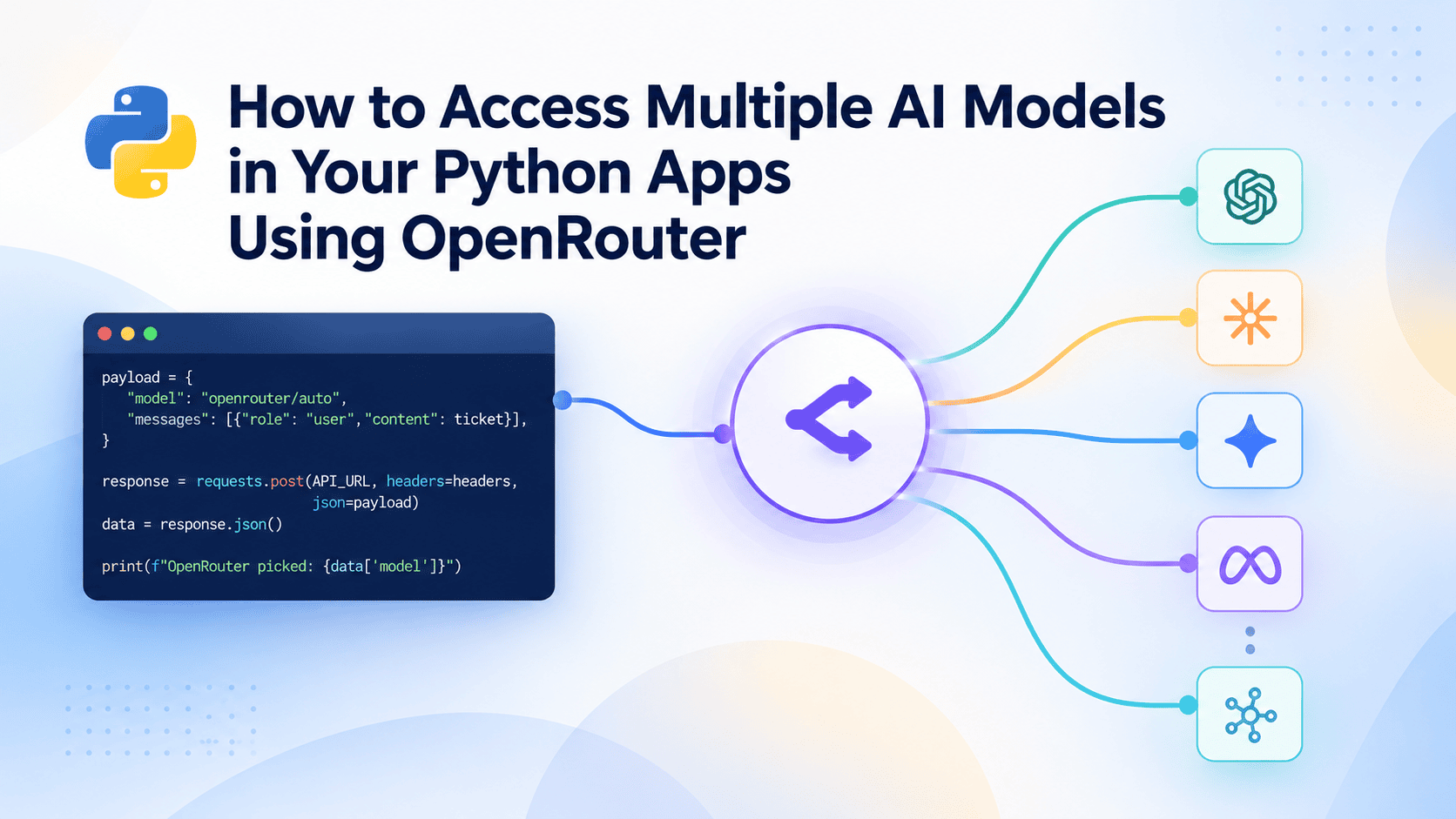
The promise of AI has always been choice, but the practical reality has been fragmentation. Developers and data professionals have been forced to juggle multiple APIs, manage separate billing accounts, and rewrite code every time they want to compare how GPT-4 handles a task against a Llama model or a Mistral variant. That friction has kept many users locked into a single provider, not because it is the best tool for every job, but because the overhead of switching is simply too high. The OpenRouter API changes that calculation, and we think it is one of the most practical steps forward for Python workflows we have seen in months.
By offering access to dozens of models through a single endpoint, OpenRouter lets you do what should have been straightforward from the start: compare responses side by side, swap models with a single parameter change, and set automatic fallbacks so your pipeline keeps running even when one provider hits capacity. This is not about chasing the "best" model for every task, a pursuit that often leads to diminishing returns. It is about building resilient, adaptable systems that make the right trade-off between cost, speed, and capability without requiring a rewrite every quarter. The approach mirrors a broader trend we have been tracking, such as the WebAI standard brings local AI models to your browser tab, which similarly aims to reduce friction by letting users run models directly in the browser. Both efforts recognize that the barrier to entry is not intelligence, it is integration.
What makes OpenRouter particularly compelling is how it reframes the developer's relationship with AI models. Instead of committing to one vendor's roadmap, you can treat models as interchangeable components in a larger system. Need a cheap model for bulk classification and a powerful one for complex reasoning? Route them through the same API. Worried about a model being deprecated or a price hike? Swap it out without touching your core logic. This flexibility is especially valuable when you consider how quickly the landscape is shifting. We recently saw how Nvidia backs Simplismart as it cuts GPU needs and revenue surges 14x, a reminder that the infrastructure underpinning these models is evolving rapidly. Building your workflows around a single API that abstracts that complexity is not just convenient, it is strategic.
The concrete takeaway is this: start using a unified API layer now, even if you only need one model today. The cost of integrating a second model later is near zero, and the fallback capability alone is worth the setup time. The open question is whether OpenRouter can maintain reliability as demand scales, and whether the pricing model stays transparent as more providers are added. For now, the value is clear. The future of AI-powered Python workflows is not about finding the single best model, it is about having the freedom to choose the right one for each moment.