Inside Claude Code Auto Mode: Anthropic’s Autonomous Coding System with Human Approval Gates
Our take
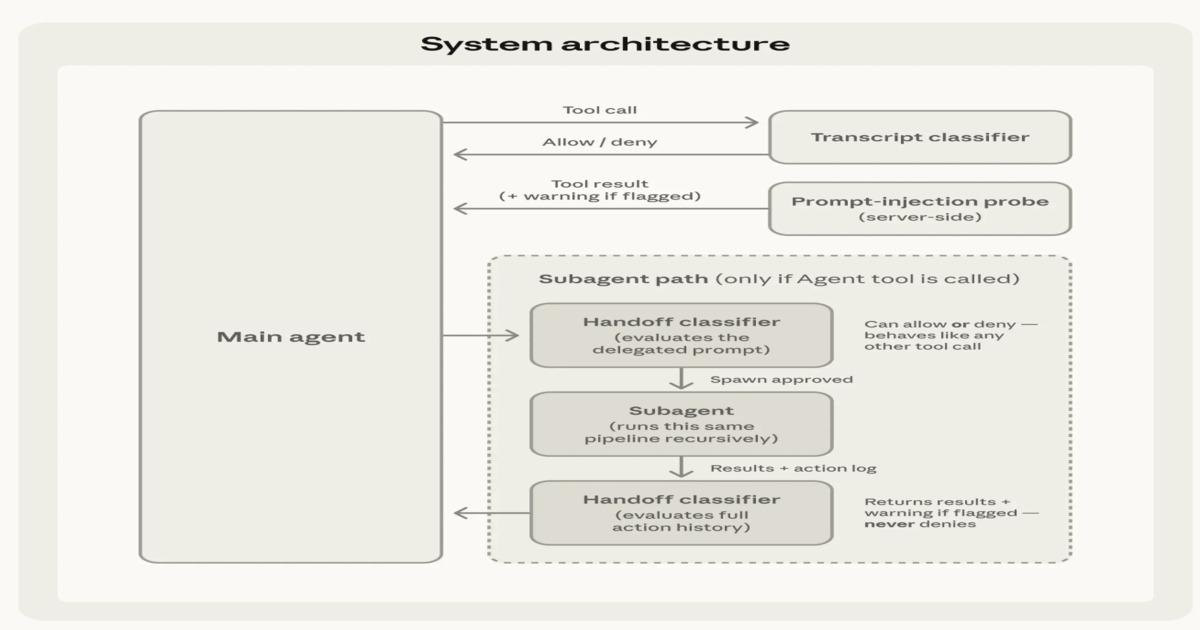
Anthropic’s new auto mode for Claude Code signals a subtle but significant pivot in how we think about AI‑assisted coding. By allowing the model to execute multi‑step workflows with fewer manual approvals, the company is moving beyond the “hands‑on” paradigm that has long dominated the developer experience. In the same breath, it keeps human oversight intact through layered safety checks—input filtering, action evaluation, and a two‑stage classification system—ensuring that the system remains accountable for sensitive operations. This blend of autonomy and control is echoed in earlier pieces such as Anthropic hands Claude Code more control, but keeps it on a leash and Anthropic Introduces Agent-Based Code Review for Claude Code, which explored how the platform is progressively refining its safety nets while expanding its functional reach.
Why does this matter to the average developer or data scientist? Traditional spreadsheets and manual coding tasks often become bottlenecks when they grow in scale or complexity. Auto mode offers a pragmatic solution: by delegating routine, deterministic steps—such as writing boilerplate code, running unit tests, or generating documentation—to Claude Code, users can reclaim cognitive bandwidth for higher‑order problem solving. The feature’s safety architecture also addresses a common pain point: the fear that an autonomous agent might introduce subtle bugs or security flaws. By embedding human approval checkpoints for critical operations, Anthropic preserves the human‑in‑the‑loop model that many enterprises rely on, while still delivering the efficiency gains that come from automation.
From a broader industry perspective, Claude Code’s auto mode exemplifies a trend toward “human‑centric AI” rather than the more dramatic “AI‑driven” narratives that dominate marketing. The approach respects the expertise of its users, positioning the AI as an empowering collaborator rather than a replacement. This is especially relevant for teams that have grown accustomed to legacy spreadsheet workflows and are wary of fully adopting new tools. By framing the transition as an incremental enhancement—think of it as adding a smart assistant to your existing spreadsheet rather than buying a new platform—Anthropic lowers the entry barrier and accelerates adoption.
Looking ahead, the success of auto mode will hinge on how well it balances speed and safety for real‑world projects. Will developers find the approval gates cumbersome, or will they become a trusted checkpoint that keeps code quality high? Will the layered safety mechanisms scale when Claude Code tackles more complex, domain‑specific tasks? These questions are worth watching as Anthropic continues to iterate on its agent‑based architecture. The next logical step will be to see how auto mode integrates with continuous integration pipelines and whether it can autonomously resolve merge conflicts or suggest optimal refactors. As the line between human and machine contributions blurs, the focus will shift from “who wrote the code” to “how effectively the code serves its purpose.”
Anthropic has introduced auto mode in Claude Code, enabling multi-step software development workflows with reduced manual intervention. The feature combines automated execution with layered safety mechanisms, including input filtering, action evaluation, and two-stage classification, while maintaining human approval checkpoints for sensitive operations.
By Leela KumiliRead on the original site
Open the publisher's page for the full experience
Related Articles
- Anthropic hands Claude Code more control, but keeps it on a leashAnthropic’s new auto mode for Claude Code lets AI execute tasks with fewer approvals, reflecting a broader shift toward more autonomous tools that balance speed with safety through built-in safeguards.
- Anthropic Introduces Agent-Based Code Review for Claude CodeAnthropic has introduced a new Code Review feature for Claude Code, adding an agent-based pull request review system that analyzes code changes using multiple AI reviewers. By Daniel Dominguez