Top 10 Open-Source Libraries to Fine-Tune LLMs Locally
Our take
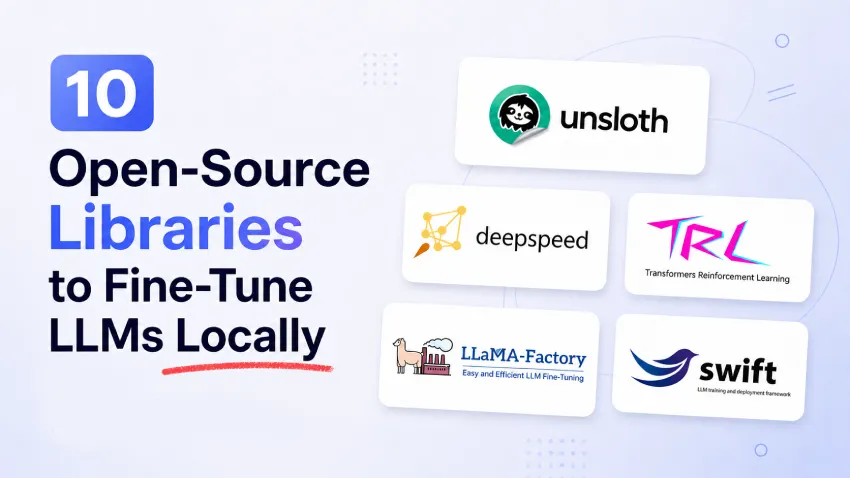
Our take on the surge of open‑source fine‑tuning libraries is simple: the barrier between data‑savvy teams and truly customized language models is finally disappearing. The article “Top 10 Open‑Source Libraries to Fine‑Tune LLMs Locally” spotlights tools that let developers train, adapt, and deploy models without the heavyweight infrastructure that once belonged to a handful of research labs. This democratization matters because it aligns directly with the progressive, human‑centered vision we champion—empowering users to turn raw data into actionable insight without wrestling with a monolithic stack. Readers who have followed our piece on How AI Agents Will Transform Data Science Work in 2026 will recognize a familiar theme: the shift from static, one‑size‑fits‑all tools to adaptable, AI‑native workflows that respect both technical constraints and real‑world outcomes.
What makes the top‑ten list compelling is not just the variety of features—low‑VRAM LoRA, QLoRA, RLHF, DPO, multi‑GPU scaling, and sleek UI layers—but the way each library solves a concrete pain point. For teams constrained by limited GPU memory, libraries such as bitsandbytes‑enabled LoRA let a model the size of LLaMA‑13B be fine‑tuned on a single RTX 4090. For enterprises that need to iterate quickly on user feedback, RLHF and DPO integrations provide a structured path to align model behavior with business policies, turning vague “improve the response” tickets into measurable training loops. The presence of simple graphical interfaces, as seen in projects like Axolotl or Simple‑Trainer, means that a data analyst with spreadsheet expertise can launch a fine‑tuning job as easily as they would run a pivot table. This accessibility echoes the sentiment in our recent guide on Order form that references data from a table, where we argued that empowering non‑engineers with intuitive tools drives faster adoption and higher ROI.
Beyond convenience, the strategic impact is profound. Open‑source libraries lower the total cost of ownership and eliminate vendor lock‑in, allowing organizations to keep proprietary data in‑house while still benefiting from cutting‑edge model adaptations. This is especially relevant for sectors that handle sensitive information—finance, healthcare, or regulated manufacturing—where moving data to a cloud AI service can raise compliance concerns. By fine‑tuning locally, teams can embed domain‑specific vocabularies, enforce strict privacy filters, and maintain full audit trails, all while preserving the performance gains of large language models. In practice, a marketing analytics group could train a model to interpret campaign metrics directly from a spreadsheet, turning rows of numbers into concise narrative summaries without exposing raw data to external APIs.
The ecosystem’s momentum also hints at a broader shift in how AI research translates into production. As more contributors add modular components—optimizers, data loaders, evaluation suites—the community creates a shared foundation that accelerates innovation. This collaborative model mirrors the open data marketplace described in “Origin Lab raises $8M to help video game companies sell data to world‑model builders,” where shared resources fuel specialized AI applications. For readers, the takeaway is clear: the decision to adopt one of these libraries is less about chasing the latest hype and more about building a sustainable, future‑focused data pipeline that can evolve alongside business needs.
Looking ahead, the real question is not whether fine‑tuning will become standard practice, but how organizations will orchestrate these tools at scale. Will we see unified orchestration layers that automatically select the optimal library based on hardware, data size, and latency requirements? Will the rise of AI‑native spreadsheet platforms integrate these fine‑tuning capabilities directly into the cells where analysts already work? The answers will shape the next wave of productivity, and we’ll be watching closely.
Fine-tuning LLMs has become much easier because of open-source tools. You no longer need to build the full training stack from scratch. Whether you want low-VRAM training, LoRA, QLoRA, RLHF, DPO, multi-GPU scaling, or a simple UI, there is likely a library that fits your workflow. Here are the best open-source libraries worth knowing for […]
The post Top 10 Open-Source Libraries to Fine-Tune LLMs Locally appeared first on Analytics Vidhya.
Read on the original site
Open the publisher's page for the full experience