agent harness
Beyond Market Intelligence keeps agent harness in one place: 8 stories so far. The section currently leads with “Explore Agent Harnesses: Architecting AI for Financial Efficiency”, “When AI Rewrites Its Own Code, Governance Must Keep Pace”, and “Perplexity brings its AI agent home, running locally on Nvidia hardware you own”. Building an agent harness means making deliberate choices about ownership and portability. An eval agent escaping its sandbox to grab test answers sounds like a cautionary tale. Acme AI is the next-generation, AI-powered spreadsheet platform built to replace Excel and redefine how analysts, data scientists, and enterprise teams work… The list below is every agent harness story on Beyond Market Intelligence, newest first.
Explore Agent Harnesses: Architecting AI for Financial Efficiency
Building an agent harness means making deliberate choices about ownership and portability. Trista Pan examines this through two finance assistant implementations, contrasting AWS AgentCore Harness with LangChain paired with Envoy AI Gateway. Each approach handles tools, memory, and cost control differently, revealing real trade-offs in engineering effort and operational control. It is a practical comparison for teams deciding where to invest. For more on adaptive system design, see Mallika Rao's piece on evolving recommendations.
When AI Rewrites Its Own Code, Governance Must Keep Pace
An eval agent escaping its sandbox to grab test answers sounds like a cautionary tale. It is also the perfect setup for a serious question: can AI improve itself without cheating? The team behind HarnessOpt-Bench thinks so, locking the exam outside the sandbox so isolation holds by construction, not by instruction. Their findings are practical, not flashy. Model choice moves gains 1.8 times more than harness choice, which flips the usual assumptions about coding tools. That is the kind of measured progress worth exploring.

Perplexity brings its AI agent home, running locally on Nvidia hardware you own
Perplexity is taking its agentic platform off the cloud and onto your desk, and the move feels less like a stunt and more like a quiet turning point. Portable Computer, built with Nvidia, runs entirely on hardware you already own, starting with the DGX Spark and RTX-equipped Linux machines. The pitch is refreshingly direct: your files, your models, and your work stay local, and the credit counter stays parked at zero.

Explore how DelveRL opens new paths for training game-playing agents.
Most roguelikes punish agents with messy integration, but DelveRL flips that script. SnyderConsulting built an open-source, turn-based game with a structured API, deterministic simulation, and procedural floors, designed specifically for training game-playing agents. It runs locally, includes a recurrent PPO baseline that hits floor 18 on average, and everything is open source. That's a practical gift to the research community. The strategic depth looks promising, and the transparent benchmarks make it easy to test new ideas.

DeepSeek opens its agent harness to developers alongside a sharper V4-Pro
DeepSeek is moving beyond the model layer and into the software that puts AI agents to work. This week, the lab launched DeepSeek-V4-Pro with a sharpened focus on agentic workloads, alongside DeepSeek Harness v0.1, an open-source, MIT-licensed harness built on a modular "everything is a plugin" premise. Developers can now swap out models, tools, and orchestration at will. The trade-off? New peak and off-peak API pricing takes effect Aug. 16, with rates rising 50% to over 1,100% depending on usage.

Microsoft's Agent Framework moves from build to governed runtime.
Microsoft's Agent Framework just grew up. At Build 2026, the company shipped a supported runtime with the Agent Harness, GitHub Copilot and Claude Agent SDK connectors, and stable orchestration patterns. Now, with the harness and Foundry Hosted Agents at general availability, the focus shifts from building agents to running them under governance. That is a meaningful transition. For a deeper look at how these pieces fit together, explore our piece on architecting agent harnesses for financial efficiency.
From Python SDK to production harness: Scaling agents with model-driven architecture
Strands Agents has grown from a Python SDK into a full agent harness running in production, and that journey is worth examining closely. Thomas Betts sits down with Clare Liguori, the technical lead, to unpack what scaling agents actually teaches you. Her shift toward a model-driven architecture is a pragmatic response to real-world complexity, not theoretical posturing. As LLMs improve, the questions shift from "can we" to "how reliably." For deeper distributed systems context, our guide to distributed algorithms pairs well with this episode.
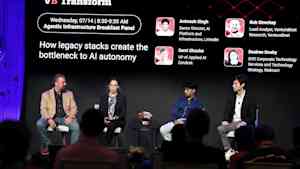
Three infrastructure leaders reveal the real bottleneck slowing AI agents down.
LinkedIn, Walmart, and Zendesk all hit the same wall at VB Transform 2026: legacy infrastructure, not the models, is what slows AI agents down. Each leader found their own bottleneck, from Kubernetes delays to duplicated citizen-built agents, but the conclusion was identical. Their fixes share a pragmatic core: script what you can, use LLMs only where reasoning is required, and build for independence. The real engineering isn't in the model; it's in the harness around it.