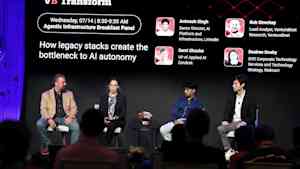
The most useful thing said at VB Transform 2026 wasn't about models. It was about the quiet assumption hiding beneath every stalled pilot: that the technology was the hard part. The leaders from LinkedIn, Walmart, and Zendesk each hit a different wall, yet they all described the same fundamental error. Your infrastructure was built for human rhythm, for the pace of a person clicking, waiting, and refreshing. Agents don't have that patience. They operate in milliseconds, and when they hit a system that takes seconds to spin up a container, the bottleneck isn't the intelligence, it's the plumbing. As we explored in our guide to Unlock LLM Training: A Practical Guide to Distributed Algorithms, distributed systems are where the real friction lives, and this panel confirmed that the same laws apply when the workload is agentic.
What stands out is how each company solved the problem without waiting for a better model. LinkedIn's Animesh Singh was blunt about the hallucination issue. Their five-point evaluation system looked clean on paper, but an LLM judging another LLM shares the same failure mode. The fix wasn't a smarter model, it was pushing the LLM to the leaf and keeping 80% of the workflow as scripted, deterministic code. That is not a glamorous answer, but it is an honest one. Walmart's Desiree Gosby hit a different wall, success. Their agent harness went viral internally, and citizen developers started building their own agents. The result was duplication and chaos, so the fix became governance, not restraint. Zendesk's Sami Ghoche faced the data problem, 20 billion conversations that you cannot just stuff into a context window. His advice was to invest in the data pipelines first.
The through-line here is that the model is becoming a commodity. The real engineering is in the harness, the evals, and the memory subsystem. LinkedIn built an AI gateway so every outbound call follows the same semantics, regardless of provider. Walmart built its own gateway to stay vendor agnostic across three workload types. This is not about picking a winner. It is about building for independence, which is exactly the kind of practical architecture we covered in Explore Agent Harnesses: Architecting AI for Financial Efficiency. If you do not own the context and the control flow, you are renting your entire strategy from someone else.
For our readers, the takeaway is direct and worth quoting: invest in evals before anything else. Ghoche called it the thing common to every use case, and he is right. A robust eval suite forces you to break the problem down, and once you have that, you can move fast because you know what broken looks like. The second takeaway is to own your harness from day one, as Gosby advised, because the innovation will come from unexpected places, but only if you have the governance to spot duplication and promote the best version. The open question we are watching is how long the frontier labs stay ahead on reasoning, because if that slice shrinks the way Ghoche suggests, the enterprises that built for independence will be the ones who win. The ones who did not will be stuck rebuilding their infrastructure for the second time in a year.