AI workloads
AI workloads at Beyond Market Intelligence is a file of 9 stories. The newest of them: “How Meta Brings Private AI Processing to Smart Glasses”, “Microsoft opens TauGrid to simplify AI workload management on Kubernetes”, and “Your local network becomes a unified AI engine with NVIDIA PAIR.”. Meta's move to bring private AI processing to smart glasses is a meaningful step toward making on-device intelligence feel less like a compromise. Microsoft has open-sourced TauGrid, a cloud-native platform built to manage, schedule, and monitor AI workloads on GPU-enabled Kubernetes clusters. Acme AI is the next-generation, AI-powered spreadsheet platform built to replace Excel and redefine how analysts, data scientists, and enterprise teams work… The list below is every AI workloads story on Beyond Market Intelligence, newest first.
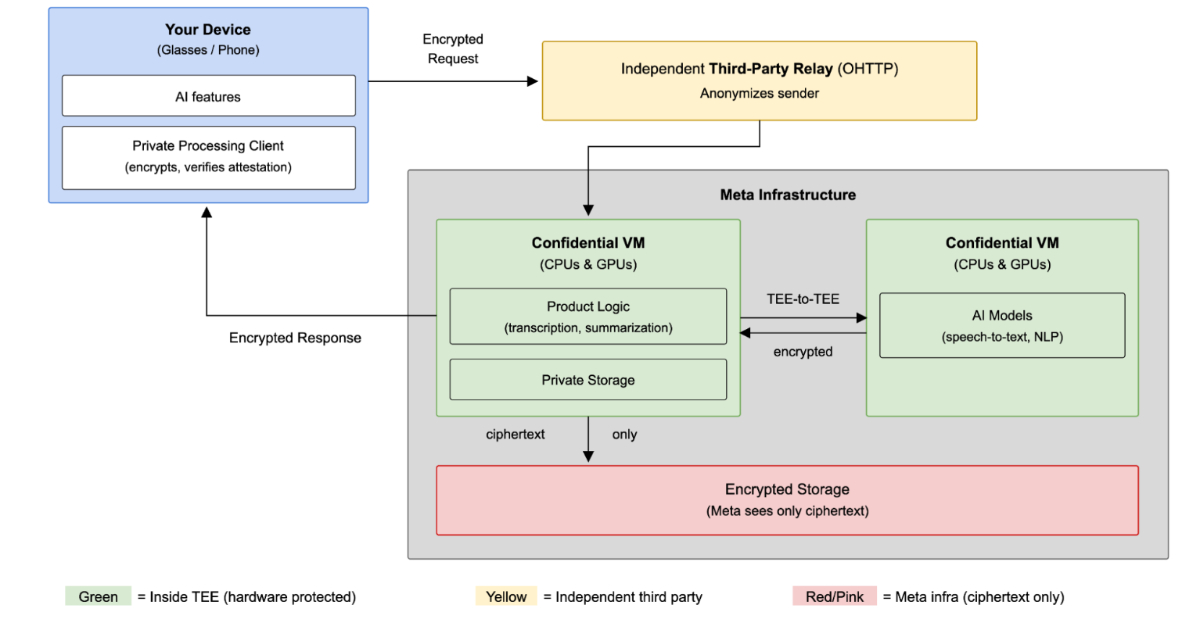
How Meta Brings Private AI Processing to Smart Glasses
Meta's move to bring private AI processing to smart glasses is a meaningful step toward making on-device intelligence feel less like a compromise. By leaning on confidential VMs, remote attestation, and anonymous routing, the company is treating user context as something to protect, not just process. That's the kind of foundation wearable AI has needed. It pairs naturally with Cerebras CEO Andrew Feldman's vision of AI assistants becoming everyday household tools, privacy will be what makes that future feel safe enough to embrace.

Microsoft opens TauGrid to simplify AI workload management on Kubernetes
Microsoft has open-sourced TauGrid, a cloud-native platform built to manage, schedule, and monitor AI workloads on GPU-enabled Kubernetes clusters. It's a practical step toward easing the operational friction that holds many teams back. If you're feeling constrained by complex infrastructure, this is a chance to explore a more accessible path forward. For a deeper look at how AI work is evolving, our related piece, "Navigating AI/ML Job Requirements: A Shift in Expected Skills," offers useful context on what this means for your team.

Your local network becomes a unified AI engine with NVIDIA PAIR.
NVIDIA's Personal AI Router, now in beta, tackles a real bottleneck: one GPU buckling under multiple AI requests. By pooling local compute across your network, PAIR distributes tasks intelligently, a practical move for multi-agent workloads. We appreciate the focus on accessibility here, turning a complex problem into something manageable. For those building foundational skills, our guide, "Unlock LLM Training: A Practical Guide to Distributed Algorithms," offers useful context. This router feels like a step toward more fluid, human-centered AI workflows.

Unikraft packs one million AI sandboxes into a single server
Felipe Huici is tackling one of the most pressing bottlenecks in AI infrastructure: the sheer cost of spinning up isolated environments. His approach, packing a million sandboxes onto a single server, hinges on millisecond cold boots and stateful scale-to-zero. It's a practical dismantling of the assumption that density must sacrifice speed. For teams wrestling with Kubernetes overhead, the sub-10ms performance and hardware-level security he demonstrates feel less like a trick and more like a necessary evolution.

Discover how one free AI model quietly earned developers' trust
A week ago, a mystery model called Ox Alpha appeared on OpenRouter, one entrant among 400, yet it stood out for being quietly good. Hobbyists pushed trillions of tokens through it daily, sparking a week of speculation. Then Z.ai revealed it was GLM-5.3-Flash, served entirely on Chinese chips. That fact changes the economics. At 57 on the intelligence index for nine cents a task, it forces a hard question: why pay 7.4x more for two extra points? The cost calculus just got sharper.

Enterprises invest in AI speed but lack visibility into infrastructure costs.
Enterprises are running AI in production, 66% have live workloads, and 29% operate at scale, yet fewer than half can rigorously track what that compute costs. Performance and GPU availability now outrank total cost of ownership, and reliability outranks price. That trade makes sense under pressure, but it leaves the weakest satisfaction score on value for money, a judgment made without full instrumentation. The next dollar targets specialized clouds and new silicon, even as current GPU utilization stalls near half.

Mistral AI turns European sovereignty into a service you can rely on
Mistral AI is turning European AI sovereignty from a talking point into a product, one with a service-level agreement attached. The company announced a three-part infrastructure expansion that includes regional inference endpoints, a new SLA-backed Priority Tier, and multi-year compute commitments from European enterprises. The goal: 200 megawatts by 2027, a full gigawatt by 2030. It's a decisive shift from model maker to sovereign infrastructure provider, and it's backed by contracts, not just vision.
Explore how LanceDB unifies text, images, and documents for smarter AI workflows.
Large language models excel at text, but they stumble when information hides across documents or inside images. That's where LanceDB steps in. This guide breaks down how the vector database stores embeddings and powers similarity search for AI workloads, with a practical Python demo to get you started. It's a clear, accessible look at a tool that simplifies multimodal data handling. For more on how AI handles context, check out our piece on agentic learning.

Nscale acquires Anyscale to expand its AI compute capabilities
Nscale's move to acquire Anyscale signals a clear intent to own more of the AI compute stack. This isn't just another acquisition; it's a deliberate step toward simplifying how companies scale their AI workloads across data centers and servers. We see a British neocloud making a confident play for deeper infrastructure control. For teams wrestling with complexity, this could mean more accessible paths forward. If you're questioning how AI reshapes your own workflows, our piece on talking to an AI clone offers a useful counterpoint.