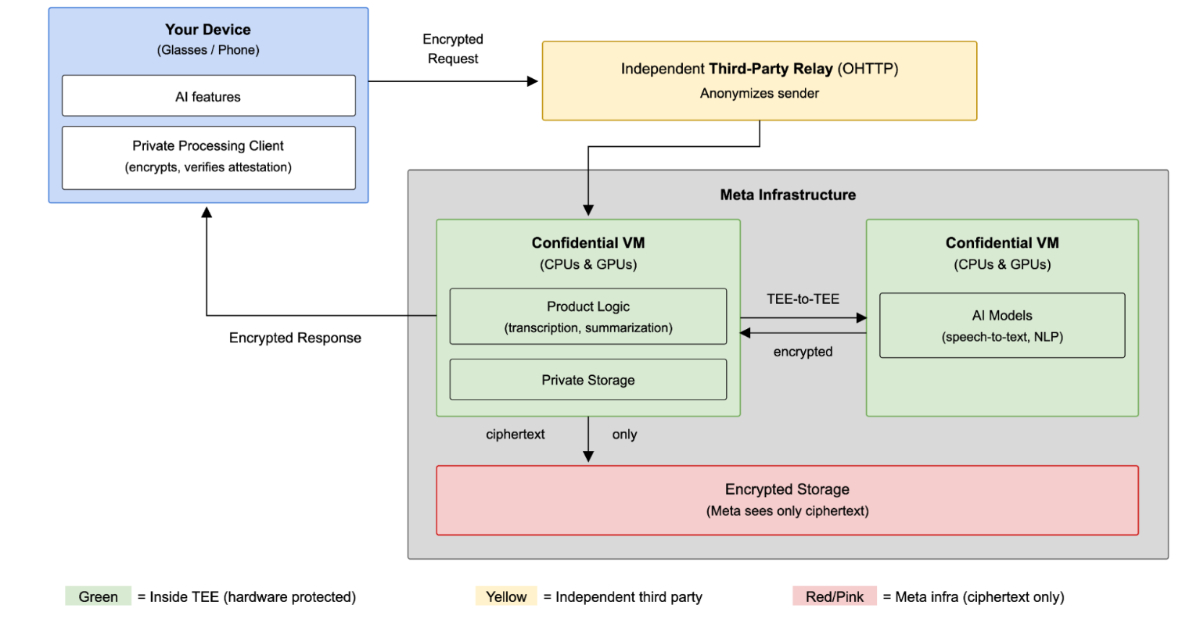
Privacy is rarely the headline feature of a new AI product. It is usually the fine print, the thing companies mention after the demo. Meta's decision to make private processing a core part of its AI glasses is the opposite, and it deserves attention. By routing workloads through confidential VMs, trusted execution environments, remote attestation, and anonymous credentials, Meta is trying to solve the trust problem before it becomes a scandal. The technical details are dense, but the intent is clear: your persistent context should not become a corporate asset.
This matters because glasses are not phones. They are always on, always watching, and always listening. A phone you pick up to ask a question; glasses just hear the question. That intimacy demands a different standard. Meta is betting that users will accept AI assistance only if the system can prove it does not retain what it processes. The combination of OHTTP routing and TEE-based storage is an acknowledgment that the cloud is not a safe place by default. It has to be engineered to be safe, and then it has to demonstrate that safety to the user. This is the same instinct driving Facebook Puts Algorithm Control Directly in Your Hands, a move that hands users more visibility into what shapes their feeds. Both efforts treat user agency as a product feature rather than a regulatory afterthought.
The practical takeaway for anyone building on top of these tools is straightforward: private processing is becoming a baseline expectation, not a differentiator. If you are designing an AI experience that touches personal data, you need to plan for attestation and confidential compute from the start. Retrofitting privacy onto a system is expensive and brittle. Meta's architecture, with anonymous credentials and TEE-based storage, is not just a security stack. It is a template for how to make a device feel safe enough to wear. That is a shift we predicted when we looked at Your Next Home Appliance: An AI Assistant That Works for You, where assistants move from screens into everyday objects. The difference is that a home appliance sits in a room; glasses sit on your face. The threshold for trust is higher.
The open question is whether users will ever verify the attestation claims, or whether they will simply trust the brand. Remote attestation is a powerful tool, but it requires the user to understand what they are checking. Most people will not run the verification. They will rely on Meta's reputation, which is a fragile foundation. The real test is not the technology. It is whether the system behaves correctly under pressure, and whether independent researchers can audit it. Watch for the first third-party security analysis of these glasses. That will tell you more than any spec sheet.