answer
4 stories filed under answer on Beyond Market Intelligence. The newest of them: “Move Beyond One-Off Checks with JEV as Your Continuous Filter”, “Production RAG's Missing Piece: Confident Answers, Honest Refusals”, and “When a RAG System Says No, It Should Show Four Proof Points”. Most hallucination checks happen after the LLM writes a response, only to hand dangerous cases to a human. Moving a RAG prototype to production means confronting the gap between demos and dependable answers. Acme AI is the next-generation, AI-powered spreadsheet platform built to replace Excel and redefine how analysts, data scientists, and enterprise teams work… The list below is every answer story on Beyond Market Intelligence, newest first.
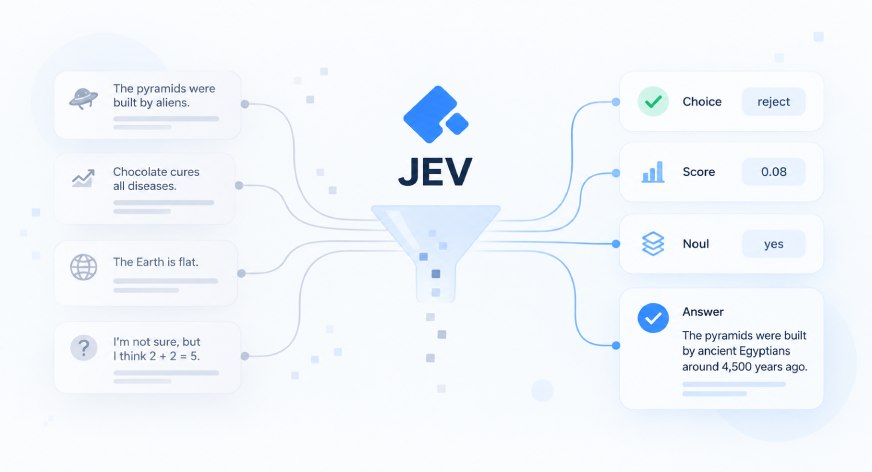
Move Beyond One-Off Checks with JEV as Your Continuous Filter
Most hallucination checks happen after the LLM writes a response, only to hand dangerous cases to a human. That approach treats verification as a one-off event. JEV flips the model. Let the LLM generate freely, then let JEV act as a continuous filter, checking every output, not just the ones that raise red flags. It's a smarter, more scalable safety net.
Production RAG's Missing Piece: Confident Answers, Honest Refusals
Moving a RAG prototype to production means confronting the gap between demos and dependable answers. The checklist we needed focuses on citations for every response, the confidence to refuse when context is insufficient, and access control that resists clever workarounds. Ingestion should never block a user. This is about building trust through honesty. For a deeper look at how systems handle uncertain inputs, our guide on multi-armed bandit simulations offers a useful parallel. Watch the full breakdown here.

When a RAG System Says No, It Should Show Four Proof Points
A confident wrong answer is a bug, but a bare "no answer" with no justification is barely better. This piece breaks down why a RAG system that says "not in this document" must show four distinct kinds of evidence to earn trust. It's a practical push for accountability in AI output. For readers wrestling with how LLMs structure their reasoning, "Exploring Paragraph Structure" offers a useful companion on the mechanics behind the curtain.

Four PDFs, one pipeline: consistent, cited answers from messy documents
Four very different PDFs. One RAG pipeline. The same four upgraded bricks in every case, and every answer typed and cited. That is the kind of consistency that makes a tool feel trustworthy, not just clever. We appreciate how the demonstration walks through the practical wiring of a paper, a NIST standard, and a report with a broken TOC. It is a grounded demonstration of what happens when retrieval is built to handle real-world mess.