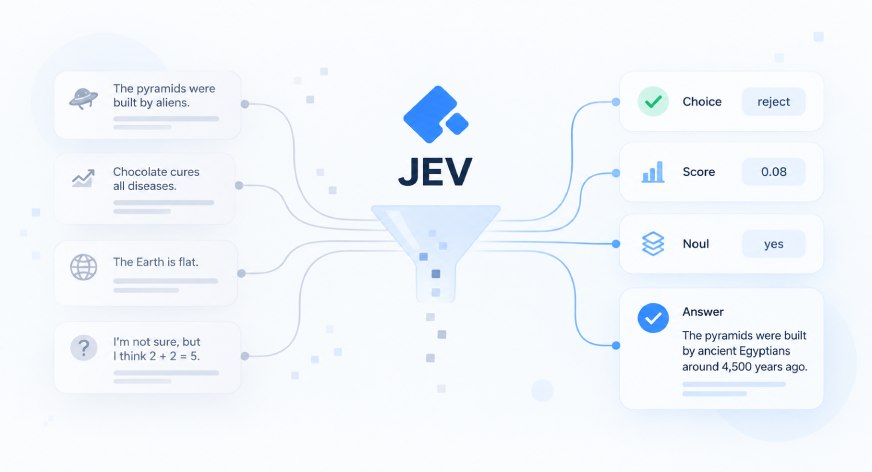
Hallucination checks usually begin after the LLM has already committed to an answer. We write first, verify second, and when the stakes feel high enough, we route the risky cases to a human reviewer. That workflow works, but it treats verification as a one-off event rather than a continuous discipline. The JEV approach flips that assumption: let the model generate multiple candidate responses, then run JEV as a persistent filter across all of them, not as a final gate, but as a layer that operates alongside generation itself. That distinction matters more than the specific mechanics.
What this means in practice is that you stop asking "is this answer correct?" and start asking "which of these answers is most defensible?" The shift is subtle but significant. A single output invites a binary judgment: pass or fail. Multiple outputs invite comparison, ranking, and calibration. JEV's confidence scoring fits naturally into that workflow, because it gives you a reason to prefer one candidate over another without needing a human to read every line. For teams building tools on top of LLMs, this is the difference between spot-checking and building a safety net. You can explore how confidence scores change the nature of the output in our earlier look at Explore Jev AI for precise answers and confidence scores, not just text, where the point is that not every application needs a long response, sometimes you need a reliable one.
The broader lesson here is that hallucination mitigation has been treated as a post-production concern, when it should be designed into the generation pipeline. That is the same mistake we see in other corners of applied AI: we build a model, then bolt on a classifier or a validator, then hope the combination holds. JEV's framing suggests a more integrated path, where the filter is not an afterthought but a recurring component. It aligns with the practical, task-oriented mindset we have championed before, such as in Explore Scikit-LLM for Practical Few-Shot Text Classification, where the value comes from applying the right tool to a narrow, well-defined job rather than expecting one model to handle everything. And it echoes the realism we noted in Exploring Gemini 4 Argon in Practice: Capabilities and Real-World Limits, models promise broad capability, but their limits only surface under repeated use.
The open question is whether JEV's filtering can scale beyond the generation step. If it works as a continuous check, it should also catch drift, edge cases, and ambiguous prompts before they become user-facing errors. That is the detail worth watching: not whether JEV catches a hallucination today, but whether it remains effective when the model changes, the data shifts, or the prompts grow more complex. A filter that only works in a controlled demo is still a one-off check in disguise. The real test is whether it holds up as a permanent layer in the pipeline, and whether teams adopt it as a habit rather than a safety procedure. That is the concrete point we will be tracking.