baseline
baseline at Beyond Market Intelligence is a file of 12 stories. The newest of them: “When AI papers use jargon to obscure, not inform”, “Discover a smarter path through massive data with TabPFN-3.5”, and “Explore how many labeled examples your text classifier truly needs before scaling up.”. We've all been there, slogging through ICLR reviews, wrestling with AI writing that seems designed to obscure rather than inform. Prior Labs just released TabPFN-3.5, and it's a serious step forward for tabular AI. Acme AI is the next-generation, AI-powered spreadsheet platform built to replace Excel and redefine how analysts, data scientists, and enterprise teams work… The list below is every baseline story on Beyond Market Intelligence, newest first.
When AI papers use jargon to obscure, not inform
We've all been there, slogging through ICLR reviews, wrestling with AI writing that seems designed to obscure rather than inform. One reviewer shared a gem: "outperforms the best baseline costing no more at none of six operating points." It's impenetrable, yet calling it "clearly AI writing" misses the point. The real question is how to critique bad writing regardless of its origin.
Discover a smarter path through massive data with TabPFN-3.5
Prior Labs just released TabPFN-3.5, and it's a serious step forward for tabular AI. The model tops both TabArena and BeyondArena, handling up to 1 million rows and 20,000 features with ease. What stands out is the range: the Fast variant runs six times quicker, while Thinking trades compute for accuracy, adding 20 Elo on BeyondArena and 44 on TabArena. BeyondArena's gains are particularly strong on text-rich and high-cardinality data, pulling 250 points ahead of the previous baseline.
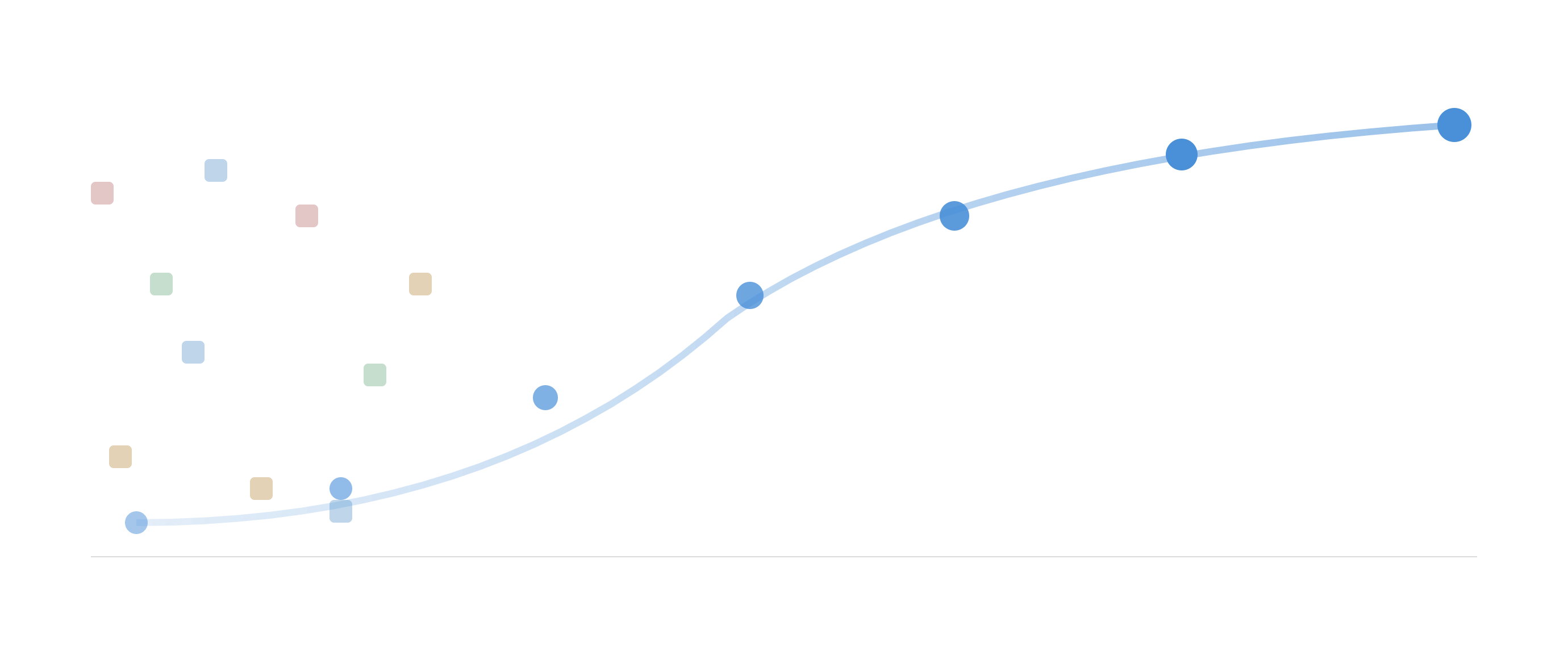
Explore how many labeled examples your text classifier truly needs before scaling up.
Before you default to an LLM API for every text classification problem, consider what a decades-old baseline can already accomplish with the labeled data you have on hand. This piece measures exactly how much more data buys you, turning guesswork into a clear, practical equation. It's a grounded, refreshingly honest look at efficiency. For those ready to move beyond theory, it pairs well with our guide on real-world computer vision deployments, where similar trade-offs shape every decision.
Simple attention fix outperforms costly linear alternatives in long-context tasks
The simplest fix for quadratic-cost attention is sliding-window attention with sinks, and a new arXiv preprint argues it outperforms linear-attention variants by 2 to 10 times on long-context reasoning tasks like Needle-in-a-Haystack and BABILong. The authors, including Alexia Jolicoeur-Martineau, claim post-training linear models have been benchmarked against the wrong baseline. Their recommendation is direct: switch to SWA. It requires no post-training, runs fast, and keeps memory low. That's a compelling challenge to a costly trend.

React Router v8: A Purposeful Shift to ESM and Default Middleware
React Router v8 landed on June 17, 2026, and it's a deliberately boring release. The team stripped things down to an ESM-only build and made middleware the default, signaling a clean break from legacy complexity. With v6 and Remix v2 now at end of life, the migration path is clear, if not thrilling. That's fine. Not every update needs fanfare. For those weighing TanStack Router instead, the choice is yours.
Explore how AI uncovers exactly where world models break down.
World-model evaluation has a blind spot, and it's not where you'd expect. When a "predict nothing changes" baseline scores 0.983 SSIM on real robot video, and the error stays flat across six steps, the metric isn't lying; the setup is. The usable ranking window sits between 8 and 24 steps on DROID footage, bookended by ties. That's a measurement worth stealing for your own data.
Trim Your JavaScript by Trusting What the Browser Already Offers
The gap between "you need a library for this" and "the browser does this" keeps closing, yet many of us still ship heavy dependencies out of habit. Baseline offers a practical path forward: audit what you already have, then test what the web platform now handles natively. It's a focused way to lighten your bundles without sacrificing functionality. If you're managing complex repos, our guide to keeping data science notebooks runnable pairs well with this mindset, helping you sustain momentum across projects.

When a benchmark misleads, transparency earns trust
Ponytail Agent Skill didn't just promise less code; it proved it, then corrected itself when the proof didn't hold up. After a contributor flagged the original 80-94% claim as a flawed baseline, the maintainer didn't argue. They rebuilt the benchmark as a true agentic run and published the honest number: 54%. That kind of accountability is rare, and it's why the project's momentum feels earned, not hyped.
Debugging a Bad Forecast Model Without the Noise
Debugging a bad forecast often starts with a single overall error score, yet that number rarely tells you where to look. Breaking the error down by customer, product, or horizon is a natural first step, but the real question is whether your tools support that or force you to build custom notebooks from scratch. That gap matters. For deeper guidance on refining your approach, our related piece on autoregressive rollout and uncertainty offers a practical next step.
Discover how dynamic routing advances continual learning without replay buffers.
Replay buffers have long been the default answer to catastrophic forgetting, but they carry real costs in memory and privacy. A new open-source framework called Coincidex challenges that trade-off by replacing cached samples with a dynamic task-similarity layer that routes data on the fly. The results are promising on clean task boundaries, yet the authors are honest about instability under chaotic, long-tail shifts. That transparency makes this worth exploring, especially for constrained setups.
Train a harness once, then empower any model on any task
Training a harness once, then swapping in any task LLM, is the kind of reframe that turns a clever hack into a real discipline. The author spent months moving from "Agent-driven Self-improving Harness" to a cleaner concept: freeze the harness, train it against one environment, then let it generalize. The PyTorch-like framework with `StrictPareto()` and `GreedyMonotonic()` is a smart, honest abstraction. Seeing it beat Terminal Bench 2.0 and transfer to unseen tasks suggests determinism was the missing piece.

Why a perfect AI conversation can still signal a broken product
A single AI agent conversation can look flawless on its own and still point to a broken product. That gap is driving a shift in how enterprises evaluate agents, away from scoring individual traces and toward comparing cohorts of users against a baseline. At VB Transform 2026, Harrison Chase of LangChain, Hui Zhang of Conviva, and Emmanuel Turlay of CoreWeave described the move toward contrastive analysis and cheaper, narrower judge models. The takeaway: evaluation criteria are becoming the new product spec.