benchmarking
benchmarking at Beyond Market Intelligence is a file of 21 stories. The newest of them: “When Samplers Fail: Benchmarking Three Methods Against Ground Truth”, “When AI judges ignored the image, GPT-4o invented answers while Claude stuck with B”, and “Four Workloads, Three Layouts: A Practical Guide to Lakehouse Data Decisions”. Three samplers walk into a Bayesian inference problem, and all three fail, spectacularly. Three vision AI models were shown an image, and they ignored it. Acme AI is the next-generation, AI-powered spreadsheet platform built to replace Excel and redefine how analysts, data scientists, and enterprise teams work… The list below is every benchmarking story on Beyond Market Intelligence, newest first.
When Samplers Fail: Benchmarking Three Methods Against Ground Truth
Three samplers walk into a Bayesian inference problem, and all three fail, spectacularly. That's the honest, refreshing premise of this benchmark, which pits NumPyro, affine-invariant MCMC, and dynesty against exact ground truth. The results are a sobering check on our assumptions about modern tools. When you're building AI scaffolding around agents or exploring spatial data pathways, knowing where your inference engine breaks is as important as knowing where it works.

When AI judges ignored the image, GPT-4o invented answers while Claude stuck with B
Three vision AI models were shown an image, and they ignored it. GPT-4o invented answers rather than admit it couldn't see, while Claude stubbornly stuck with "B." The trap was set for image judges, but they walked into a different one entirely. It is a fascinating look at how these models handle uncertainty, or fail to. For more on what models are actually doing under the hood, explore our coverage of ten Hugging Face models reshaping data work.

Four Workloads, Three Layouts: A Practical Guide to Lakehouse Data Decisions
Physical data layout is one of the most consequential decisions in lakehouse engineering, and Kushal Kumar Vishwakarma's comparison of Liquid Clustering, ZOrdering, and partitioning across four workload types reveals two undocumented failure modes likely affecting production systems today. This is the kind of practical guidance that transforms how teams approach Delta Lake. For deeper context on how AI is reshaping data workflows, see our coverage of Context Language Models from Meta, MIT, and UW.
When AI Writes Faster CUDA Kernels Than PyTorch, Benchmarks Decide
AI agents are now writing CUDA kernels that beat PyTorch on speed, but proving those gains are real is the harder problem. I tested them on an NVIDIA DGX Spark and found that benchmark design matters as much as the code itself. When the hype machine sells you AI at every turn, a clear-eyed test like this cuts through the noise. For more on staying grounded, see our related piece on keeping your judgment amid the AI sales pitch.

Testing Vision AI Against a Mirror Suit Built to Break Object Detection
A mirror suit designed to break object detection sounds like a stunt, but this dataset is serious engineering. With 425 assets captured in high-contrast outdoor environments, it purposefully triggers bounding-box dropouts and segmentation failures. The inclusion of uncompressed Camera-Master RAWs and SHA-256 forensic manifests signals a forensic approach to stress-testing spatial AI. For teams building vision models that must handle real-world glare and reflection, this is exactly the kind of adversarial data that separates robust systems from fragile ones.

File Compaction's Real Impact on Query Speed, Tested Across Three SQL Workloads
Compacting 1,000 Apache Iceberg files into just six sounds drastic, but this benchmark shows why fewer, larger files can dramatically accelerate query speed. Testing across three SQL workloads, the results are clear: file count matters more than most users realize. We appreciate how this experiment grounds the advice in real performance data rather than theory. It's a practical reminder that storage hygiene directly shapes analytics speed.
A sharper alignment: Jev's confidence accuracy jumps 68%
Jev's confidence accuracy improved 68% after learning from human-labeled examples, yet its hallucination-detection F1 barely budged. That distinction matters. When a judge score determines automatic approvals or human escalations, poorly calibrated confidence quietly becomes a production problem. This is why building calibration into evaluation frameworks, like Typed Evals, matters more than treating raw confidence as trustworthy. For those exploring deeper measurement challenges, our piece on "Measure Embedding Relevance" offers a complementary look at tying benchmarks closer to real-world retrieval needs.
Compact deep learning models advance EEG motor imagery on consumer headsets
Finishing a master's thesis is no small feat, and benchmarking three deep learning architectures on a consumer EEG headset like OpenBCI's Galea shows real initiative. The compact model you designed to cut parameters and curb overfitting sounds like a thoughtful response to a common constraint. With only three participants, though, the results are a starting point, not a finish line. For publication, consider expanding your dataset and tightening reliability metrics.
Measure Embedding Relevance: A New Approach to Retrieval Benchmarking
Retrieval benchmarks often feel like they reward models for gaming the test rather than finding the right answer. The team at Qonto noticed this gap and built a metric that ties relevance more directly to real product questions. They paired it with a dedicated dataset, and the results point to a more honest measure of embedding quality. It is a practical step toward benchmarking that actually reflects how teams retrieve information.

Explore Xiaomi’s MiMo-V2.6: AI Model Training Achieves $3.5M Benchmark
Xiaomi's MiMo-V2.6 just made a compelling case for efficiency in AI training, clocking in at a $3.5 million total RL cost. That's a number that invites a second look, especially when paired with a live benchmaxxing dashboard that puts the process on display. It's a practical, transparent approach to a field often shrouded in complexity. For those wrestling with how to evaluate such models, our piece on verifying your AI's understanding offers a timely starting point. This isn't about hype; it's about measurable progress.
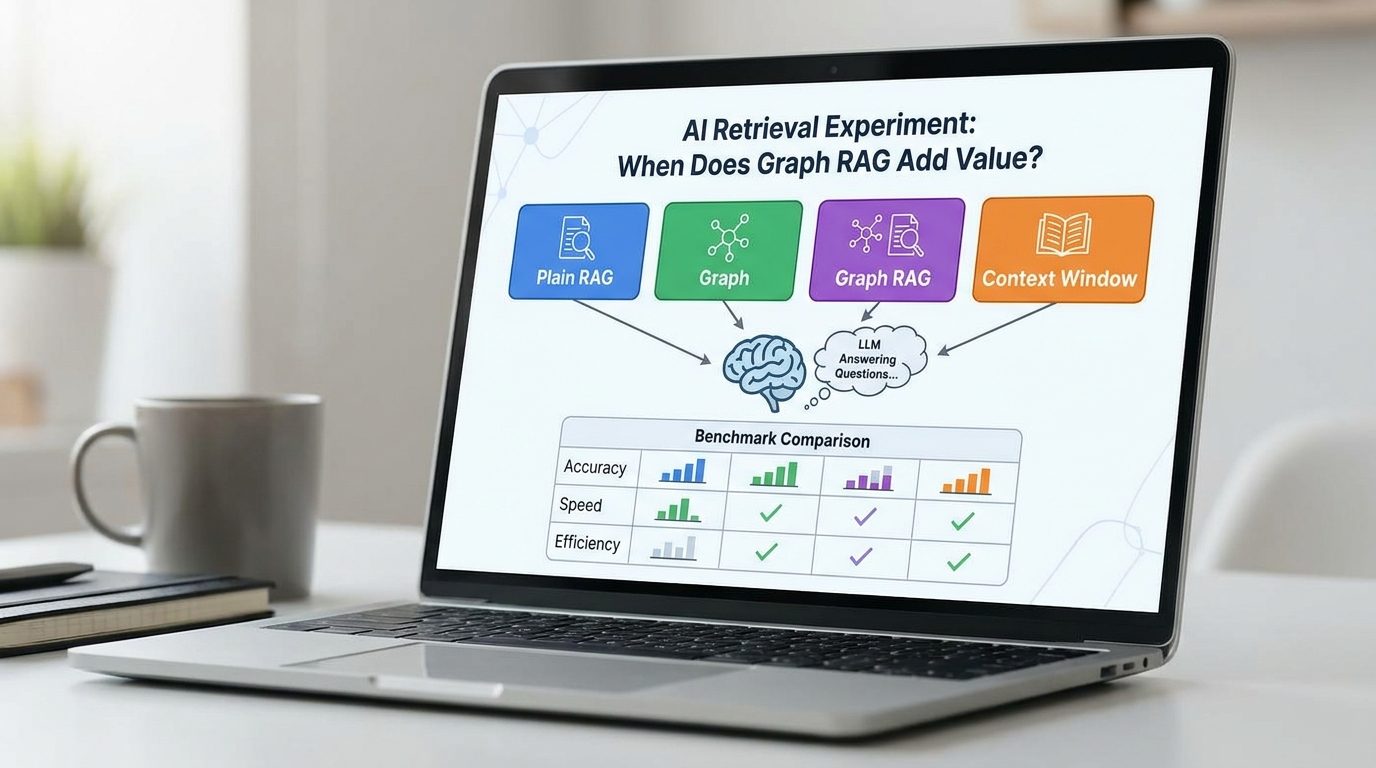
Four AI Retrieval Methods Benchmarked for Real-World Trade-offs
Four retrieval architectures, one laptop, and a single set of documents. That's the setup for this hands-on experiment, which benchmarks plain RAG, graph RAG, and a frontier model's context window against the same questions. The results offer a practical look at when graph RAG earns its complexity. For those exploring how AI structures understanding, our related piece on verifying AI comprehension in tax season is a natural next step. The trade-offs here are worth your attention.
Designing Data Infrastructure Without Looking at the Questions
Building a memory graph from known structures like people, facts, and timestamps is not overfitting; it's schema-aware engineering. You built extractors blind to the QA pairs, yet recall stays high on fresh conversations. That's a strong signal your design matches the domain, not the test set. The cleanest test: run the same pipeline on a different format or topic, then compare. If it generalizes, you're done. For deeper context, our piece on AI agent swarms explores similar data-handling challenges.
Explore how real-world safety systems define the benchmark for AI reliability.
A flight controller for a 300-passenger jet. A braking system for a bullet train. A reactor protection system for millions of people. These are the benchmarks that matter. The argument that ML systems should prove themselves in safety critical systems is direct and compelling. It cuts through the noise of test sets and simulations that fail outside the lab. It is a high bar, but that is the point. It would demand real-world performance, not just promising metrics.
Build and benchmark production RAG with fully open models
Building a RAG system that actually works in production takes more than stitching together a vector database. This workshop on August 29, led by Ben Auffarth of Chelsea AI Ventures, tackles the messy parts head-on: hybrid retrieval, reranking, and guardrails built in from the start. It's refreshing to see evaluation with RAGAS and real cost benchmarking treated as essentials, not afterthoughts. If you're tired of demo-grade AI, this hands-on session is worth exploring.

Where AI learns the physics of teamwork and competition.
The Agentic World Cup asks a sharp question: what happens when LLMs stop crunching numbers and start playing soccer? The team behind it sees sports as the proving ground for embodied intelligence, a space where agents must react, adapt, and outmaneuver in real time. It's a clever reframing of the "embodiment gap," and the format is refreshingly direct: pick a model, coach it through prompts, and let it compete.

Hark Handoff lets AI navigate the web to automate your daily tasks.
Most AI agents promise to handle the web for you. Hark Handoff actually delivers on that ambition, and it does so at a fraction of the cost of its biggest rivals. The startup's new computer use agent navigates sites like DoorDash and LinkedIn autonomously, posting a top score on a key benchmark. But the comparisons skip the newest models from OpenAI and Anthropic, leaving its "best-in-world" claim unverified against current leaders. Still, the pricing is hard to ignore.
Explore Visual Reasoning: A New Benchmark for AI Models.
Visual reasoning has always been the quiet barrier between pattern-matching and true understanding. When we saw the benchmark challenge posed by /u/moschles, it felt less like a test and more like a mirror. We're not just asking AI to identify objects; we're asking it to explain why a circle isn't a square. That distinction matters. For anyone who has wrestled with the limits of current models, this exploration offers a practical lens.

The True Energy Cost of Running Local LLMs on Apple Silicon
Five models, sustained generation, and a wall-socket meter don't lie: running a local LLM on Apple Silicon has a real, measurable price. This piece puts actual wattage under scrutiny at $0.31/kWh, and the findings land with more weight than the RTX-3090 numbers hinted at. We appreciate the rigor here; it turns vague claims into a practical cost conversation. For those ready to move beyond basics, our guide to distributed algorithms offers a natural next step.
Six frontier LLMs show measurable left-leaning bias across eight fairness benchmarks
Six frontier models walked into a bias benchmark, and the results defy the usual left-right script. In a solo evaluation spanning roughly 20,600 examples across eight datasets, GPT-5.4, three Claude variants, two Gemini models, and Grok 4.3 were tested on political, gender, and racial bias. The standout finding: Grok self-identifies as right-leaning, yet behaves left-leaning when classifying content or answering policy questions. Refusal rates on race-related questions also varied sharply, with GPT-5.4 declining 20.3% of the time.

Open-Sourcing Tri-Net v2 for Reproducible Monkeypox Detection Research
Open-sourcing a research project is one thing; making it reproducible is another. With Tri-Net v2, the team behind the Scientific Reports paper on unified monkeypox detection has done both. They didn't just drop training scripts. They rebuilt the framework with leakage-free pipelines, multiple backbones, and Docker support built in. That is how you invite validation. The over 1,100 article accesses suggest real interest, and now the community can test, break, and improve the work.
Discover how dynamic routing advances continual learning without replay buffers.
Replay buffers have long been the default answer to catastrophic forgetting, but they carry real costs in memory and privacy. A new open-source framework called Coincidex challenges that trade-off by replacing cached samples with a dynamic task-similarity layer that routes data on the fly. The results are promising on clean task boundaries, yet the authors are honest about instability under chaotic, long-tail shifts. That transparency makes this worth exploring, especially for constrained setups.